
The interface problem humanoids are about to have
A humanoid is built to work in spaces designed for people, which means it will be surrounded by people: pickers, nurses, line workers, visitors. Those people will not open a fleet dashboard to re-task it. They will talk to it, in the language they use at work, which in India is often a mix.
The obvious answer is to put a large chat model in the robot's head. That is exactly the wrong answer for a machine with arms moving near people: a chat model can say anything, improvise a plan nobody approved, and be talked out of its instructions. And it usually needs a network connection that a factory floor may not allow.
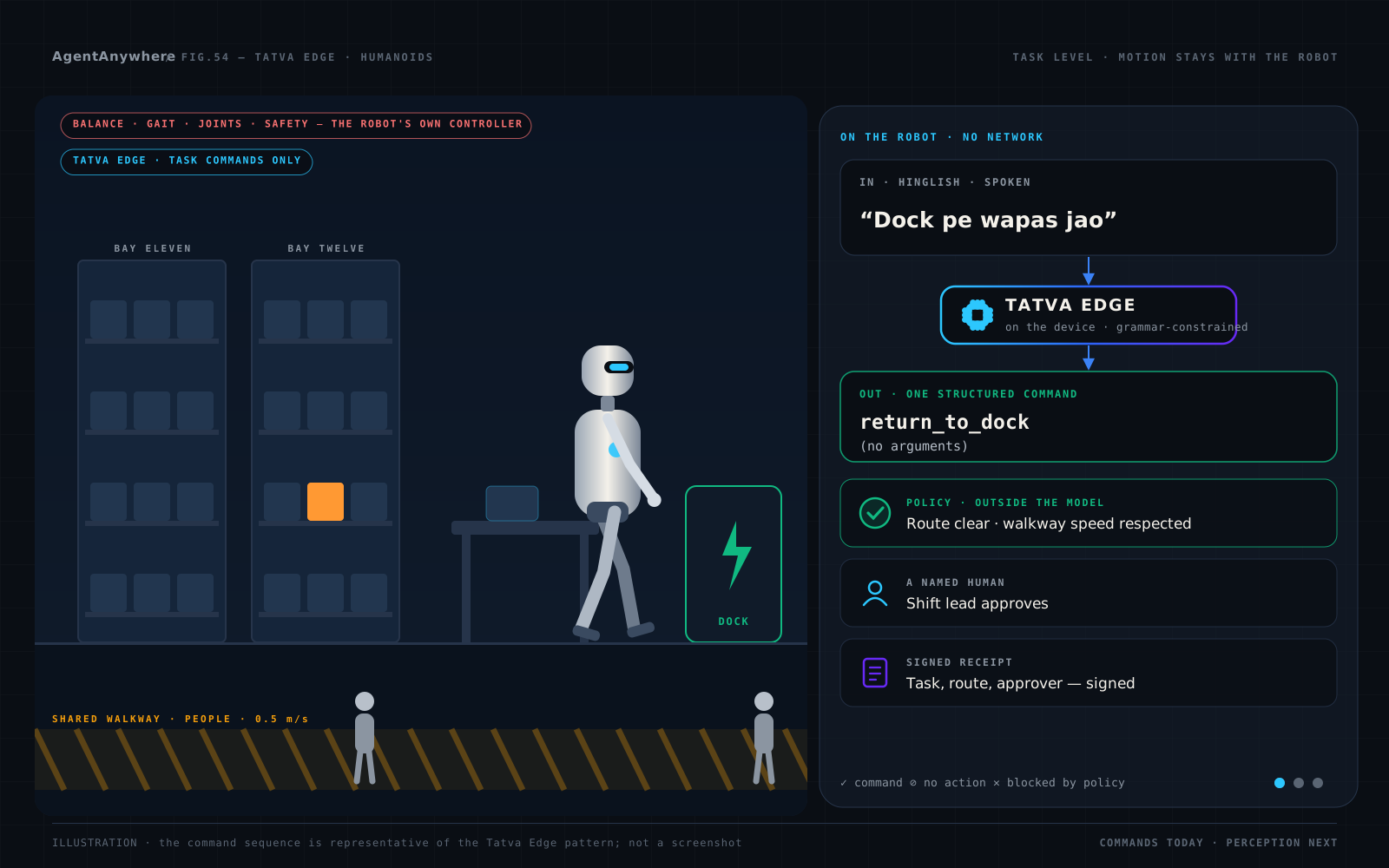
A humanoid needs the opposite: a small model on the robot that turns an instruction into one task it is allowed to do, or refuses.
What Tatva Edge gives a humanoid
Instructions into exact tasks
Navigate, fetch, pick, place, hand over, inspect, return to dock: each instruction maps to commands from the robot's own vocabulary, with arguments named.
The way people actually talk
English, Hinglish and Indian languages, typed or spoken, with the phrasings your staff use made part of the adaptation.
Refusal built in
“Call the manager”, “what's the steel price”, “switch off your safety stop”: out-of-scope requests return no action. Nothing is proposed, so nothing moves.
People-safety outside the model
Speed caps near walkways, no extended arm near a person, allowed destinations, payload limits: checked by Kavach before a task runs.
On the robot, offline
Runs on the robot's own compute in our runtime. Instructions, maps and camera context never leave the robot or the site.
A signed record of every task
Who asked, what was proposed, what policy decided, who approved: one signed receipt per task, for safety reviews and incident investigations.
Use cases
Warehouse and fulfilment
Tote moves, picks and replenishment re-tasked by voice during peaks, with the walkway rules enforced whatever the instruction.
Line-side material handling
Parts to the line, empties back, “cell 2 needs housings”: instructions from line leads in their language, approved in one tap.
Hospital logistics
Linen, supplies and samples carried between wards on a nurse's instruction, never a clinical task, with every trip recorded.
Front desks and guidance
Visitors guided to a room or a counter in the language they asked in, with the robot declining anything outside its role.
Inspection rounds
Plant and data-centre rounds started by instruction: go to transformer T9, inspect in thermal mode, return and report.
Humanoid makers and integrators
A sovereign, on-robot language layer to ship under your brand, on your compute, with no per-query cloud cost.
Outcomes
On the floor
Anyone can re-task the robot, in their own words, without a specialist or a dashboard.
No half-understood actions. An instruction becomes a valid task or a refusal, never an improvised plan.
It keeps working without a network, because the understanding is on the robot.
For safety and operations leaders
The safety case stays intact. The language layer is outside balance, motion and every safety function, so certified safety is not reopened.
Rules that hold under pressure. Walkway speed and keep-out rules apply whatever anyone says to the robot.
Evidence after an incident. A signed record of every instruction, proposal, block and approval.
See it on your own scenario
Bring your humanoid's task list and how your staff will actually phrase instructions. Book a live demo and we will show the pattern on your machine, your language and your rules.
See it in Humanoid Assist
Humanoid Assist is our demonstration of this pattern: a simulated humanoid on a facility floor, an operator console, and the governed loop step by step: the instruction, the proposed task, the policy check, your approval, the robot acting, and a signed, verifiable receipt chain. Every Tatva Edge output in it is real recorded model output on a ground-robot command set, replayed rather than scripted; the humanoid body, the facility and the policy rules are simulated, and the screen says so. Ask us for a guided walkthrough.
What Tatva Edge is not, on a humanoid
It is not a whole-body controller, a motion planner or a balance system, and it never sits in a safety path or a control loop. It is not on-device perception yet; vision on the robot comes next. It is not a general conversational companion. It is not a humanoid-specialised model yet, and no humanoid maker's integration is claimed: adapting it to a specific robot's task vocabulary and compute is design-partner work. Tatva Edge is in private preview.
Turning speech into words on the robot uses an on-device speech component that we select and integrate with you; Tatva Edge understands the words.
More in this series
Tatva at the edge — the family, the pattern and the eight settings.
Satellites — plain-language commanding for mission operations.
Launch operations — a launch-control console that answers, and a flight computer it never touches.
Drones — missions that survive a lost link.
Robotics and industry — task-level commands on the floor, in the operator's language.
Vehicles — an in-cabin assistant that works in the tunnel.
Wearables — private voice on the wrist and the ear.
Defence — air-gapped, observe-and-assist, a human in command.
Frequently asked questions
How do you give voice commands to a humanoid robot safely?
Use a task-level language layer that can only emit commands from the robot's defined vocabulary, and refuses everything else; enforce people-safety rules such as speed near walkways and keep-out zones with policy outside the model; keep a named person approving consequential tasks; and leave balance, motion and safety functions to the robot's own certified controllers.
Does Tatva Edge control a humanoid's movement?
No. Tatva Edge proposes task-level commands such as navigate, pick, place or return to dock. Balance, gait, joint control, whole-body control and all safety functions stay with the robot's own controllers.
Can a humanoid robot understand Hinglish instructions?
Tatva Edge is built to take instructions in English, Hinglish and Indian languages; recorded examples include “dock pe wapas jao” and “gripper kholo”. Adapting it to a specific robot includes the phrasings that robot's operators actually use.
Does a humanoid need an internet connection for Tatva Edge?
No. Tatva Edge runs on the robot's own compute in ShepHertz's runtime, fully offline. Instructions and site context stay on the robot.
Can humanoid makers integrate Tatva Edge?
Yes, through the design-partner programme. Tatva Edge is in private preview; adapting it to a specific humanoid's task vocabulary, compute and safety architecture is done jointly with the maker or integrator.
Written by
AgentAnywhere Research
The team that builds the platform and the models
AgentAnywhere Research writes about the platform, the model families and the trust layer we build and run in India. Where a figure is ours, it says what it covers; where something is a demonstration or in preview, it says so.