
Why an appliance should not need the cloud to take an instruction
A common way to give an appliance a voice is to send the request to a service on the internet. That works until the router restarts. It also means an account, a running cost for the maker on every request, and the sounds of a kitchen travelling somewhere else to be interpreted.
Yet an appliance is a small problem. A microwave accepts a handful of commands. So does a fridge. A robot vacuum cleaner accepts a few more. Nobody needs a general assistant to set a timer; they need the one command the appliance already has, filled in correctly, or a clear nothing.
That is the job a small model on the device can do. It does not need to know anything about the world. It needs the appliance's own list.
The appliance already knows what it can do. The model only has to turn a sentence into one line of that list.
What changes, for the person at home and for the maker
One command, or none
The output is one command from the appliance's list, with its arguments named, or an explicit no action. It is never free text.
It stays in the home
The model runs on the device, so the instruction and the command never leave the hardware. There is nothing to send, store or leak somewhere else.
It still works with the internet down
No network is required. A power cut at the exchange or a forgotten Wi-Fi password does not turn a feature off.
No cloud bill for each appliance
There is no cloud inference service to pay for on every request.
The firmware keeps the last word
A command from the model reaches the firmware the way a button press does. Every rule the firmware enforces today still applies, and the model cannot argue with it.
Your list, and the words your users use
The command list is yours. Adapting the model to it, and to the languages and phrasings your users actually use, is part of the work on a product.
Four appliances, three outcomes each
These scenes are illustrative. They describe no product and no maker. Each appliance shows the same three outcomes: a command, a command that the appliance's own rule refuses, and no action.
| The appliance | A command | Refused by the appliance's own rule | No action |
|---|---|---|---|
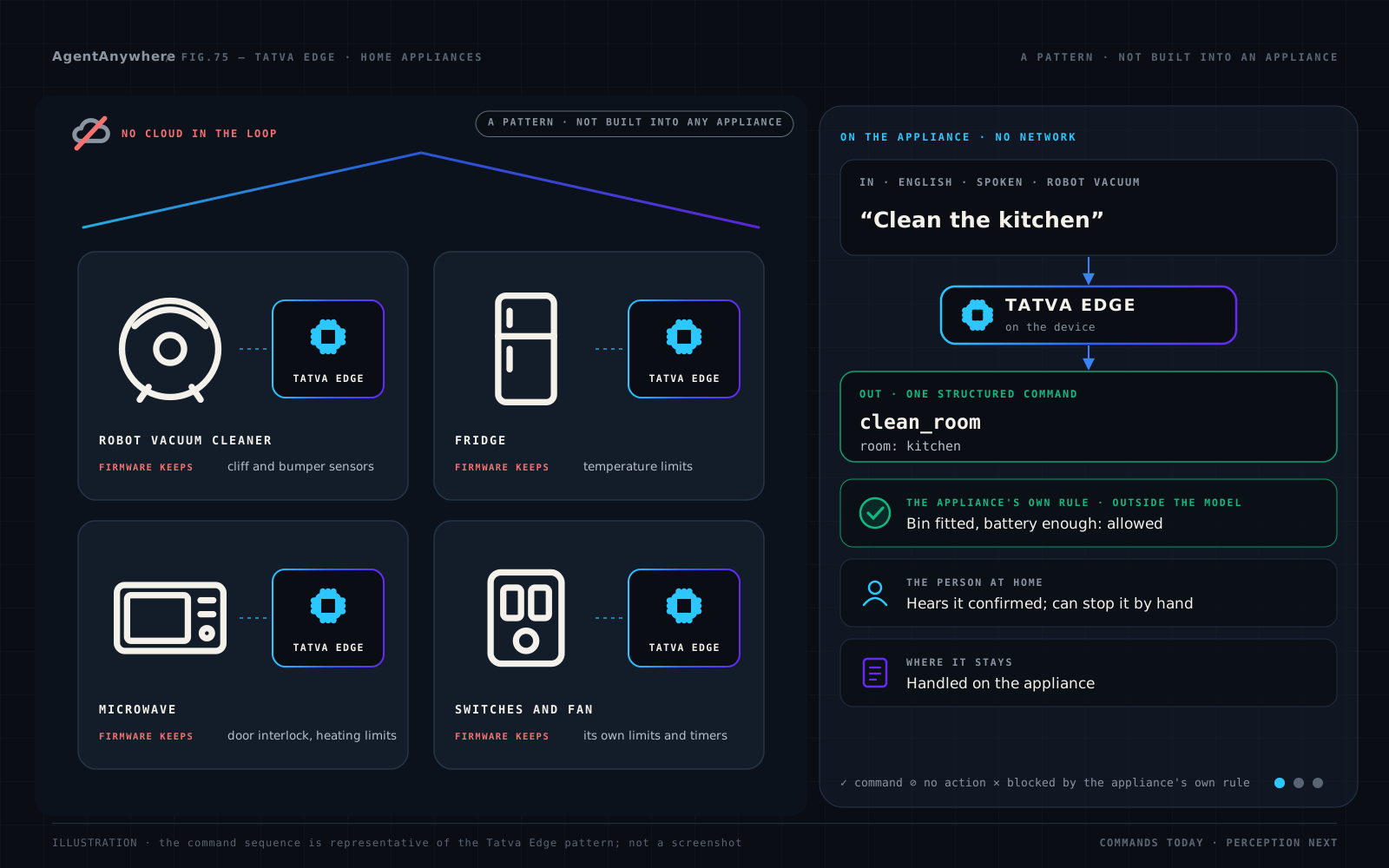
| The appliance: Robot vacuum cleaner. Someone is cooking and has flour on the floor. | “Clean the kitchen.” becomes one command, clean_room with room: kitchen. The vacuum sets off. | “Start cleaning.” with the dust bin taken out becomes start_cleaning, and the vacuum's own rule refuses it: no bin fitted. Its cliff and bumper sensors are the firmware's as well, and no sentence reaches them. | “Order new filters.” The vacuum has no command for shopping. No action. |
| The appliance: Fridge. Someone has come back from the market with fish for the weekend. | “Set the freezer to minus eighteen.” becomes set_temperature with compartment: freezer and celsius: -18. | “Set the fridge to fifteen degrees.” becomes set_temperature with celsius: 15, and the fridge's own temperature limits refuse it. The display says why. | “What should I cook tonight?” A fridge with this model has no command that answers a question. No action, and no made-up answer. |
| The appliance: Microwave. Someone is holding a bowl in one hand. | “Two minutes on high.” with the door shut becomes start_heating with seconds: 120 and power: high. The oven runs. | The same words with the door open become the same command, and the oven's own door interlock refuses it. The interlock and the heating limits belong to the oven. They do not ask the model. | “Is this bowl safe to heat?” That is a question, not an oven command. No action. |
| The appliance: Home automation. Someone is in bed and the fan is too fast. | “Bedroom fan to speed two.” becomes set_fan with room: bedroom and speed: 2. | “Unlock the front door.” becomes unlock with door: front, and the lock's own rule refuses it: the lock opens from its keypad or its key, not from a sentence. | “Tell me a joke.” No action. |
The command names are examples. In a product the list is the maker's own, and so are the rules.
Where the model sits, and what it never touches
The division is simple, and it is the reason this can be put in a home at all.
The model's job
It receives text. A person's words, typed or already turned into text.
It returns one command or none. Its output is a valid command with named arguments, or an explicit no action.
It refuses by design. A question, a joke, or a request the appliance has no command for returns no action. That is a normal output, not a failure.
The firmware's job, unchanged
Every safety rule. The door interlock and the heating limits on a microwave. The cliff and bumper sensors on a robot vacuum cleaner. The temperature limits on a fridge.
Every control loop. Motors, heaters, compressors and timers are driven by the firmware, as they are today.
The last word. The firmware checks a command from the model as it checks any other input, and refuses what its own rules do not allow.
Speech, and the words people use
The model works on text. Turning a voice into text is the job of a separate speech recogniser on the device, which would be selected and fitted with the maker. We say this plainly because the two are often sold as one thing.
The instruction can be typed or spoken, in English, Hinglish or an Indian language. Which languages and which phrasings matter for a product is part of adapting the model to it.
See it on your own scenario
Bring the command list of one appliance and the rules its firmware enforces. Book a live demo and we will show the pattern on your command list, your language and your rules.
What this is not
It is not built into any appliance. No appliance-specialised model exists, no appliance maker is a customer of ours, and we have not built or tested Tatva Edge in a robot vacuum cleaner, a fridge, a microwave or a home-automation product. We have not run it on an appliance's own processor; whether it fits one is part of the work with a maker.
It is not a safety function. The model is never placed in a safety path or a control loop. Interlocks, sensors and limits stay in the appliance's own firmware.
It is not an assistant. It is not a chat model and will not hold a conversation. It answers no questions, suggests no recipes and gives no advice.
It does not see. It does not look inside the fridge or recognise what is in a bowl. On-device perception for Tatva Edge is next, not now.
It comes with no numbers here. We publish no accuracy, speed or size figure for it in this post.
It is not a speech recogniser. That is a separate component, as above.
More in this series
Tatva at the edge — the family, the pattern and the eight settings.
Satellites — plain-language commanding for mission operations.
Launch operations — a launch-control console that answers, and a flight computer it never touches.
Drones — missions that survive a lost link.
Robotics and industry — task-level commands on the floor, in the operator's language.
Humanoids — task-level instructions for humanoids, with balance and motion left to the robot.
Vehicles — an in-cabin assistant that works in the tunnel.
Wearables — private voice on the wrist and the ear.
Home hubs — a design, not yet built, for a command model beside an open home hub on a small board.
Defence — air-gapped, observe-and-assist, a human in command.
Frequently asked questions
Can a home appliance take voice commands without the internet?
That is the pattern this post describes. Tatva Edge is a small on-device command model that turns a typed or spoken instruction into exactly one structured command, or no action, with no network. A separate speech recogniser on the device turns the voice into text. We have not built this into any appliance.
What would Tatva Edge do inside an appliance?
It would turn a person's plain words into one command from the appliance's own list, with its arguments named, or return no action when the request is outside the list. The appliance's firmware then checks the command as it checks any other input.
Does the model control the heater, the motor or the door?
No. The model is never placed in a safety path or a control loop. The door interlock and heating limits on a microwave, the cliff and bumper sensors on a robot vacuum cleaner and the temperature limits on a fridge stay in the appliance's own firmware.
Does what I say to the appliance leave my home?
In this pattern, no. The model runs on the device with no network, so the instruction and the command never leave the hardware.
Is there an appliance with Tatva Edge in it today?
No. No appliance-specialised model exists, no appliance maker is a customer of ours, and we have not built or tested Tatva Edge in any appliance. This post describes a pattern for a maker to build with us.
Written by
AgentAnywhere Research
The team that builds the platform and the models
AgentAnywhere Research writes about the platform, the model families and the trust layer we build and run in India. Where a figure is ours, it says what it covers; where something is a demonstration, it says so.