
Why defence AI has to be different
Defence buyers ask three questions that most AI vendors cannot answer. Where does it run? Often the only acceptable answer is inside the wire, on a node with no link out. What did it learn from? A model fine-tuned from foreign weights inherits a history nobody can fully audit. What will it do if someone says the wrong thing? At a forward post, a model that improvises is a liability.
Tatva Edge was designed around those questions rather than retrofitted to them. It runs disconnected on modest hardware. Its family was trained from zero in India on data whose licence was recorded. And its output is structurally limited: one command from a defined vocabulary, or no action.
What it provides
Air-gapped by default
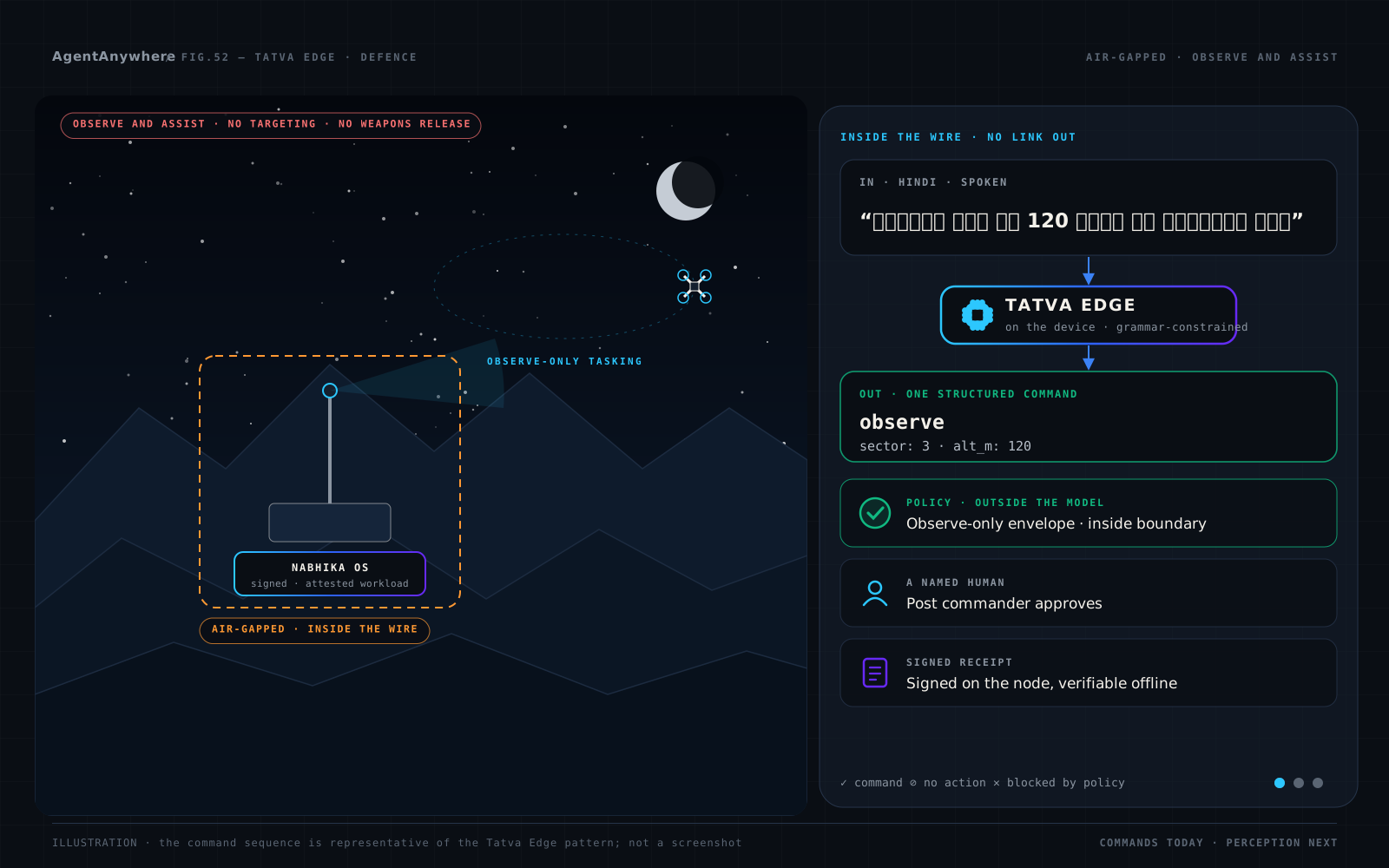
Runs on a node inside the perimeter with no network egress. On AgentAnywhere Nabhika OS, in development, it runs as a signed, attested workload that can reach the local broker and nothing else.
From-scratch Indian lineage
The Tatva family is trained from zero in India. Tatva Nano is the public proof: no foreign base, no inherited weights.
India's languages
Operators from every part of the country give instructions in Hindi, English or their own language, adapted to the unit's vocabulary.
Rules of the post, outside the model
Observe-only envelopes, boundaries, altitude limits and authority levels are enforced by policy the model cannot argue with.
A commander who decides
Every consequential command waits for the named authority. The model proposes; people decide.
Receipts that verify offline
What was asked, proposed, blocked and approved is signed on the node and verifiable without any external service.
Use cases
All are observe, inform or sustain. None engage.
Observe-only drone tasking
“Sweep sector three at 120 metres” becomes a surveillance task inside the permitted envelope, approved by the post commander.
Sensor and camera control
Pan, zoom, switch modes, change patrol patterns on perimeter sensors, by voice, with every change logged.
Logistics and sustainment
“Show generator fuel for all posts”, “Raise a ration indent for post 4”: read-only queries and routine requests, in plain language.
Maintenance and technical manuals
“Open the fault-finding procedure for the post generator” goes straight to the right procedure, offline, on the technician's tablet.
Disaster relief and HADR
Multi-drone search sweeps and supply tracking when civilian networks are down and the forces are first in.
Critical-site security
Border outposts, depots, ports and power sites where no frame or record may leave the perimeter.
Outcomes
For the operator and the post
Faster tasking under stress. Say the task; the exact command is ready for approval.
One interface across systems. Sensors, drones, logistics and manuals answer the same plain language.
No link, no problem. Nothing depends on a connection that may be jammed, denied or forbidden.
For the programme and the security officer
Aatmanirbhar in fact, not in label. Indian lineage, Indian runtime, on your hardware.
Provable control. The model cannot target, cannot exceed its envelope and cannot act without a named approver, and the receipts show it.
Simpler accreditation. No egress, a narrow vocabulary and an attested node make the security case easier to write and easier to check.
See it on your own scenario
Tell us the setting; we brief in person and demo on disconnected hardware. Book a live demo and we will show the pattern on your machine, your language and your rules.
The line we do not cross
Tatva Edge is not a targeting, fire-control or autonomous-engagement system, and it will not be offered as one. It is never placed in a weapons chain, a safety path or a control loop. It does not fly aircraft or drive vehicles. It is not on-device perception yet. And it is not pre-integrated with any platform, sensor or command system: integration is design-partner work, done on your equipment, under the agreements your programme requires.
Detection on imagery for defence and strategic customers is the work of our Astra line, engaged under appropriate agreements.
More in this series
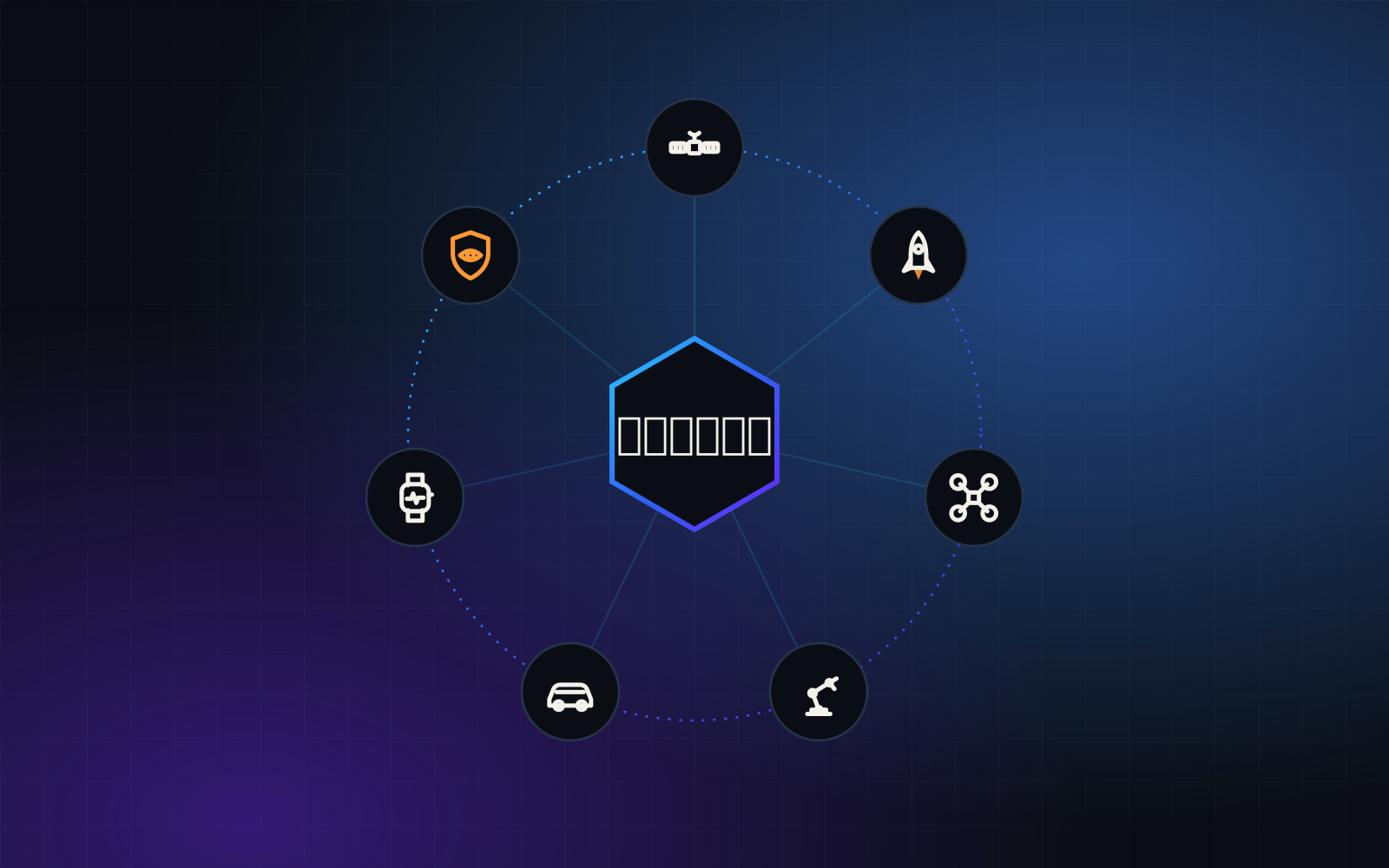
Tatva at the edge — the family, the pattern and the seven settings.
Satellites — plain-language commanding for mission operations.
Launch operations — a launch-control console that answers, and a flight computer it never touches.
Drones — missions that survive a lost link.
Robotics and industry — task-level commands on the floor, in the operator's language.
Vehicles — an in-cabin assistant that works in the tunnel.
Wearables — private voice on the wrist and the ear.
Frequently asked questions
Can AI models run in air-gapped defence environments?
Yes. Tatva Edge runs fully offline on hardware inside the perimeter with no network egress. On AgentAnywhere Nabhika OS, in development, it runs as a signed, attested workload that can reach only the local broker.
Is Tatva Edge built on a foreign AI model?
No. The Tatva family is trained from scratch in India by ShepHertz on licence-recorded data, with no foreign base model and no inherited weights. Tatva Nano is the public proof of that lineage.
Can Tatva Edge target or engage?
No. Targeting, engagement and weapons release are not in its vocabulary and it is never placed in a weapons chain. It is limited to observe, inform and sustain tasks, with every consequential command approved by a named commander.
What defence tasks is it used for?
Observe-only drone tasking, sensor and camera control, logistics and sustainment queries, maintenance and manual look-ups, disaster-relief coordination and critical-site security, all through plain-language instructions with human approval.
Which languages can soldiers and operators use?
Hindi, English and other Indian languages, with the unit's own vocabulary and phrasing made part of the adaptation.
Written by
AgentAnywhere Research
The team that builds the platform and the models
AgentAnywhere Research writes about the platform, the model families and the trust layer we build and run in India. Where a figure is ours, it says what it covers; where something is a demonstration or in preview, it says so.