
SOVEREIGN MODEL PORTFOLIO
One sovereign perimeter. A family of models built for India’s institutions.
Taksha, our coding family, is serving developers today — measured on execution-graded tasks, with the results published, failures included. The families below apply that same discipline to reasoning, regulated domains and the edge.
THE STACK
One sovereign stack — from foundation engines to specialist minds.
Every family stands on a foundation we operate, and everything ships inside the same trust layer — not beside it. The saffron slab is the lineage trained from scratch in India.
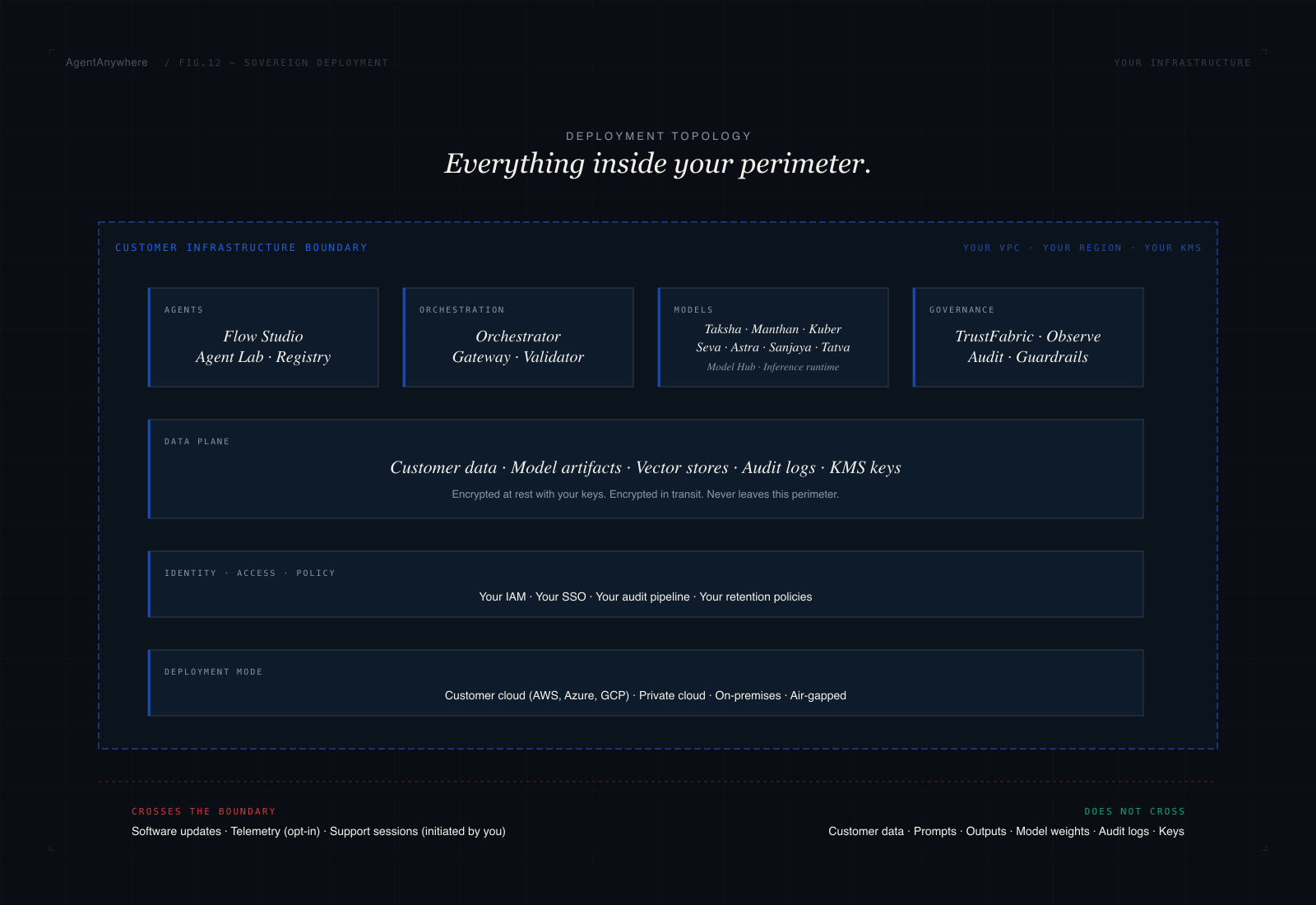
The trust perimeter — every request crosses it
Gateway · Aavaran · Kavach · TrustFabric · Custodian · Governance
Our sovereign AI engineer, in developers’ hands now — with an independent referee that checks its work and says so when a claim doesn’t verify.
- Taksha ProThe everyday default — edits, runs, verifies and finishes. 45/45 agentic, zero phantom completions.
- Taksha Max45/45 on the graded agentic battery. 160K context, dedicated node, provisioned on request.
- Taksha AdhunikLegacy modernization under a migration doctrine.
- Taksha ParikshaTesting that bites — proves the suite goes red before claiming a pass.
- Taksha YantraFor teams building agentic AI — frameworks, tool protocols, evals. Talk to us about Yantra for your agent work.
- Taksha KritiInterfaces that work — the interface specialist: wired, accessible, and behaving under interaction. Talk to us about Kriti for your interface work.
Sovereign engines
Open foundation models — selected, measured & operated by us, served from India or inside your perimeter.
Indigenous
Trained from scratch in India — Tatva Nano (first checkpoint trained, 32k Indic tokenizer); larger models are planned.
WHAT WE PUBLISH
Taksha is in developers’ hands today. We publish a number only where a model has been measured, and we say which model it belongs to. Two candidates failed our gates and were rejected.
HOW THE PORTFOLIO IS NAMED
Two axes, one vocabulary — across every family.
CAPABILITY TIER
Nano → Fast → Pro → Max → Ultra
The same five words mean the same five things everywhere. Nano runs on a phone; Fast is the everyday driver; Pro is the everyday default; Max brings frontier-class reasoning and long context; Ultra is reserved for dedicated, customer-funded capacity. Learn it once and you can read any model in the portfolio.
PURPOSE NAME
Yantra · Adhunik · Pariksha · Kriti · Kuber · Seva · Drashta · Kisan · Sanjaya
A Sanskrit name states what a model is for, not how big it is. Taksha Adhunik modernizes legacy estates; Taksha Pariksha writes tests that bite; Kuber knows BFSI; Kisan speaks to the field. Any model reads as family · purpose · tier — for example Taksha Pariksha Pro or Tatva Kisan Nano.
Tiers listed on each card below are the ones planned for that model. A tier appears in the product only once it exists and has been measured — the naming system is a map of intent, not a claim of availability.
THE MANTHAN LINE · DOMAIN INTELLIGENCE
For the work your regulator asks about.
Hosted reasoning models with a chat surface and an API — general, or shaped to a regulated domain. Served in India or inside your own network.

Manthan मंथन
General reasoning
Pro · Max
The sovereign assistant for everyday enterprise work — the class of tool your teams already paste confidential documents into, except it answers from inside your perimeter.
- Live now at chat.agentanywhere.ai — sign in and try it
- Chat and API surface, OpenAI-compatible
- Served in India or inside your VPC
- No prompt or document leaves the perimeter
Kuber कुबेर
BFSI
Banking, insurance and capital markets cannot send customer data to a foreign cloud — and increasingly cannot justify it to a regulator. Kuber is built for that constraint first.
- Regulatory and circular comprehension
- Credit, claims and compliance workflows, built with you
- Audit trail on every answer
Seva सेवा
BPO & service operations
India runs the world's service desks under client contracts that bind where data may live. Seva is the assistant those contracts can actually accommodate.
- Agent assist and ticket comprehension
- Quality review of interactions
- Deployable per-client, per-jurisdiction
THE TATVA LINE · INTELLIGENCE AT THE EDGE
Where the network isn’t.
A data centre is an assumption. Most of India — the field, the border, the factory floor — does not make it. The Tatva line runs on the device, offline, in the language spoken there.
Tatva तत्त्व
On-device reasoning
Nano · Fast · Pro
Intelligence that runs where the network does not. Modest hardware, no cloud round-trip, no connectivity assumption.
- Runs on-device, fully offline
- Indic-language capable
- Embedded tool-calling profile: trained from scratch with no base model, it turns plain language into device actions
- Runs in our own dependency-free engine on Raspberry Pi-class hardware
- The same sovereign story, without a data centre
Tatva Edge तत्त्व
On-device command model
Nano
One sentence in — typed or spoken, in English, Hinglish or an Indian language — and exactly one structured command out, or none. Runs disconnected on Pi-class boards in our own runtime.
- Grammar-constrained: schema-valid by construction, refuses out-of-scope requests
- Policy outside the model (Kavach) and a human approving every consequential action
- Demonstrated live in the Tatva Ops Console and the Drone Mission Ops suite
Tatva Kisan किसान
Agriculture
Nano · Fast
Advisory for the farmer standing in a field with one bar of signal — in their language, on a device they already own.
- Crop, input and advisory guidance offline
- Indic languages, voice-first by intent
- Built for the connectivity India actually has
Tatva Nano नैनो
Indic, from scratch
Nano
The sovereignty maximalist position: small and trained from scratch in India, with no base model and no inherited weights.
- Trained from scratch, not adapted
- Training sources listed, dataset by dataset
- Indic-first by construction
Sanjaya सञ्जय
Telemetry & anomaly detection — defence, space, energy, industrial
The seer who watched the distant war and narrated it live to the blind king. Sanjaya is a compact proof model that scores anomalies across many sensor channels at once. It has been tested on one public benchmark. Applying it to your sensors is work we do with you, on your data.
- Detects anomalies across many telemetry channels at once, measured on a public benchmark of simulated system telemetry held out from training
- Multivariate time-series sentinel: point, contextual and temporal anomalies and limit monitoring
- Trained from scratch on a public benchmark, with no pre-trained base. A compact proof model today, designed to run on-prem or air-gapped, with telemetry kept in the room
THE VISION LINE · DRASHTA
Giving machines eyes. Keeping people in command.
Drashta is the seer of the portfolio. It finds what matters in a wide scene and hands it to the person who decides — offline, inside the perimeter, with the imagery going nowhere.
Drashta द्रष्टा
Vision — satellite and aerial imagery
Offline · in-perimeter
Reads satellite imagery offline and finds objects of interest, such as aircraft and buildings, across wide scenes, handing analysts structured findings to review.
- Designed to run inside air-gapped perimeters, with the imagery kept on the network
- A named officer in command; never placed in a weapons-release chain
- Vision for inspection and agriculture: we are looking for design partners for this
THE SPEECH LINE · AGENTANYWHERE VAANI
The caller speaks. The recording stays home.
Most of India’s conversations with its institutions are spoken, not typed. A recording is the most sensitive artefact a helpline or a bank holds. AgentAnywhere Vaani makes it useful without letting it leave — and without keeping it.
Vaani वाणी
Indic voice — AgentAnywhere Vaani
Server-side · CPU at runtime
A voice note or call in Hindi, Hinglish, Urdu, Tamil, Telugu, Marathi or English — understood, masked, classified and answered, and designed to run on Indian infrastructure. Nothing kept but an anonymised tally.
- Aavaran masks the transcript before any model reads it; a classifier trained on your categories, built for each deployment, classifies and routes
- Speech recognition is an open-licensed external interim component, replaced by ours per language when it wins on held-out audio
- Built for helplines, banking correspondents, contact centres, insurers and rural services
WHY THIS PORTFOLIO
The discipline is the product.
Sovereign by construction
Models we operate ourselves, on licensed open weights, served from India or inside your perimeter. Data residency as a network fact, not a contractual promise.
Verified, not asserted
The independent referee we ship with Taksha — a check the model never sees — is a portfolio principle, not a coding feature. It travels to every family.
Measured in the open
We publish the benchmark table including the cells we lose. Ask any other vendor for theirs; the silence is the comparison.
Indian by intent
Indic languages, Indian regulation, Indian connectivity and Indian procurement — designed for, not translated into.
THE TRUST LAYER
Every model here ships inside the same trust stack — not beside it.
A sovereign model is only as sovereign as the path a request takes to reach it. The portfolio serves behind the AgentAnywhere trust layer — live today, governing production traffic.
Kavach
AI-security proxy in front of the model
कवच — shield. Sits in front of any OpenAI-compatible model and enforces security on every request and response: ensemble threat detection inbound, secret redaction outbound, PII masking via Aavaran, and an audit trail that stores metadata — never raw values.
THE TRUST LAYER · IN MOTION
Your data’s bodyguards — every request, every time.
Watch one request make the trip. Nothing reaches the model unguarded — policy checked at the door, personal data masked before the model ever sees it, threats stopped at the shield. And nothing goes unrecorded: each mask carries a signed receipt, and every step of the run is recorded for your auditor.
Now showing: a clean request, end to end
Incoming request
“KYC update for PAN ABCDE1234F⟨PAN_1⟩, A/C 0000 1111 2222⟨ACC_1⟩”
“KYC update for PAN ABCDE1234F, A/C 0000 1111 2222”
- policy: allowed · logged
ABCDE1234F ⟨PAN_1⟩ 0000 1111 2222 ⟨ACC_1⟩
- clean request: threat scan cleaninjected prompt: blocked
- processing inside the perimeter
- run tf_9f42…c1a ✓ recorded
- evidence pack appended · SOC 2 · ISO 27001 · RBI-aligned
Each guard is a real product, live today: Gateway · Aavaran · Custodian & TrustFabric · Governance.
FAQ
Frequently asked questions.
- How do I find out what is ready for my use case?
- Talk to us. Tell us the system, the data it may touch and the constraint, and we will show you the closest demonstration and tell you plainly what is ready today and what we would build with you.
- Can these run inside our own network or air-gapped?
- That is the design intent for the entire portfolio, and it is already delivered for Taksha. Drashta, our vision family, assumes air-gapped operation as a starting condition rather than an option.
- What does sovereignty mean here, concretely?
- Models we operate ourselves, on licensed open weights, served on infrastructure in your jurisdiction or inside your perimeter, with no requirement for data to cross a border for the product to function.
- How do you evaluate models before claiming anything?
- Execution-graded tasks with identical graders for every model, ours and the frontier ones. Tests are mutation-checked, servers are actually called, and claims a model makes about its own work are verified by a command it never sees. We publish the failures alongside the wins.
Tell us which of these you need first.
It starts with a conversation, not a form: we will tell you plainly what each model can and cannot do today, and what a pilot would actually prove. Taksha is in developers' hands today if you want to see the discipline first.