
The count is a conversation between people and screens
A launch campaign, and every static fire before it, runs on thousands of telemetry channels, long procedures and a tight chain of authority. The engineers are expert. What slows them down is navigation: which display holds this channel, which revision of the procedure is current, which step we are on, who has to say go.
India's launch sector is growing past the national agency into private launch companies, propulsion startups and test facilities, each building its own ground systems with small teams. They need their consoles to be fast to learn and hard to misuse, and they cannot put vehicle data on anyone's cloud.
Tatva Edge is built for exactly that edge of the problem, and for nothing on the vehicle itself.
What it does in launch control
Telemetry on request
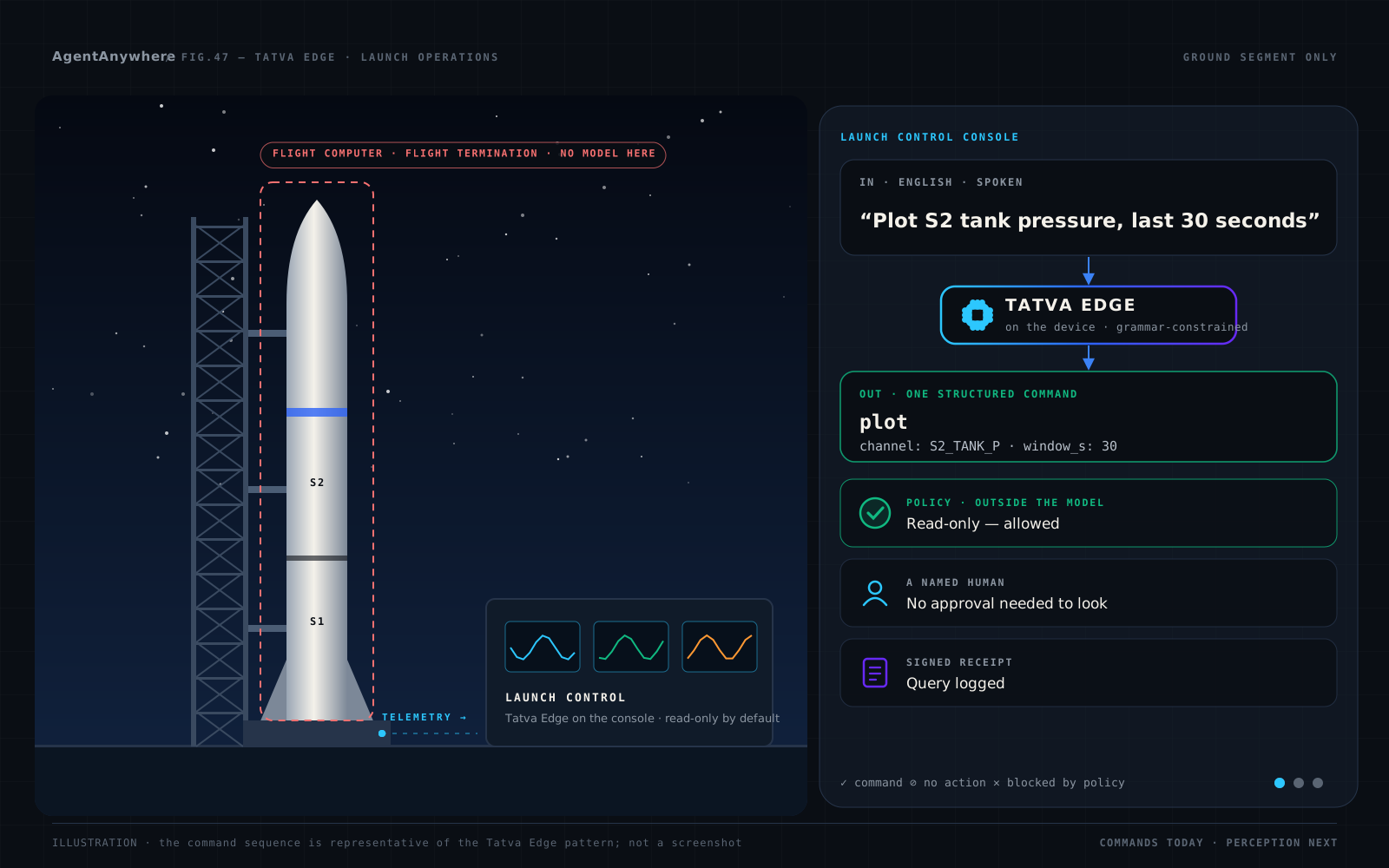
“Show chamber pressure against the red line for the last burn” becomes the exact plot or query, with channel and window named.
Procedures in plain language
“Go to the LOX loading procedure, step 42” opens the controlled procedure at the right step, the current revision, every time.
Authority built in
State-changing commands are checked against the campaign's rules outside the model, and wait for the role that owns them.
Verbs that do not exist
Flight termination, range safety and vehicle commanding are not in the vocabulary. Ask for them and the answer is no action.
Spoken, hands-busy
Engineers at a test stand can ask by voice, in English or Hinglish, without leaving the hardware.
A signed campaign log
Every request, command, check and approval is written as a signed receipt, which is useful evidence for anomaly reviews.
Use cases
Static-fire and test stands
Fast, voice-driven access to channels and limits during hot-fire tests, where eyes stay on the stand and hands stay busy.
Countdown procedures
Plain-language navigation of the count, with holds, step changes and polls surfaced to the right role.
Post-test analysis
“Compare turbopump speed in test 7 and test 9” becomes the exact comparison query, ready in seconds for the review.
Training new controllers
New console operators work in plain language while learning the channel lists and procedures, and always see the exact command before it runs.
Integration and checkout
Checkout sequences in the assembly building, with every read logged and every state change approved.
Small launch companies
A modern, sovereign console layer without building one, and without exporting a single channel of vehicle data.
Outcomes
In the control room
Answers in seconds, not screens. Controllers ask for what they need instead of navigating to it.
The right step, the right revision. Procedure navigation that cannot open the wrong version.
Calmer holds. When the count stops, the data the team needs is one sentence away.
For the programme
Vehicle data stays on the range. No cloud, no vendor access, no export question.
A defensible boundary. The model is provably absent from flight software and flight termination, which makes the safety case simpler rather than harder.
Evidence for reviews. A signed record of what was asked, shown and approved during every test and count.
See it on your own scenario
Bring a channel list and one procedure from your last campaign. Book a live demo and we will show the pattern on your machine, your language and your rules.
The boundary, stated plainly
Tatva Edge does not run on the launch vehicle and is not part of flight software, guidance, navigation, engine control or flight termination. It does not participate in range safety. It does not start, hold or abort a count on its own: it can propose, policy checks, and the named authority decides.
It is also not pre-integrated with any launch provider's ground system. Connecting it to your telemetry and procedure systems is design-partner work, done on your infrastructure, inside your perimeter. Tatva Edge is in private preview.
More in this series
Tatva at the edge — the family, the pattern and the seven settings.
Satellites — plain-language commanding for mission operations.
Drones — missions that survive a lost link.
Robotics and industry — task-level commands on the floor, in the operator's language.
Vehicles — an in-cabin assistant that works in the tunnel.
Wearables — private voice on the wrist and the ear.
Defence — air-gapped, observe-and-assist, a human in command.
Frequently asked questions
Can AI be used in rocket launch operations?
In the ground segment, as an assistant to controllers. Tatva Edge turns plain-language requests into exact console commands for telemetry, procedures and checkout, read-only by default, with state changes checked by policy and approved by the named authority. It is never part of the vehicle's flight software or flight termination.
Does Tatva Edge control the rocket?
No. It runs on launch-control and test-stand consoles only. Flight software, guidance, engine control, flight termination and range safety are outside its vocabulary and outside its reach.
Can it run in an air-gapped launch range?
Yes. Tatva Edge runs fully offline on a console or server inside your perimeter, in our own runtime. No telemetry or procedure content leaves the range.
Is it useful for engine test stands?
Yes. Voice and typed requests for channels, limits and procedure steps during static-fire tests are one of the main use cases, because engineers' hands and eyes are busy at the stand.
Written by
AgentAnywhere Research
The team that builds the platform and the models
AgentAnywhere Research writes about the platform, the model families and the trust layer we build and run in India. Where a figure is ours, it says what it covers; where something is a demonstration or in preview, it says so.