
Why the next wave of AI will not live in a data centre
The AI conversation of the last three years has been about the biggest models on the biggest clusters. That is the right tool for writing and research. It is the wrong tool for a machine that must keep working when the link drops, keep its data where it was made, and do exactly what it was told or nothing at all.
Most of the machines that matter to India's economy and security live in those conditions. Satellites see their ground station for minutes at a time. Drones fly where coverage is thin, contested or forbidden. Plants and warehouses keep their operational networks sealed. Vehicles drive through tunnels, ghats and rural highways. Defence systems are air-gapped on purpose.
For all of them, an assistant that needs the cloud is an assistant that fails at the moment it is needed. The intelligence has to be on the machine.
The Tatva family, in one paragraph each
Tatva is a family, not a single model. Two members carry this series.
Tatva Edge: commands for machines
Plain language in, one schema-valid command out, or no action. Grammar-constrained, so the output is always a valid command and never free text. Runs disconnected on Raspberry-Pi-class boards, laptops, servers and in the browser, in our own runtime. Model page.
Tatva Nano: lineage you can show
A compact language model trained from zero in India, with no foreign base and no inherited weights, that writes India's languages in their own scripts, the Dravidian languages included. It is the proof that the whole family's lineage is ours. Model page.
Kavach: the policy outside the model
Geofences, envelopes, speed caps, consent rules: whatever must never happen is checked outside the model, where a persuasive sentence has no effect. About Kavach.
AgentAnywhere Nabhika OS: the node underneath
Our sovereign operating-system layer, in development. On it, Tatva Edge runs as a signed, attested workload that can reach the local broker and nothing else, so the node can prove what it ran.
What makes a model safe to put on a machine?
Not size and not cleverness. Four properties, and Tatva Edge is designed around each of them.
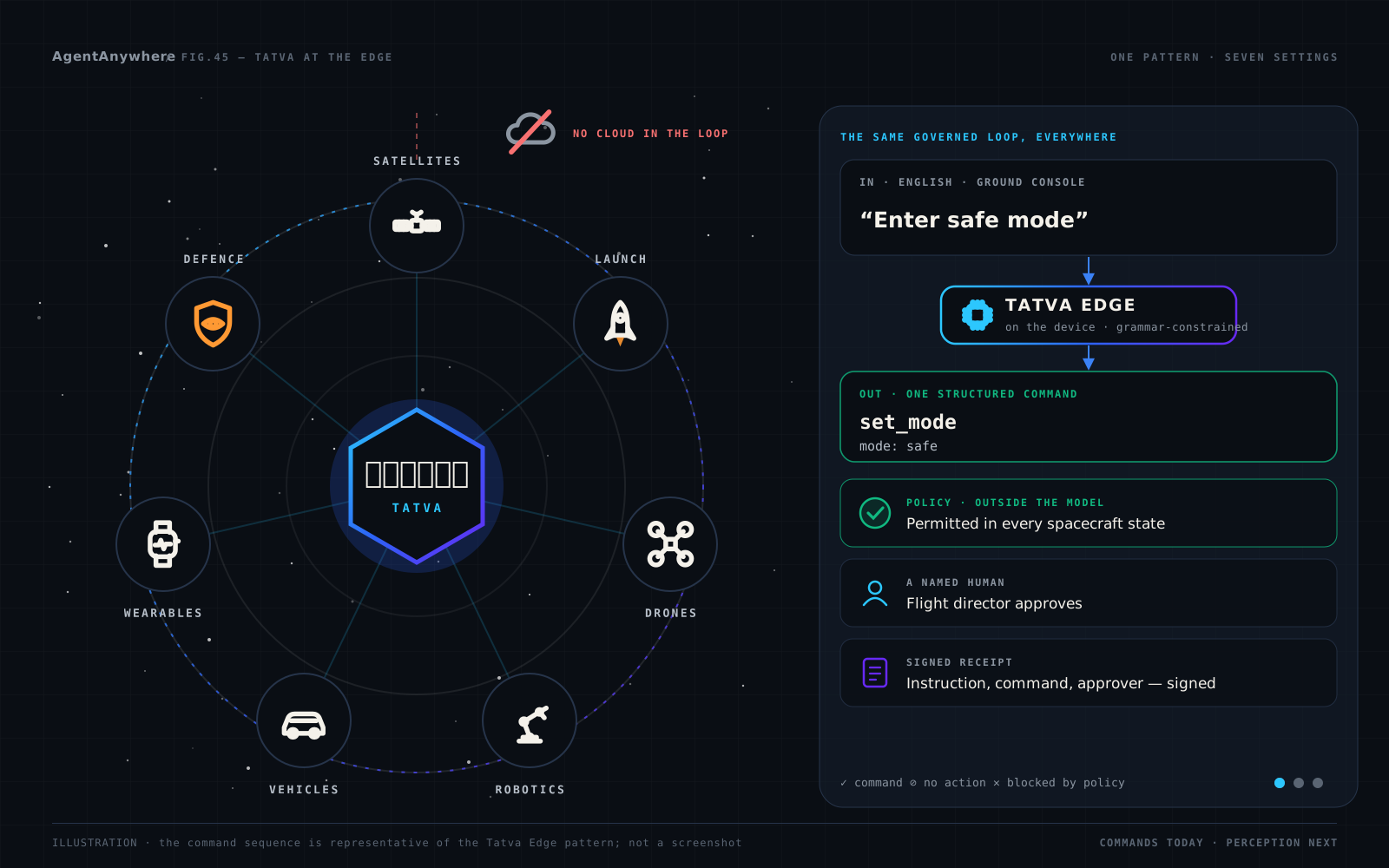
It compiles; it does not chat. A chat model can say anything. Tatva Edge can only emit a command from your vocabulary, with named arguments, because decoding is constrained by your command grammar. There is no free-text path from a sentence to a motor.
It says no. A question, a joke, or a request the machine has no verb for returns no action. For a satellite, a robot or a drone, the ability to decline is worth more than the ability to improvise.
It proposes; people decide. Every command passes a policy check outside the model and, when it matters, waits for a named human. That is the pattern in every figure in this series.
It leaves evidence. What was asked, what was proposed, what was blocked, who approved: every decision is recorded as a signed Trust Receipt that an auditor can verify offline, without trusting us.
Seven settings, one pattern
Each article in the series takes one setting and walks through the use cases, the outcomes and the boundary.
Satellites
A mission-operations console where “enter safe mode” or “image Mumbai on the next pass” becomes the exact command, checked against flight rules and queued for the pass. Read it.
Launch operations
Launch control that answers in plain language: plots, procedures, checklists. The flight computer and flight termination are fenced off. Read it.
Drones
Plans, surveys and revisits understood on the aircraft, so the mission continues when the link does not. Read it.
Robotics and industry
“Bin 14 ko dock 3 pe le jao.” Task-level commands in the operator's own language, with the safety controller untouched. Read it.
Vehicles
An in-cabin assistant that understands Hinglish in a tunnel and never touches steering, braking or driver assistance. Read it.
Wearables
Voice on the wrist and the ear, in Indian languages, where health data never leaves the device. Read it.
Defence
Air-gapped, observe-and-assist, from-scratch lineage and a commander who decides. No targeting and no weapons release, by design. Read it.
What changes when the model lives on the machine
The outcomes buyers tell us they are after, in their words rather than ours.
For the operator
One interface for many machines. Operators speak the task instead of navigating menus, in the language they think in, whether that is English, Hinglish or their own.
Fewer mistakes under pressure. The model cannot invent a command or half-understand one. It emits a valid command or tells you it will not.
It keeps working. No signal, no cloud outage, no vendor API change can take the assistant away mid-shift or mid-mission.
For the organisation
Data stays where it was made. Instructions, telemetry and context never leave the device or your perimeter, which is what DPDP-era data rules, defence security officers and your own customers expect.
Provable control. Policy outside the model and signed receipts turn “we have guardrails” into a record an auditor can check.
A lineage you can defend. Trained from scratch in India on licence-recorded data, so the question “what did it learn from?” has an answer.
See it on your own scenario
Pick the setting closest to yours. Book a live demo and we will show the pattern on your machine, your language and your rules.
Where Tatva is today
Tatva Edge is in private preview. It is demonstrated live on Pi-class hardware and in the browser, and in two drivable demo suites: the Tatva Ops Console for mission operations and Drone Mission Ops for multi-aircraft missions. Both replay real model output against simulated telemetry, and the screen says which is which. On-device perception is the next step, and we describe it as next.
Integration with a specific spacecraft, airframe, robot, vehicle, controller or wearable is done with a design partner, on the partner's hardware and against the partner's command set. That is the programme we are enrolling now.
How a pilot works
1. Bring your command set. The verbs your machine accepts, and a few hundred examples of how your operators actually phrase them, in the languages they use.
2. We adapt Tatva Edge to it. The grammar becomes your grammar. Your policy rules go into Kavach, outside the model. Your approvers are named.
3. You run it on your hardware, inside your perimeter. No data leaves. You judge it against your own scenarios, including the ones it must refuse.
More in this series
Satellites — plain-language commanding for mission operations.
Launch operations — a launch-control console that answers, and a flight computer it never touches.
Drones — missions that survive a lost link.
Robotics and industry — task-level commands on the floor, in the operator's language.
Vehicles — an in-cabin assistant that works in the tunnel.
Wearables — private voice on the wrist and the ear.
Defence — air-gapped, observe-and-assist, a human in command.
Frequently asked questions
What is Tatva?
Tatva is AgentAnywhere's on-device AI model family, built from scratch in India by ShepHertz. It runs on the machine itself, with no internet connection, and is designed for satellites, drones, robots, vehicles, wearables, industrial systems and defence. Tatva Edge, the family's command model, turns plain-language instructions into exactly one structured command, or no action.
What is the difference between Tatva Edge and Tatva Nano?
Tatva Edge is the command model: it converts an instruction into one schema-valid command for a machine, or declines. Tatva Nano is a compact Indic language model trained from zero in India that writes Indian languages in their own scripts; it is a capability proof of the family's from-scratch lineage, not an assistant.
Can an AI model run on a device without the internet?
Yes. Tatva Edge runs fully offline on Raspberry-Pi-class boards, laptops, servers and in the browser, in ShepHertz's own runtime. The instruction, the command and the context never leave the hardware.
How do you stop an on-device AI model from doing something unsafe?
Three layers. The model can only emit commands from a defined vocabulary and returns no action for anything else. A policy engine outside the model (Kavach) blocks what must never happen. A named human approves anything consequential, and every decision is written as a signed receipt.
Is Tatva available today?
Tatva Edge is in private preview with live demos available on request. Integration with a specific spacecraft, drone, robot, vehicle or wearable is done with design partners on their hardware.
Written by
AgentAnywhere Research
The team that builds the platform and the models
AgentAnywhere Research writes about the platform, the model families and the trust layer we build and run in India. Where a figure is ours, it says what it covers; where something is a demonstration or in preview, it says so.