
Why drone AI has to leave the cloud
India's drone sector is scaling across agriculture, infrastructure, mapping, logistics, disaster response and security. The missions share one condition: the aircraft spends much of its working life where the link is thin, contested or deliberately absent. Behind a ridge. Over a 40-kilometre pipeline. Inside a perimeter where no frame may leave.
A drone whose intelligence lives in a data centre stops being intelligent exactly there. And an operator flying several aircraft cannot hand-hold each one through a menu.
Tatva Edge takes the opposite position: the instruction is understood on the aircraft, the command is checked on the aircraft, and nothing is sent anywhere to be interpreted.
What Tatva Edge adds to a drone
Mission intent, understood on board
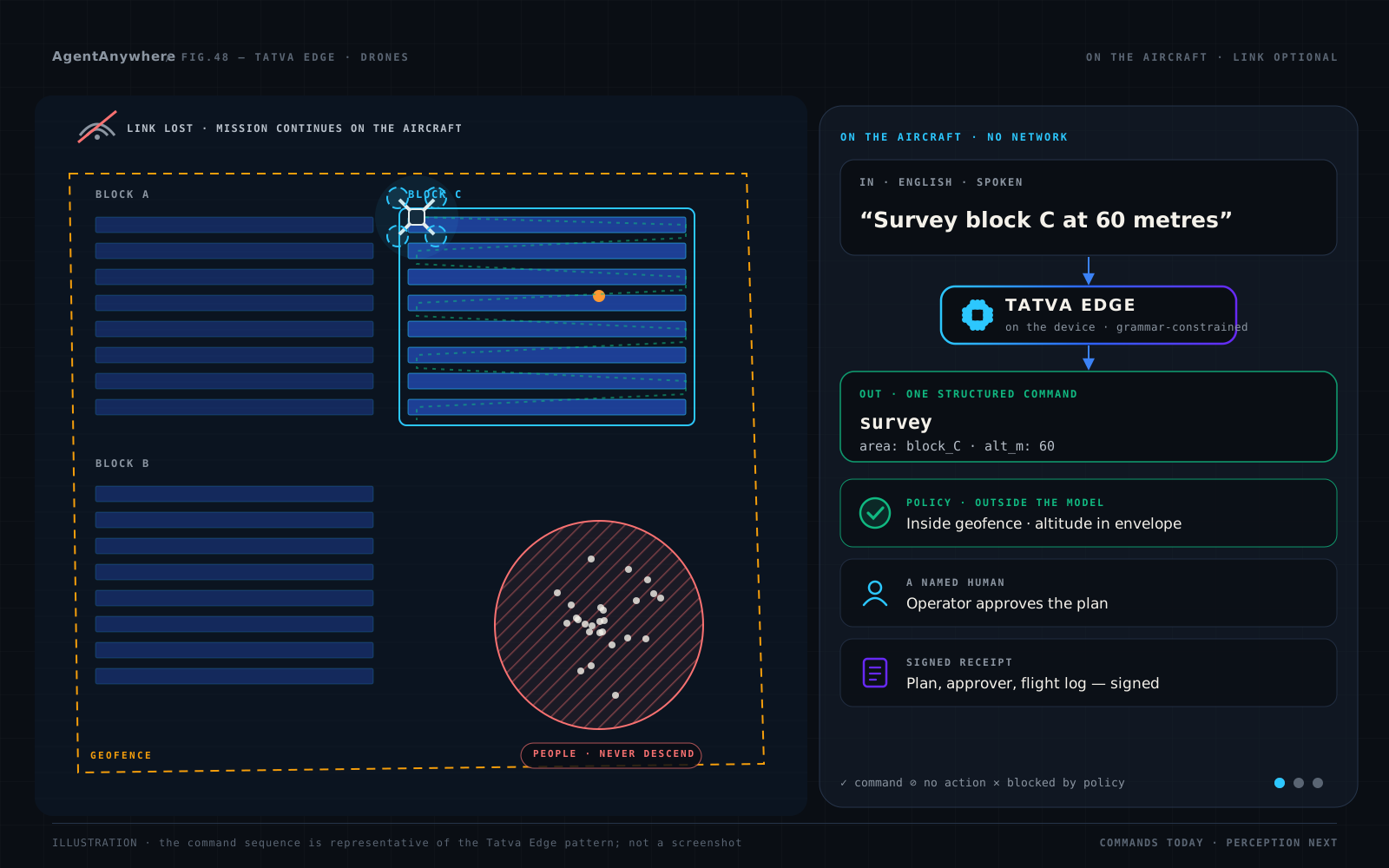
“Survey block C at 60 metres, then revisit any hotspot lower” becomes exact commands from your mission vocabulary, with arguments named.
Works with the link down
Understanding happens on the companion computer, so a lost link means a quieter operator screen, not a lost mission.
Geofences it cannot argue with
No-fly zones, altitude envelopes and keep-out areas are checked by Kavach outside the model. A persuasive sentence changes nothing.
The operator's own language
Commands in English, Hinglish or an Indian language, typed or spoken, so field teams do not have to learn a menu tree.
One operator, several aircraft
Sector assignments, battery rotation and handovers expressed as intent, with each aircraft's command checked separately.
Receipts you can verify offline
Plan, checks, approver and flight log are signed. Change one character and the receipt fails.
Use cases
Solar and power-line inspection
Coverage plans for large, remote sites, with a request to go lower over a suspected hotspot approved before it happens.
Pipeline and corridor survey
Long linear missions that spend most of their time out of link, and keep their plan anyway.
Search and rescue
Multi-aircraft sweeps after floods or landslides, where the network is the first thing to fail and minutes matter.
Perimeter patrol
Observe-only patrols inside your own wire, where no image may leave the perimeter and a controller approves every deviation.
Agriculture and mapping
Field and plot survey tasks spoken in the operator's language, planned on the aircraft, logged on the aircraft.
Drone OEMs and integrators
A sovereign on-board assistant to ship inside your airframe, under your brand, on your hardware.
Outcomes
For operators
More missions completed. Link loss stops being a reason to abort.
Faster tasking in the field. Say the mission instead of building it on a tablet.
Fewer unsafe requests executed. The rules are enforced where a tired or hurried instruction cannot reach them.
For OEMs and fleet owners
A differentiated, made-in-India AI feature on your aircraft, with no dependency on a foreign cloud or API.
Data sovereignty for customers in defence, energy and government, where imagery and flight logs must stay in-country and often on-site.
Evidence for regulators and customers. Signed receipts for every plan, deviation and approval.
See it on your own scenario
Bring your airframe, your mission and your no-go rules. Book a live demo and we will show the pattern on your machine, your language and your rules.
See it in Drone Mission Ops
Drone Mission Ops is our drivable demo suite: a 3D airspace, a fleet board and three consoles for perimeter patrol, solar-farm inspection and a three-aircraft search-and-rescue sweep. You take the controller's seat, approve or reject each recommendation, and verify the receipts yourself. The flights are simulated and the screen says which elements are captured model output, which are real code and which are synthetic.
For the full setting, including what Tatva does and does not do on an aircraft, see Tatva for drones and UAVs.
What Tatva Edge is not, on a drone
It is not an autopilot and does not stabilise, steer or land the aircraft. It is not on-device perception yet; detection and tracking on the aircraft come next. It is not a targeting or autonomous-engagement system. And it is not pre-integrated with a specific airframe or flight stack: that is done with a design partner.
More in this series
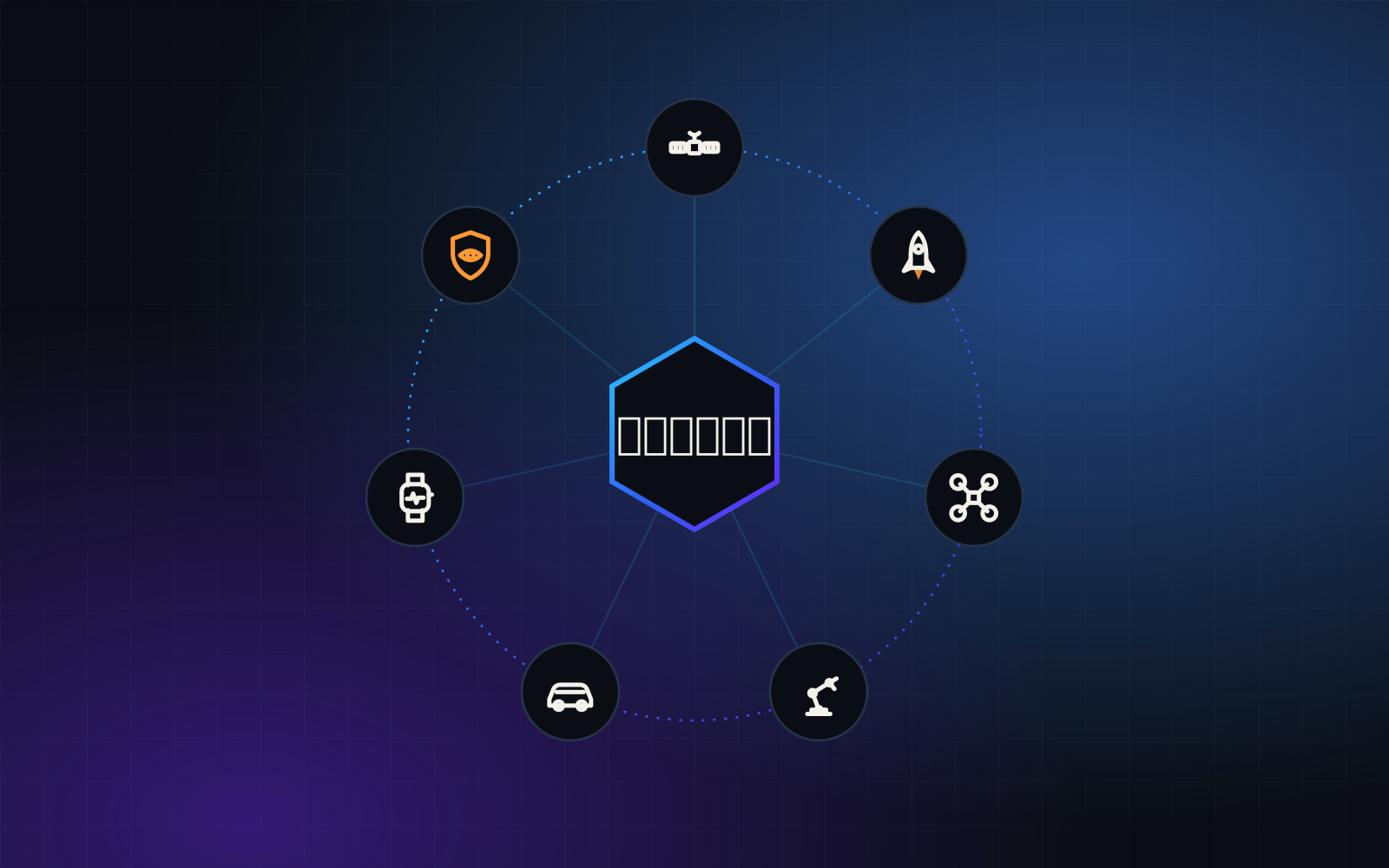
Tatva at the edge — the family, the pattern and the seven settings.
Satellites — plain-language commanding for mission operations.
Launch operations — a launch-control console that answers, and a flight computer it never touches.
Robotics and industry — task-level commands on the floor, in the operator's language.
Vehicles — an in-cabin assistant that works in the tunnel.
Wearables — private voice on the wrist and the ear.
Defence — air-gapped, observe-and-assist, a human in command.
Frequently asked questions
Can a drone run AI without an internet connection?
Yes. Tatva Edge runs on a drone's companion computer or at the ground station with no network. The instruction is interpreted on the aircraft, so a lost link does not stop the mission from being understood.
What does Tatva Edge do on a drone?
It turns an operator's plain-language instruction into exactly one command from a defined mission vocabulary, such as plan, survey, inspect, revisit or return, and returns no action for anything outside it. Flight control stays with the flight controller.
How are geofences and no-fly zones enforced?
By a policy engine outside the model. Every proposed command is checked against geofences, altitude envelopes and keep-out rules such as never descending over people before a named operator approves it, so the model cannot talk its way past them.
Can drone OEMs integrate Tatva Edge into their aircraft?
Yes, through the design-partner programme. Tatva Edge is in private preview; integration with a specific airframe and flight stack is done jointly on the partner's hardware and command set.
Is Tatva Edge made in India?
Yes. It is part of AgentAnywhere's Tatva family, trained from scratch in India by ShepHertz on licence-recorded data, and it runs entirely on your hardware.
Written by
AgentAnywhere Research
The team that builds the platform and the models
AgentAnywhere Research writes about the platform, the model families and the trust layer we build and run in India. Where a figure is ours, it says what it covers; where something is a demonstration or in preview, it says so.