
TATVA EDGE · ON-DEVICE COMMANDS
Private preview · commands today · perception nextTatva Edge
तत्त्वOne sentence in. One command out. Or none.
Tatva Edge is the Tatva family's on-device command model. It turns a plain-language instruction — typed or spoken, in English, Hinglish or an Indian language — into exactly one structured command your machine already understands, or returns no action when the request is outside its schema. It runs disconnected, on Raspberry-Pi-class boards, laptops and servers, in our own runtime — with policy outside the model and a human approving anything consequential. In private preview.
- Output
- Exactly one schema-valid command, or NO ACTION. Never free text — valid by construction.
- Runs
- On the device: Pi-class boards, laptops, servers, even the browser. No network required.
- Lineage
- Trained from scratch on openly licensed, receipt-tracked data. No base model.
- Status
- Private preview — commands today, on-device perception next. Accuracy measured internally, not yet published.
The last metre is where the cloud stops.
A drone at the fence line, a robot on a shop floor, an operator's console in a ground station, a machine in a plant with no link out: the intelligence that matters there is not a chat window. It is a small model on the box that understands what the operator said, turns it into the one command the machine accepts, and refuses when it is not sure.
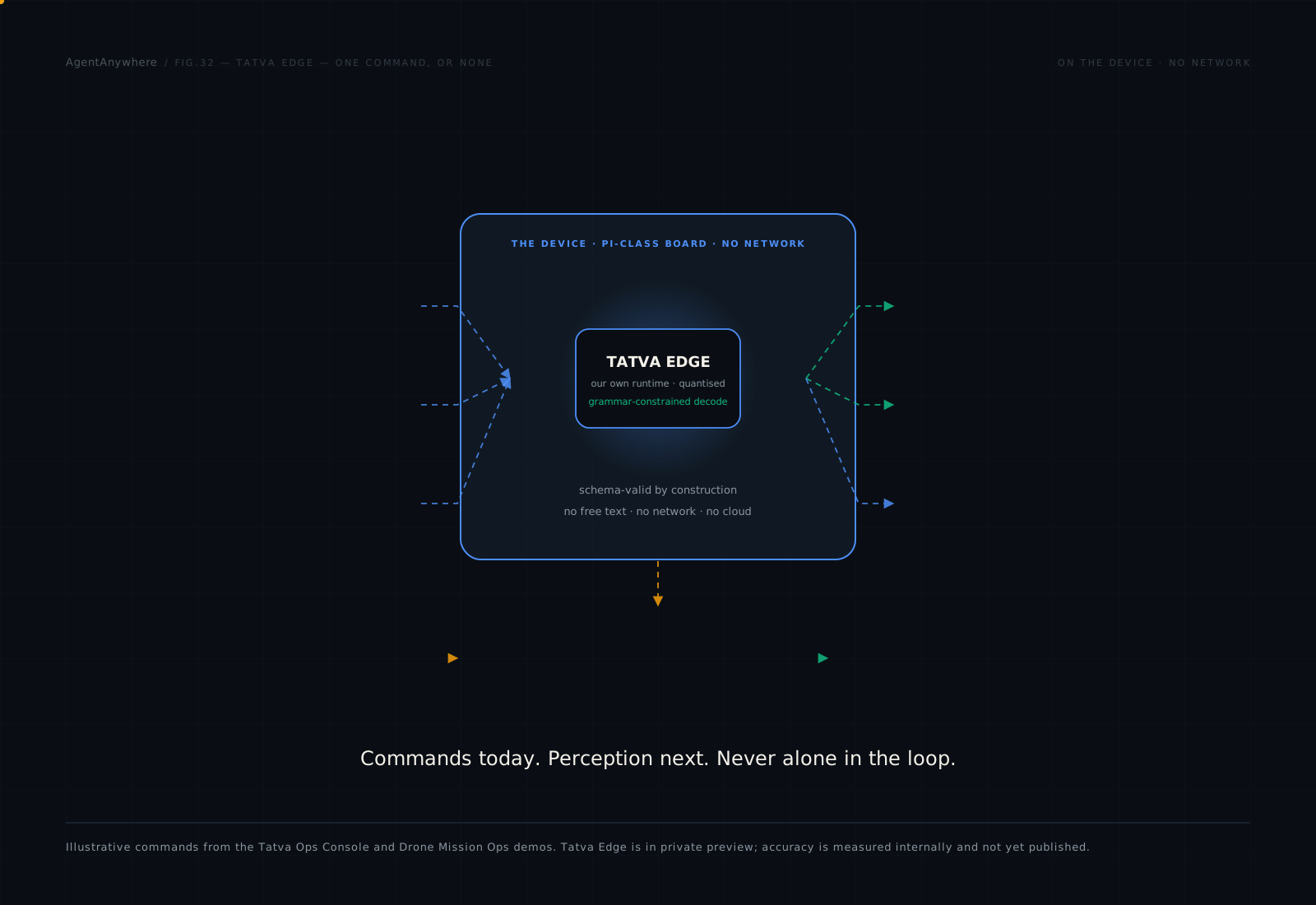
That is the whole of Tatva Edge. It does not generate; it compiles — plain language into a structured, schema-valid command, or an explicit *no action*. Because the decoding is constrained by your command grammar, the output cannot be malformed and cannot wander. And because it runs on the device, the instruction, the command and the context never leave the hardware.
How it behaves.
Grammar-constrained decoding
The model can only emit tokens that form a valid command in your schema. The output is a command, with named arguments, or nothing — never prose, never a near-miss.
Refusal by design
An instruction outside the schema — a question, a joke, a request the machine has no verb for — returns NO ACTION. Refusing is a first-class output, not a failure mode.
Your schema, a small adaptation
Teach it your command set from a few hundred examples in the languages your operators use. The grammar changes; the discipline does not.
Our own runtime
A single-file engine of our own, quantised weights, prefix-cached serving, a browser build. No third-party inference framework between the model and the board.
Policy outside the model. A human in command.
A command model is only safe to deploy if it is never the last word. Tatva Edge is designed to sit inside the same governance pattern as the rest of the platform.
The model proposes
Tatva Edge turns the instruction into a candidate command. A policy engine outside the model — Kavach — checks it against geometry, envelope and permissions the model cannot talk its way around. What must never happen is blocked there, regardless of what was asked.
A person disposes
Anything consequential waits for a named operator's approval, and every decision — what was asked, what was proposed, what was blocked, who approved — is written as a signed Trust Receipt an auditor can verify without trusting us.
This is the pattern our Drone Mission Ops demo shows end to end: the model recommends, the policy constrains, the human commands.
Where regulated teams are looking at it.
Where something is a demonstration, we say so: the consoles replay real captured model output against simulated telemetry, and the screen says which is which.
Defence and border security
Observe-only drone tasking from an operator's sentence — “sweep sector three at 120 metres” — with a policy fence outside the model and a controller approving every consequential action. The Drone Mission Ops demonstration shows the pattern on simulated flights.
Space and mission operations
A ground-station console where “enter safe mode” or “point the camera at Mumbai”, typed or spoken, becomes the exact command or a refusal — the Tatva Ops Console demonstration.
Industrial plants and PSUs
Machine commands in Hinglish on the shop floor, on a board with no link to anything, with the plant's own command set as the grammar.
Vehicles and robotics — in the cabin, on the floor
In-cabin commands and task-level robot instructions that never leave the machine. Never in a safety path or a control loop; integration with a flight stack, PLC or vehicle bus is design-partner work, not a claim.
What Tatva Edge is not.
It is not a perception model. Detection on imagery is Astra's work and Tatva Drishti's; on-device perception for Tatva Edge is next, not now, and every page says so. It is not a chat model and will not hold a conversation. It is never placed in a safety path or a control loop, and we do not claim integration with any vehicle bus, airframe, flight stack or PLC — that is done with a design partner, on their hardware, against their command set.
We also do not publish accuracy, latency or size figures for it here. They are measured internally on held-out phrasings and will be published when the programme clears them, with the coverage label that is part of the claim.
Where Tatva Edge is today.
Tatva Edge is in private preview, demonstrated live on Pi-class hardware and in the browser, and being adapted to design partners' command sets. It runs on any Linux board today; on AgentAnywhere Nabhika OS, the sovereign node OS in development, it runs as a signed, attested workload. If your machines take commands and your operators do not type, talk to us.
Where Tatva Edge runs
One model, at every edge.
The same on-device principle, told for the setting you work in — what Tatva Edge does there today, and what it does not.
Related
Where Tatva Edge fits.
FAQ
Frequently asked questions.
- What is Tatva Edge?
- Tatva Edge is AgentAnywhere's on-device command model, part of the Tatva family trained from scratch in India. It turns a plain-language instruction — typed or spoken, in English, Hinglish or an Indian language — into exactly one structured, schema-valid command, or returns no action when the request is outside its schema. It runs disconnected on Raspberry-Pi-class boards, laptops and servers, and is in private preview.
- How is Tatva Edge different from a chat model?
- It does not generate free text. Decoding is constrained by your command grammar, so the only possible outputs are a valid command with named arguments or an explicit NO ACTION. That makes it small enough to run on the device and predictable enough to put in front of a policy engine and a human approver.
- Does Tatva Edge need the internet or a GPU?
- No. It runs on-device in ShepHertz's own runtime on CPU-class hardware — Raspberry-Pi-class boards, laptops, servers, and in the browser — with no network connection. The instruction, the command and the context never leave the hardware.
- Can Tatva Edge control a drone, a vehicle or a machine directly?
- It is designed never to be the last word. Tatva Edge proposes a command; a policy engine outside the model (Kavach) checks it, a named human approves anything consequential, and a signed Trust Receipt records the decision. It is not placed in a safety path or a control loop, and integration with a flight stack, vehicle bus or PLC is design-partner work rather than a product claim.
- Does Tatva Edge do object detection or perception on the device?
- Not today. Tatva Edge handles commands; on-device perception is next on the roadmap and is described as such. Detection on imagery is done by the Astra and Tatva Drishti families.
Bring us your command set and your operators' language.
Tatva Edge is in private preview with design partners. We adapt it to your schema, run it on your board with the network off, and put it behind your policy and your approver.