
TATVA · DRONES & UAVS
Private previewAn on-board AI that works when the link doesn't.
Tatva Edge runs on the aircraft's companion computer, with no cloud and no network. An operator's plain-language instruction becomes an exact, structured command — and a request outside the mission's scope gets no action at all. Built in India, in private preview.
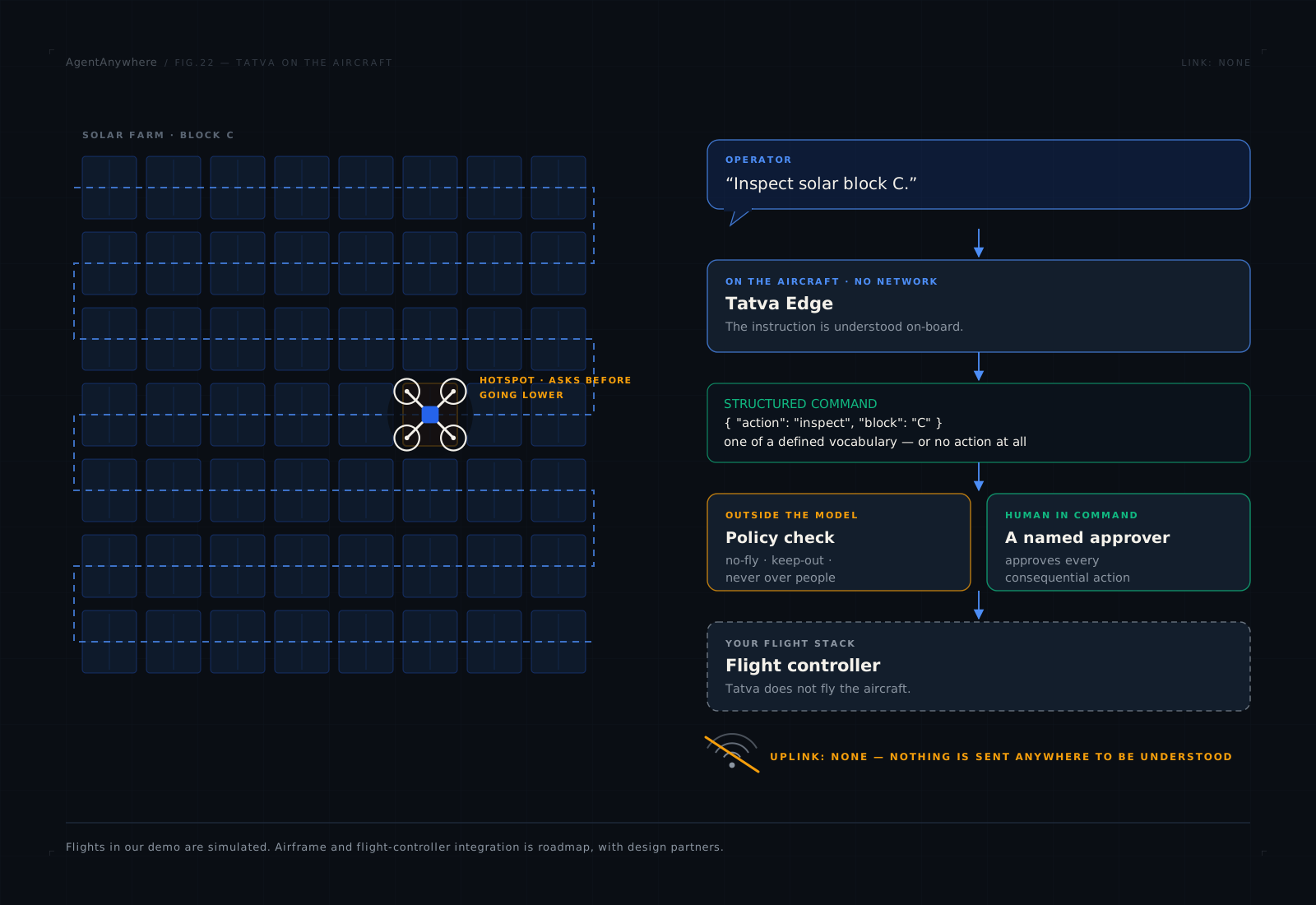
In short
Tatva for drones is an on-device AI model from AgentAnywhere that runs on a UAV's companion computer with no internet connection. It turns an operator's plain-language instruction into a structured command and declines requests outside its defined scope. It is built in India, runs fully offline or air-gapped, and is in private preview with design partners.
- Runs on
- The aircraft's companion computer or the ground station — offline.
- Does today
- Plain-language instruction → structured command, or no action if out of scope.
- Comes next
- On-device perception. Not claimed today.
- Status
- Private preview. Airframe integration with design partners.
Claims last reviewed · Tatva is in private preview.
The places drones matter most are the places the cloud isn't.
A survey line over a pipeline corridor, a search grid in a valley after a landslide, a perimeter at a remote site: the link is thin, contested, or absent by policy. An aircraft whose intelligence lives in someone else's data centre stops being intelligent exactly when it is needed.
Tatva takes the opposite position. The model sits on the aircraft, the instruction is interpreted on the aircraft, and nothing — not the imagery, not the command, not the mission — is sent anywhere to be understood. It is the same sovereignty principle as the rest of AgentAnywhere, taken to the edge of the network and then past it.
Five questions a drone has to answer.
Drone AI is five layers, not one. Tatva is honest about which of them it answers today — and the platform around it answers the rest with a human in command.
Perception — what am I seeing?
Detection, tracking, thermal and defect finding. On-device perception is where Tatva Edge goes next; it is not claimed today.
Navigation — where should I go?
Obstacles, terrain, and positioning when GPS is weak. This stays with the flight stack — Tatva does not fly the aircraft.
Reasoning — what does it mean?
Turning what the sensors report into something an operator can act on, without sending the frame to a cloud to be explained.
Agentic action — what next?
This is what Tatva Edge does today: an instruction becomes one exact, structured command — plan, fly, inspect, revisit, report.
Fleet intelligence — who does what?
Sectors, routes, battery rotation and handover across many aircraft, with one operator holding the whole picture.
One controller who decides
The aircraft recommends. A named human approves every consequential action, and a policy outside the model blocks what must never happen.
It plans the action — or it declines.
For an aircraft, the most important property of an on-board model is not what it can do. It is what it will not do.
In scope
“Inspect solar block C.” One goal in: a coverage plan, the flight, a hotspot found, a request to go lower before it does, and a signed report out.
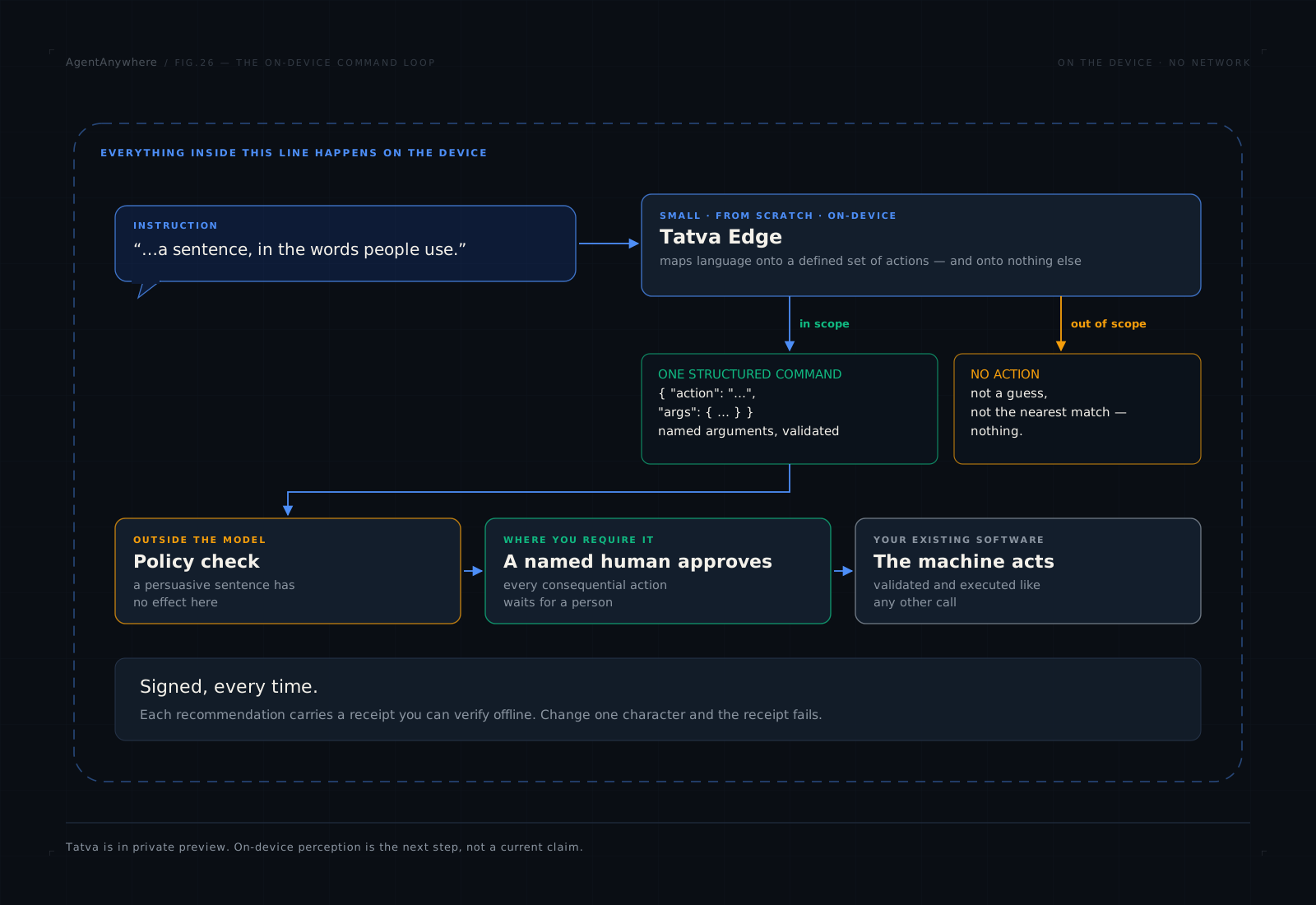
Every command is one of a defined vocabulary, with named arguments. There is no free-text path from a sentence to a motor.
Out of scope
A request with no matching in-scope action returns nothing — not a best guess, not a creative reading. The model emits valid structured actions or none.
And the model cannot talk its way past the policy. No-fly zones and geofences, keep-out yards, never descending over people: these are checked outside the model, where a persuasive sentence has no effect.
Where drone operators use it.
Infrastructure inspection
Solar farms, power lines, pipelines and towers — sites that are large, remote, and often forbidden to connect.
Survey & mapping
Long corridors and wide areas where the aircraft is out of link for most of the flight.
Search & rescue
Disaster zones where the network is the first thing to fail and minutes matter.
Perimeter & border
Observe-only patrol inside your own wire, where no frame may leave the perimeter.
Drone OEMs & integrators
A sovereign on-board assistant to ship inside your airframe, under your brand, on your hardware.
Regulated operators
Every recommendation carries a signed receipt you can verify offline — change one character and the receipt fails.
What it runs on.
On the edge box, Tatva Edge runs inside AgentAnywhere Nabhika OS — our sovereign operating-system layer. Nabhika puts a kernel-level network filter and a sandbox around the model runtime, so the model reaches the local broker on the box and nothing else, and it signs a hash-chained record of what is installed. The model cannot leave. The node can prove what it ran.
Nabhika OS is in development. The edge evidence we show today is a recorded test run on a small single-board-class computer — not yet an aircraft in flight — and we say so wherever we show it.
See it run.
Drone Mission Ops is our drivable demo suite: a 3D airspace, a fleet board, and three consoles — perimeter patrol, solar-farm inspection, and a three-aircraft search-and-rescue sweep. You take the controller's seat, approve or reject each recommendation, and verify the receipts yourself.
The flights in it are simulated, and every screen says which elements are captured model output, which are real code, and which are synthetic. No aircraft was flown for the demo. Ask us for a walkthrough.
What Tatva for drones is not.
An honest boundary is part of the product. If a vendor cannot tell you what their drone AI does not do, that is the finding.
- It is not an autopilot. Tatva does not stabilise, steer or land the aircraft — your flight controller does.
- It is not on-device perception yet. Detection and tracking on the aircraft are the next step, not a current claim.
- It is not a UAV-specialised model yet. The command vocabulary is defined and the mechanism is proven on a demonstration tool space; the aircraft-specific model is being built with design partners.
- It is not a targeting or autonomous-engagement system. It assists a human controller, who decides.
- It is not integrated with a specific airframe or flight stack out of the box. That integration is roadmap, done with a design partner.
FAQ
Frequently asked questions.
- Can an AI model run on a drone without an internet connection?
- Yes. Tatva is built to run on-device — on a drone's companion computer or at the ground station — with no network and no cloud. The model and the data stay on the hardware. It is designed for thin, contested or prohibited links, where a cloud-dependent model stops working.
- What does Tatva actually do on a drone today?
- Today, Tatva Edge turns an operator's plain-language instruction into one exact, structured command from a defined vocabulary, and returns no action when a request is out of scope. On-device perception — detection and tracking on the aircraft — is the next step and is not claimed today.
- Does Tatva fly the drone?
- No. Tatva is not an autopilot. Flight control, stabilisation and navigation stay with your flight controller. Tatva assists the human operator: it interprets instructions and recommends actions, and a named human approves every consequential one.
- How do you stop an on-board AI from doing something unsafe?
- Two ways. The model only emits commands from a defined vocabulary and declines anything outside it. And safety rules — no-fly zones, geofences, keep-out areas, never descending over people — are enforced by a policy check outside the model, so the model cannot argue its way past them. Every recommendation is signed.
- Is Tatva for drones made in India?
- Yes. Tatva is AgentAnywhere's own model family, trained from scratch in India by ShepHertz, and it runs entirely on your hardware inside your jurisdiction. Nothing is sent to a third-party cloud.
- Can we integrate Tatva into our own airframe?
- That is what the design-partner programme is for. Tatva is in private preview; integration with a specific airframe and flight stack is done jointly with a partner. Bring your airframe and your mission and talk to us.
Put a sovereign model on your airframe.
Tatva is in private preview. We are working with drone OEMs, integrators and operators who need intelligence that survives a lost link. Bring your airframe and your mission.