
Two ways to sort drones: by size and by job
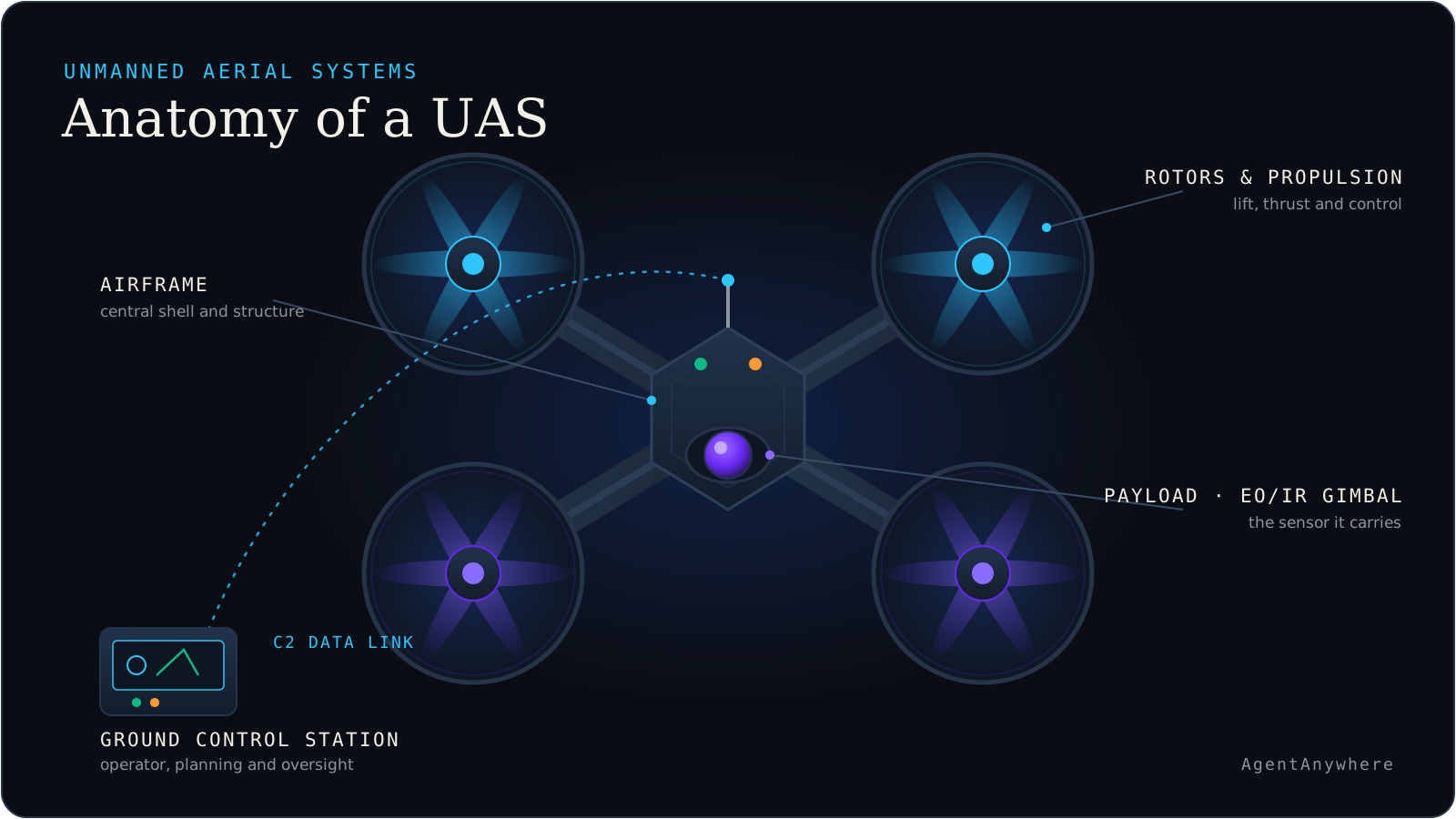
Drones are sorted by size and endurance and by job: size tells you what the aircraft is, and job tells you why it is flying.
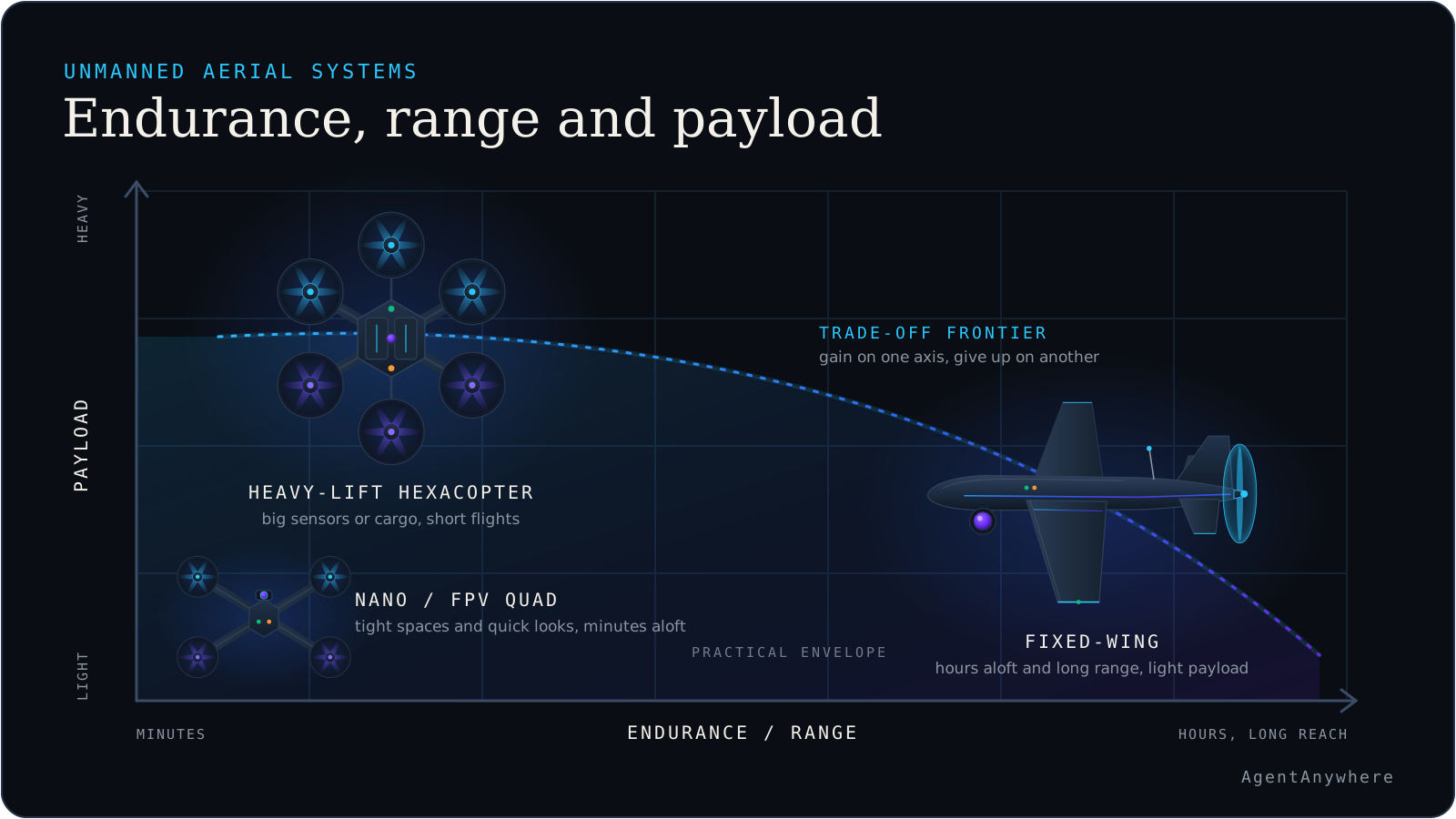
By size and endurance. Defence organisations and regulators group unmanned aircraft into classes by weight, ceiling and range. Small classes cover nano and micro aircraft that fit in a hand through to small systems launched by a person or two. Mid classes cover tactical systems that need a launcher or short runway and a small crew. The largest classes cover medium-altitude long-endurance (MALE) and high-altitude long-endurance (HALE) aircraft that fly high, for a long time and a long way, and need proper airfields and large control stations. Class names and boundaries differ between alliances and countries, so treat any scheme as a guide rather than a law.
By job. The same aircraft can often do several jobs by changing the payload, so many practitioners sort by job rather than by shape. What matters is the mission: what has to be seen or moved, how far, for how long, and with what degree of oversight. The table below uses the job as the organising idea, with the typical airframe and payload that tend to go with it. Airframe types are covered in fixed-wing vs multirotor vs VTOL and payloads in drone payloads explained.
Military and security uses: mostly watching, relaying and supporting
Intelligence, surveillance and reconnaissance (ISR). This is the core military use of unmanned aircraft: carrying cameras, thermal imagers and other sensors so that commanders and analysts can see an area without putting a crew at risk. It spans everything from a small hand-launched aircraft that lets a patrol look over a ridge, to large long-endurance aircraft that can watch a region for many hours. The value is persistence and perspective, the ability to keep a sensor over an area for longer than a person could.
Communications relay and support roles. Aircraft that stay aloft for long periods can carry radio relays that extend communication across terrain that blocks line of sight. Others serve as aerial targets for training air-defence crews, or as logistics aircraft that carry small loads such as medical supplies or spares to places that are difficult to reach.
A note on armed systems. Some militaries also operate armed unmanned aircraft. That is a separate field with its own law, oversight and a long public debate, and it falls outside this series.
Reconnaissance, counter-drone and interceptor roles
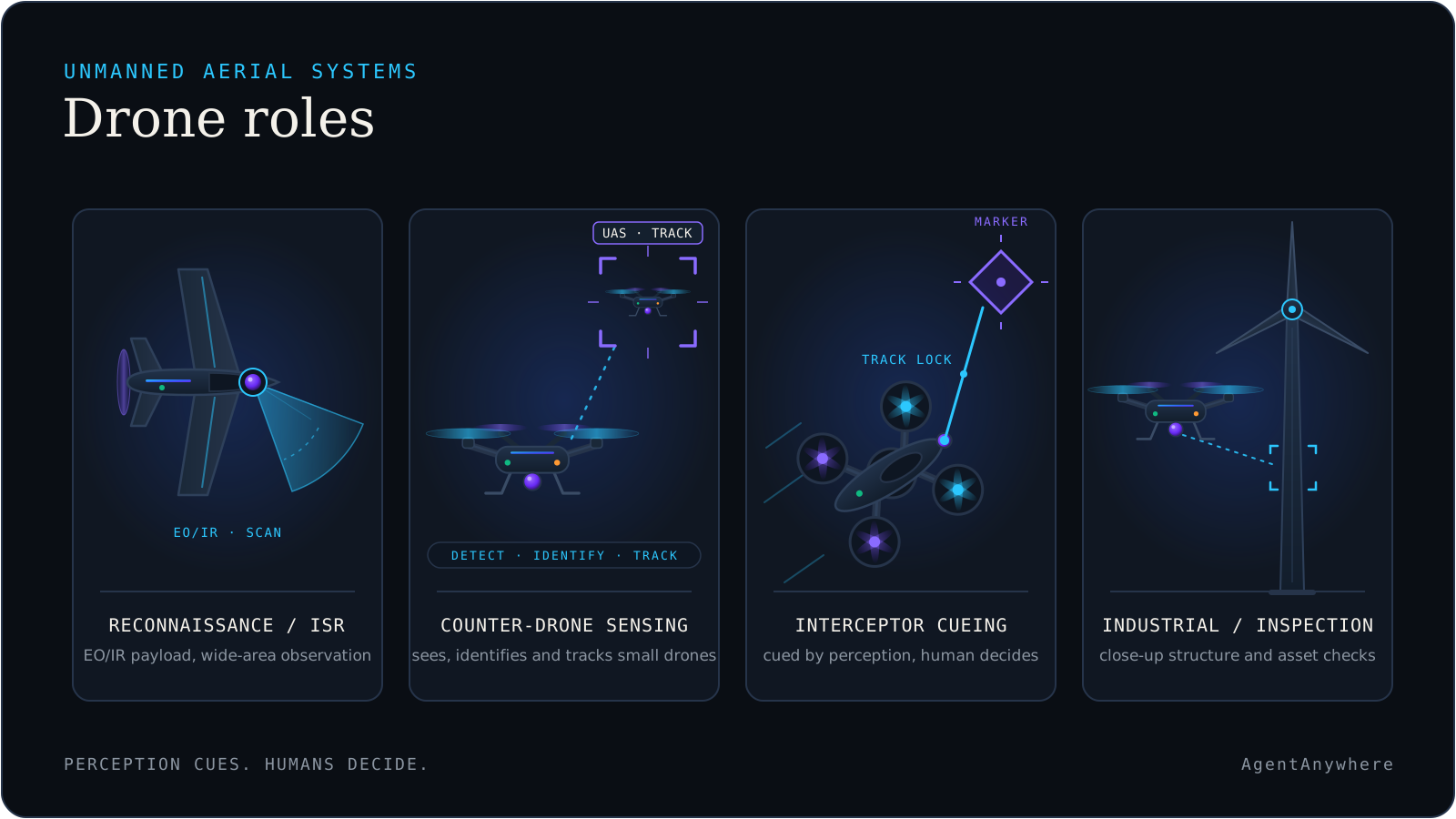
Beyond the airframe, military and security drones are grouped by the job they do. Three roles matter most today.
Reconnaissance and ISR. The largest category. These aircraft carry EO/IR cameras and other sensors to observe an area and build a picture: what is there, where it is moving, and what has changed. The value is in the perception, turning hours of imagery and sensor feed into something a person can act on.
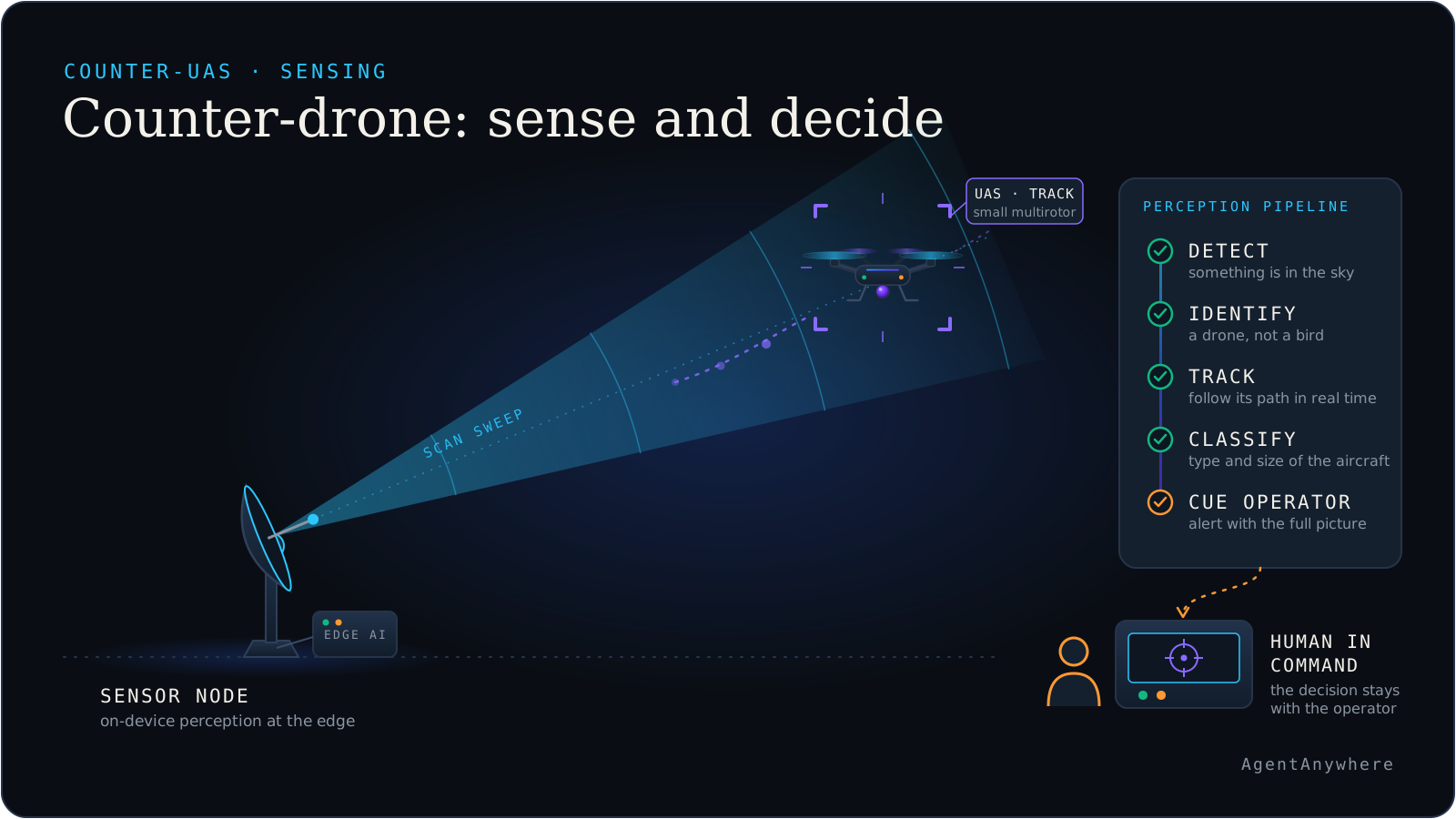
Counter-drone (counter-UAS). As small drones spread, so does the need to spot them. A counter-drone capability detects an incoming or unauthorised drone, identifies and classifies it, tracks it, and alerts the operator, usually by fusing radar, radio-frequency and optical sensing. The hard part is the AI that turns a faint, fast, low-flying signature into a confident track in time to matter.
Interceptor. Where a drone has to be stopped, an interceptor is cued onto the target by that same sensing and tracking. The perception layer sees and follows; a person decides whether and when to act. The decision stays with a human in command.
Where AgentAnywhere fits
Across all three, our work is the sense-and-decide layer: sovereign, on-device edge AI that detects, identifies, tracks and classifies, and cues the operator, running air-gapped inside the customer's own perimeter. We build the perception and the reasoning these roles depend on. The engagement decision remains with a person.
The main categories at a glance
A simplified map of the field by job. Real systems cross these lines, and the same airframe often serves several roles with different payloads.
| Category | What it is for | Typical airframe | Typical payload |
|---|---|---|---|
| Category: Tactical ISR (small) | Short-range observation by small teams: look over terrain, a perimeter or an incident. | Small multirotor or hand-launched fixed-wing. | EO/IR camera on a stabilised gimbal. |
| Category: Long-endurance surveillance (MALE / HALE) | Persistent wide-area observation over many hours, including maritime and border regions. | Large fixed-wing aircraft needing an airfield. | Multi-sensor turret, radar, communications relay. |
| Category: Logistics and cargo | Moving small to medium loads to remote or hard-to-reach places: medical supplies, spares, parcels. | Heavy-lift multirotor, VTOL or fixed-wing. | Cargo bay, winch or drop mechanism. |
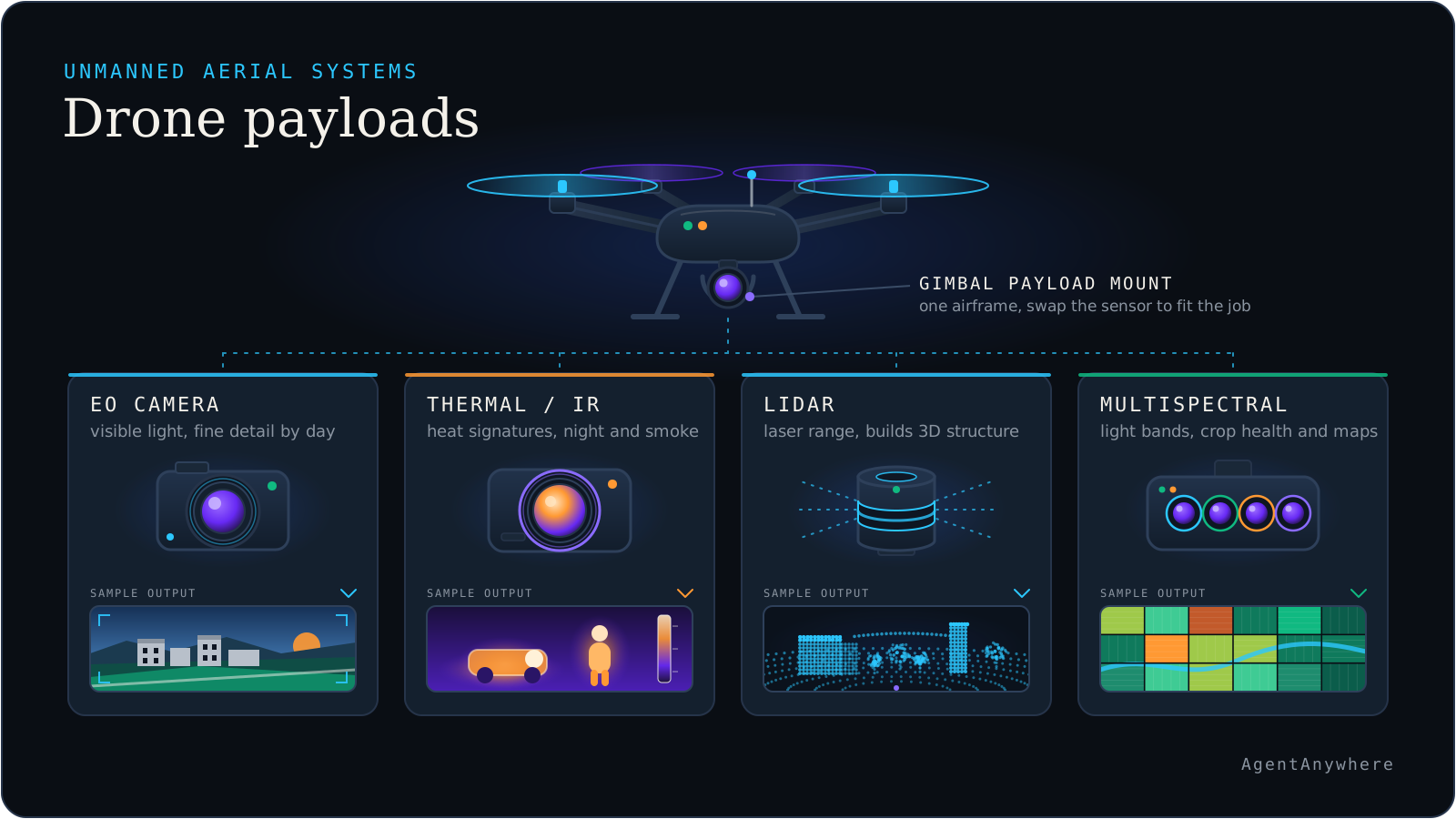
| Category: Infrastructure inspection | Examining power lines, pipelines, wind turbines, solar farms, bridges and towers without climbing. | Multirotor for close work, fixed-wing for long corridors. | High-resolution camera, thermal imager, sometimes LiDAR. |
| Category: Survey and mapping | Producing maps, 3D models and terrain data for construction, mining, land records and planning. | Fixed-wing or VTOL for large sites, multirotor for small ones. | Mapping camera for photogrammetry, or LiDAR. |
| Category: Agriculture | Monitoring crop health, counting plants and, in some jurisdictions, applying treatments to fields. | Multirotor or fixed-wing; larger multirotors for spraying. | Multispectral camera, or a spray tank and nozzles. |
| Category: Public safety and search and rescue | Finding missing people, supporting firefighters, assessing disaster areas and managing crowds. | Small multirotor, often with a thermal imager. | Thermal and zoom camera, searchlight, loudspeaker. |
Industrial and civil uses: data, inspection and delivery
Most commercial drone flying is the quiet kind. Inspection is the clearest case: a drone can look at a wind turbine blade, a pipeline run or a transmission tower without a person climbing it or shutting it down. We have written about this in detail for wind turbines, pipelines, power lines and solar plants.
Survey and mapping turn overlapping photographs or laser scans into maps and 3D models, replacing days of ground work with hours in the air. Agriculture uses multispectral cameras to show where crops are stressed, and in some countries larger drones apply sprays under tight rules. Logistics is growing too, carrying small, urgent loads such as medical items across terrain that makes roads slow. Public safety agencies use thermal-equipped drones to search for missing people and to give incident commanders a view from above.
The common thread is that the aircraft is a vehicle for a sensor or a small load, and the economics come from the information or the time saved. That is also why so much of the interesting engineering is in what happens to the data afterwards.
What every category shares, and where AI helps
Whatever the category, three questions repeat. What does it carry, and how much? That sets the payload and, through the energy budget, the endurance, as covered in endurance, range and payload capacity. How far and for how long? That sets the airframe. Who is in command, and what do they see? That sets the control station, the link and the human oversight around the flight.
The last question is where AI is most useful and most sensitive. A long flight produces more imagery than any person can watch. Models that run on the aircraft or ground station can help a human notice what is worth a closer look, such as a damaged component on a line or a heat signature in a search area, and can do so without a network connection. AgentAnywhere works on edge AI and perception for this observe-and-assist role: it highlights, the person decides. Our public page on AI for drones and UAVs describes that role in more detail.
Common mistakes when sorting drones
Treating class names as universal. Size classes and their boundaries differ between alliances and countries, so read the scheme a document actually uses.
Sorting by airframe alone. The same aircraft can do several jobs by changing the payload, which is why the job is usually the more useful label.
Assuming the job fixes the sensor. Inspection, mapping and surveillance all start with a camera, and what separates them is the sensor mix and what is done with the data.
More in this series
What is an unmanned aerial system?: the aircraft, the control station, the link and the people: the whole system.
UAV vs UAS vs drone: what each word actually covers, and why the difference matters.
Fixed-wing vs multirotor vs VTOL: three ways to stay in the air, and what each one trades away.
Drone payloads explained: EO, infrared, thermal and LiDAR: what each sensor sees and misses.
Endurance, range and payload capacity: the three numbers on every spec sheet, and why they pull against each other.
Frequently asked questions
What are the main types of military drones?
Military unmanned aircraft are commonly grouped by size and endurance, from small hand-launched tactical aircraft through mid-size tactical systems to large medium-altitude and high-altitude long-endurance (MALE and HALE) aircraft. By job, the largest category is intelligence, surveillance and reconnaissance, followed by communications relay, logistics and resupply, and aerial targets for training.
What are the main types of industrial drones?
Industrial and commercial drones are usually grouped by job: infrastructure inspection of power lines, pipelines, turbines and solar plants; survey and mapping for construction and land planning; agriculture, including crop monitoring and in some places spraying; logistics and cargo; and public safety such as search and rescue. Many use the same airframes with different payloads.
What does MALE and HALE mean for drones?
MALE means medium-altitude long-endurance and HALE means high-altitude long-endurance. They describe large unmanned aircraft that fly at altitude for many hours, covering wide areas for persistent observation. They typically need airfields and sizeable control stations. The exact class boundaries differ between alliances and countries.
What is ISR in the context of drones?
ISR stands for intelligence, surveillance and reconnaissance. It means using sensors, such as cameras, thermal imagers and radar, to observe an area and understand what is happening. Unmanned aircraft are well suited to ISR because they can keep a sensor over an area for longer than a person could, without putting a crew at risk.
How is AI used on drones?
Most AI on drones sits around the payload and the operator rather than in the flight controller. Models running on the aircraft or the ground station can help an operator notice relevant items in imagery, summarise long flights and flag anomalies for review, often without a network link. In responsible use the AI informs a human, who remains in command of every consequential decision.
Written by
AgentAnywhere Research
The team that builds the platform and the models
AgentAnywhere Research writes about the platform, the model families and the trust layer we build and run in India. Where a figure is ours, it says what it covers; where something is a demonstration, it says so.