
What is an unmanned aerial system, exactly?
The word unmanned means no pilot on board. It does not mean no human involved. Every UAS has a person responsible for it, usually called the remote pilot or operator, who plans the flight, supervises it and can take over or end it. The aircraft is flown from the ground, or follows a route set from the ground.
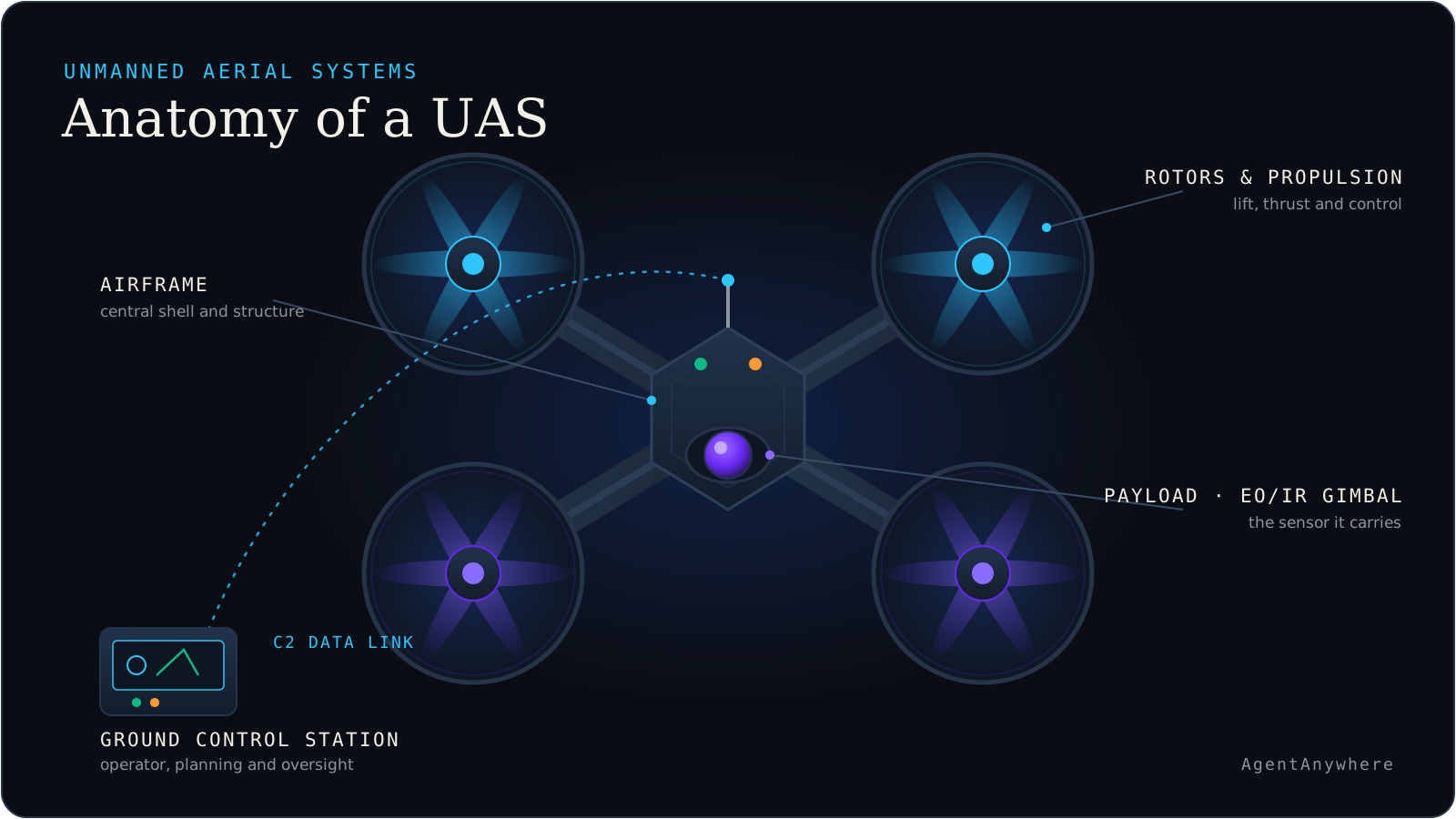
The word system is the important part. A UAS is a set of cooperating elements: the unmanned aircraft, the payload, the control station, the data link, launch and recovery equipment, and the crew and procedures. Take any of them away and the others cannot do the job. A camera needs an aircraft to carry it; an aircraft needs a link or a pre-loaded plan to be directed; a link needs a station and a person at the other end.
The term has a long pedigree. International civil aviation bodies such as the International Civil Aviation Organization (ICAO), and national regulators, use unmanned aircraft system so that rules, certification and safety cases cover the whole chain, not just the flying machine. That is why you will see UAS in regulation and procurement documents, while everyday speech says drone.
The parts of a UAS
A typical system, element by element. Sizes and designs vary enormously, but these roles are present in almost every UAS, from a pocket-sized quadcopter to a large long-endurance aircraft.
| Element | What it is | What it does |
|---|---|---|
| Element: Unmanned aircraft | The airframe, motors or engine, battery or fuel, and the flight controller (autopilot). | Flies. The autopilot reads sensors such as GNSS, inertial units and a barometer to hold attitude and position. |
| Element: Payload | The equipment carried to do the job: a camera, thermal imager, LiDAR, a delivery box, a sprayer. | Captures data or performs the task the flight exists for. It is why the aircraft is flying at all. |
| Element: Control station | A handheld controller, a laptop or tablet, or a dedicated ground control station (GCS). | Plans the mission, shows telemetry and video, and lets the operator command or override the aircraft. |
| Element: Command-and-control (C2) link | A radio, cellular or satellite data link, plus a separate video or payload downlink in many systems. | Carries commands up and telemetry and imagery down. Its range, latency and reliability shape what the system can do. |
| Element: Launch and recovery | A runway, hand launch, catapult, landing pad, net, parachute or dock. | Gets the aircraft into the air and back safely. Often the hardest part of fixed-wing and larger systems. |
| Element: People and procedures | Remote pilot, payload operator, visual observer, maintenance crew, and the rules they follow. | Plan, supervise, maintain and take responsibility for the flight. Safety depends on them as much as on hardware. |
How a UAS actually flies
A UAS flies in three layers: a fast control loop that keeps the aircraft stable, a mission layer that decides where it goes, and a link that ties both to the person in command.
Inside the aircraft, a flight controller runs a fast control loop: it reads attitude and position from onboard sensors, compares them with what the operator or the mission plan wants, and adjusts the motors or control surfaces hundreds of times a second to close the gap. Position comes mostly from satellite navigation (GNSS) fused with inertial and barometric data. This inner loop is what lets even a beginner hold a multirotor steady in the air.
Above that loop sits the mission layer. An operator can fly by hand, send simple commands (take off, hold here, return home), or load a route of waypoints for the aircraft to follow. The payload is controlled in parallel: a pan-tilt gimbal pointed at a target area, a camera triggered at intervals, a sensor recording continuously.
Then there is the link. If the radio link degrades, a well-designed system does not simply crash. Common failsafes include hovering, returning to the launch point, or landing in place when the link drops or the battery runs low. Which behaviour is chosen, and whether the aircraft can complete a mission without the link at all, is a design and safety decision made before the flight, not during it.
How much of it is autonomous? Levels of human control
Autonomy changes how much the operator hand-flies, never who is accountable.
A useful way to read any UAS is by asking what the aircraft decides on its own and what a person decides. At one end, the operator controls the aircraft directly through sticks. In the middle, the aircraft stabilises itself and executes pre-planned routes while a person supervises and can intervene. Further along, the aircraft handles more of the flight itself, for instance avoiding obstacles or following a planned inspection path, while the person still defines the mission, monitors it and stays accountable.
What does not change across that spectrum is the responsibility. Aviation rules assume a person answers for the flight, and good system design keeps that person in a position to understand what the aircraft is doing and to end the flight when needed. Autonomy is best seen as less hand-flying, not less accountability.
Six questions that tell you whether you are looking at a system
A pilotless aircraft becomes a system only when you can answer six questions about it. What does it fly, and what does it carry? Who commands it, and from what station? What link joins them, and what happens when that link degrades? How is it launched and recovered? Who is the named remote pilot or operator? Which rules govern the flight?
We call this the six-question test. If a brochure, a tender or a news story answers only the first, it is describing a UAV and calling it a system. It is a quick way to read any claim about drones, and it explains why regulators write rules for the system rather than the airframe.
Common mistakes when thinking about a UAS
Judging the system by the aircraft. A strong airframe with a weak link, an untrained crew or no recovery plan is a weak system.
Treating the link as unlimited. The range, latency and reliability of the command-and-control link shape what the system can do, and loss of link is a design case to plan for, not a surprise.
Reading autonomy as the absence of responsibility. However automated the flight, a person sets the mission and answers for it.
Forgetting the payload. The payload is why the aircraft is flying at all, and it sets the weight, the power draw and the volume of data the system produces.
Where AI fits, and where it should not
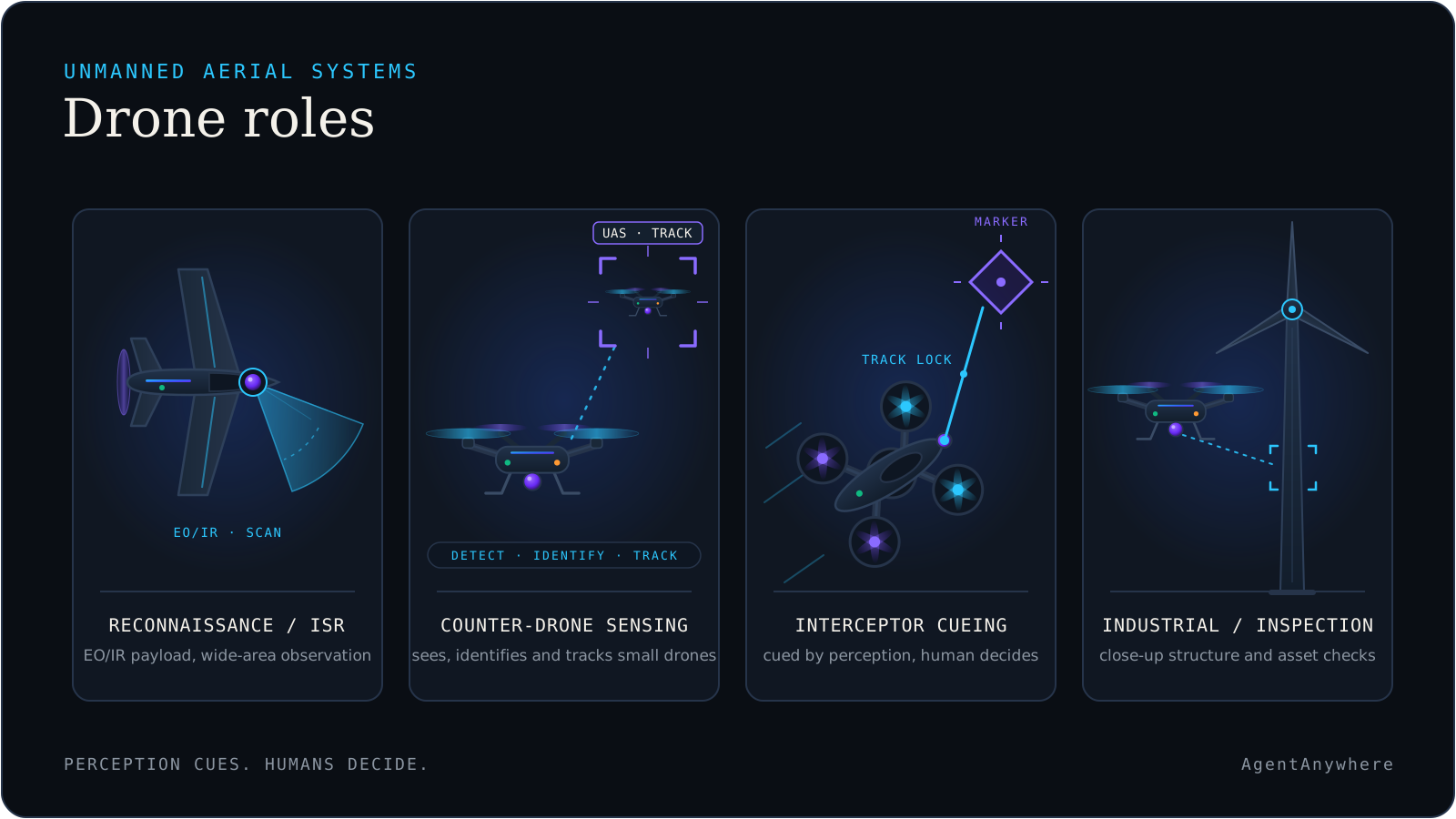
Most of the interesting AI in a UAS sits around the payload and the operator rather than in the flight controller. Models that run on the aircraft or the ground station can help an operator notice things in imagery and sensor data, summarise what a long flight captured, and flag anomalies for review. Running that inference on the device, rather than streaming everything to a distant server, matters when links are thin, bandwidth is scarce or data must stay inside the operator's own perimeter.
AgentAnywhere works on edge AI and perception of this kind: software that assists the people in command by helping them see and understand, with a person making every consequential decision. If a person is the one accountable for the flight, then the AI's job is to make that person better informed, not to take the decision away. The rest of this series covers the field in the same spirit, starting with how the words UAV, UAS and drone differ and the three main airframe types. The sensors a UAS carries are covered in drone payloads explained, and our public page on AI for drones and UAVs describes the observe-and-assist role in more detail.
More in this series
UAV vs UAS vs drone: what each word actually covers, and why the difference matters.
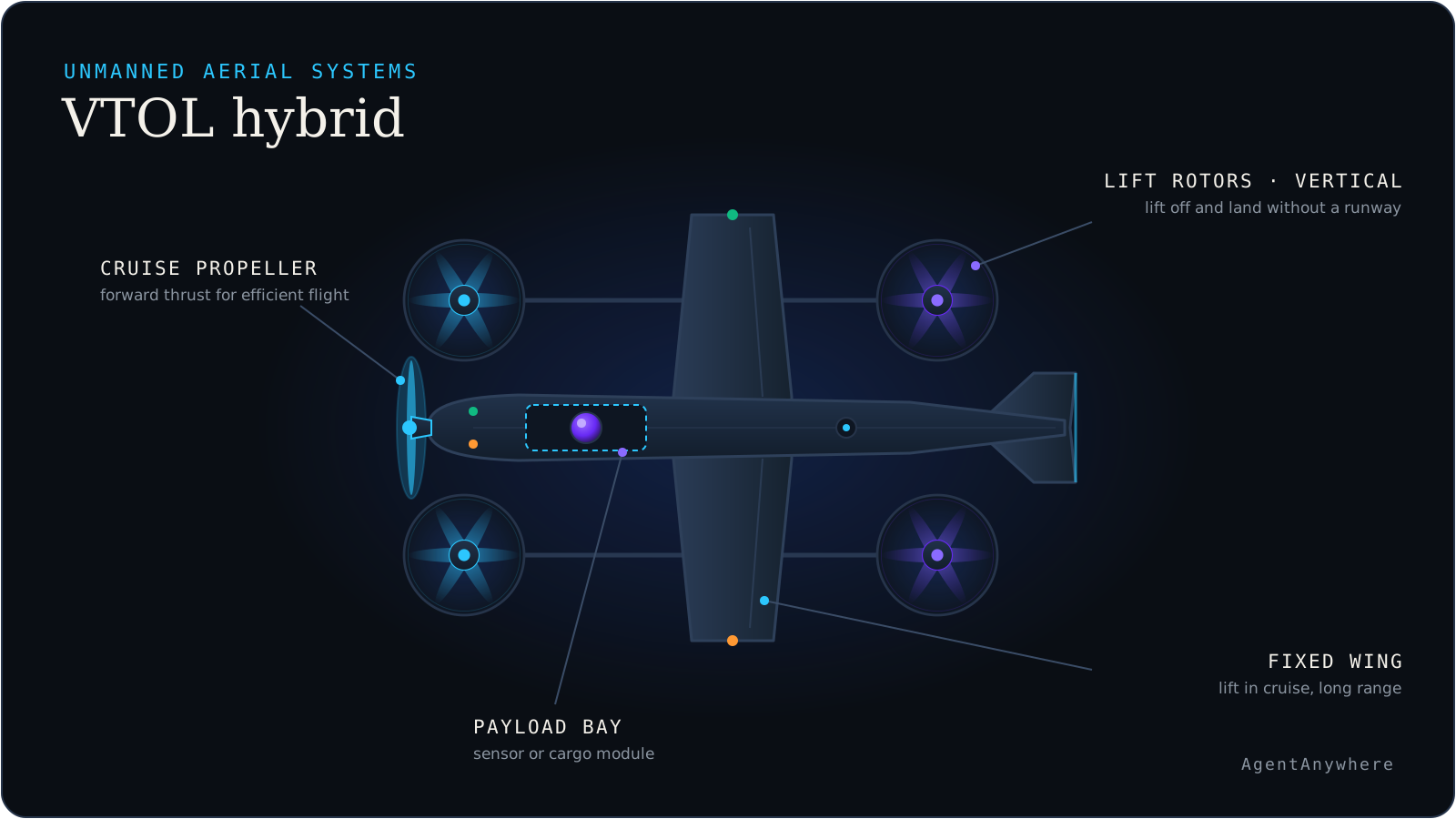
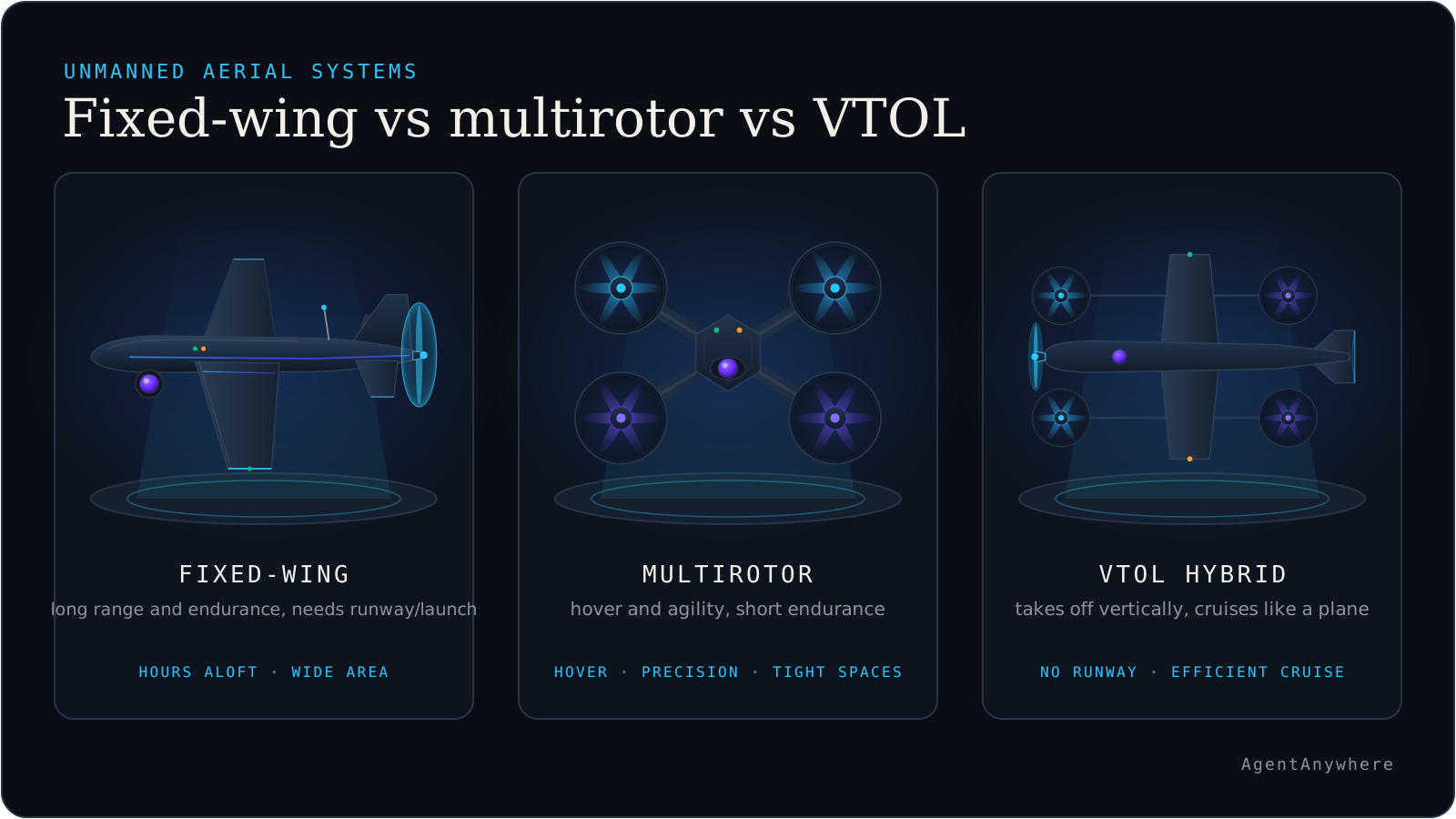
Fixed-wing vs multirotor vs VTOL: three ways to stay in the air, and what each one trades away.
Types of military and industrial drones: the main categories by size and by job, described neutrally.
Drone payloads explained: EO, infrared, thermal and LiDAR: what each sensor sees and misses.
Endurance, range and payload capacity: the three numbers on every spec sheet, and why they pull against each other.
Frequently asked questions
What is an unmanned aerial system (UAS)?
An unmanned aerial system is a pilotless aircraft together with everything needed to operate it: the aircraft, its payload, a ground control station, a command-and-control data link, any launch and recovery equipment, and the people and procedures that run the flight. The term covers the whole system rather than just the flying machine.
What are the main components of a UAS?
The main components are the unmanned aircraft with its flight controller, the payload such as a camera or sensor, the control station used by the operator, the command-and-control data link between aircraft and station, launch and recovery equipment, and the crew who plan, supervise and maintain the flight. Each depends on the others.
Is a UAS the same as a drone?
In everyday speech the two words are used interchangeably, but strictly a UAS is the whole system, including the control station, link and people, while drone is a casual word that usually means just the aircraft. Regulators and procurement documents use UAS because safety and certification depend on the entire chain.
Does unmanned mean nobody is in control?
No. Unmanned means there is no pilot on board the aircraft. A remote pilot or operator is still responsible for the flight, plans it, supervises it and can intervene or end it. Even highly automated systems follow routes and rules set by a person who remains accountable.
What happens if a UAS loses its control link?
Well-designed systems have failsafe behaviours chosen in advance, such as hovering, returning to the launch point or landing in place when the link drops or the battery is low. Which behaviour applies, and whether the aircraft can continue a pre-planned mission without a link, is a safety decision made before the flight.
Written by
AgentAnywhere Research
The team that builds the platform and the models
AgentAnywhere Research writes about the platform, the model families and the trust layer we build and run in India. Where a figure is ours, it says what it covers; where something is a demonstration, it says so.