
What is a drone power line inspection?
It is a flight by a drone along an overhead line, slow enough and close enough to photograph each tower and each span, to record the state of the line and of the strip it runs over. The pictures are read for anything damaged, out of place or too close.
Conductor. The wire that carries the current from tower to tower.
Insulator. The string of discs, or the single long piece, that holds a conductor away from the tower. As an example of how basic it is, the United Kingdom's regulations require any live part of an overhead line that is out of ordinary reach to be supported on insulators or surrounded by insulation 3.
Span. The stretch of line between two towers.
Minimum vegetation clearance distance. The least distance that has to be kept between a line and what grows near it. The United States standard has these distances written into its text 1.
What does a drone look for on a power line?
This table carries only what a regulation or a standard we have read names, and says in each row whose rule it is. India's electricity safety regulations lead where they speak 5; the rules of other countries are documented examples. We would sooner print a short table than a long one we cannot stand behind.
| The finding | What it looks like | Which camera shows it | Whose rule, and what it says |
|---|---|---|---|
| The finding: Vegetation too close to a conductor | A tree crown under or beside the line, inside the distance that has to be kept. | Colour, with a way to measure the distance | India: no trees are to be grown below or in the vicinity of bare overhead conductors in contravention of the regulations that set a line's clearances from buildings 5. United States: the reliability standard for transmission vegetation management sets minimum vegetation clearance distances and a minimum annual inspection 1. California: minimum clearances between line conductors and vegetation are to be maintained 2. United Kingdom: there is to be no interruption of supply caused by too little clearance between an overhead line and a tree or other vegetation 3. |
| The finding: A dead or diseased tree leaning towards the line | A dead, rotten or diseased tree, or part of one, that overhangs a span or leans towards it and could fall into it. | Colour | California: when the company knows of such a tree, the tree or the part should be removed 2. |
| The finding: A building or structure too close to the line | A roof, a wall or a mast near the conductors. | Colour, with a way to measure the distance | India: an overhead line is not to cross over an existing building as far as possible, and no building is to be constructed under an existing overhead line; where a line passes above or beside a building, minimum vertical and horizontal clearances apply, set by the line's voltage and worked out at maximum sag and at maximum deflection by wind. “Building” there includes any structure, permanent or temporary 5. United Kingdom: no overhead line is to come so close to any building, tree or structure as to cause danger, so far as is reasonably practicable 3. |
| The finding: A conductor too low over the ground or a road | A span that hangs lower than it should, most of all over a road. | Colour, with a way to measure the height | India: the minimum clearance of the lowest conductor above the ground and across roads, railway traction conductors and rivers is set by voltage in a schedule to the regulations 5. United Kingdom: a line's height above ground must not be less than the figure set for its voltage, measured at the line's maximum likely temperature, with a separate figure over roads 3. |
| The finding: A conductor worn by vegetation | On a low-voltage circuit, a wire under strain from a branch, or its covering worn through where a branch rubs it. | Colour | California: a circuit at 750 volts or less that shows strain or abrasion from vegetation contact has to be corrected 2. |
| The finding: A missing safety sign or anti-climbing guard on a support | A tower or pole of a high-voltage line without its danger signs, or without the device that keeps people from climbing it. | Colour | India: the owner of every overhead line above 650 volts is to make arrangements that stop unauthorised people climbing any of its supports that can be easily climbed, and each pole or tower of a line of 11 kilovolts and above is to carry barbed wire or spiked clamps at a set height 5. United Kingdom: supports carrying high-voltage lines are to carry safety signs, and where circumstances require, devices to prevent unauthorised people reaching the line 3. |
| The finding: Material stored, or a fire, under the line | A stack of pipes or timber, a heap of earth or farm produce, or smoke, below or beside the conductors. | Colour | India: no material, earth work or agricultural produce is to be dumped or stored below or in the vicinity of bare overhead conductors in contravention of the clearance regulations, no flammable material is to be stored under an electric line, and no fire is allowed below an overhead line 5. |
The table says what an inspection looks for. It is not a list of what any product of ours finds; see “What this is not”.
Why is a power line inspected from the air?
Because the things to look at are high up, far apart and many, and some of them can only be seen from above or from beside the tower.
The look is also required, in every rule we have read. As examples from other countries: the United States standard for vegetation near transmission lines includes a minimum annual inspection, and a revision approved in 2013 extended it to some lines operated below 200 kilovolts 1. California's rules say lines shall be inspected frequently and thoroughly, to make sure they are in good condition 2. The United Kingdom's regulations require a network to be inspected often enough for its owner to know what action is needed, and a record of each inspection of an overhead line to be kept for at least ten years 3.
In India, the Central Electricity Authority's safety regulations of 2023 require the periodic inspection and testing of electrical installations: by the Electrical Inspector above a notified voltage, and by self-certification of the owner, supplier or consumer at or below it, at intervals the government concerned directs and that are not to exceed five years 5. The English text of the regulations does not mention drones or patrols.
The same regulations put a duty on whoever builds near a line: a person who proposes to put up or alter a building or structure after an overhead line has been erected is to give notice in writing to the supplier or owner and to the Electrical Inspector, with a scale drawing 5. A flight along the line is one way an owner learns that someone has not.
A clearance is a distance. Seeing the tree is half the job; knowing how far it is from the wire is the other half.
What does a vision model have to see?
A model that is to help with this job is looking at thin things in front of cluttered backgrounds, from a moving camera. Five things are hard.
The wire itself. A conductor is a thin line across a frame full of fields, roads and roofs. Finding it is the first step and not a small one.
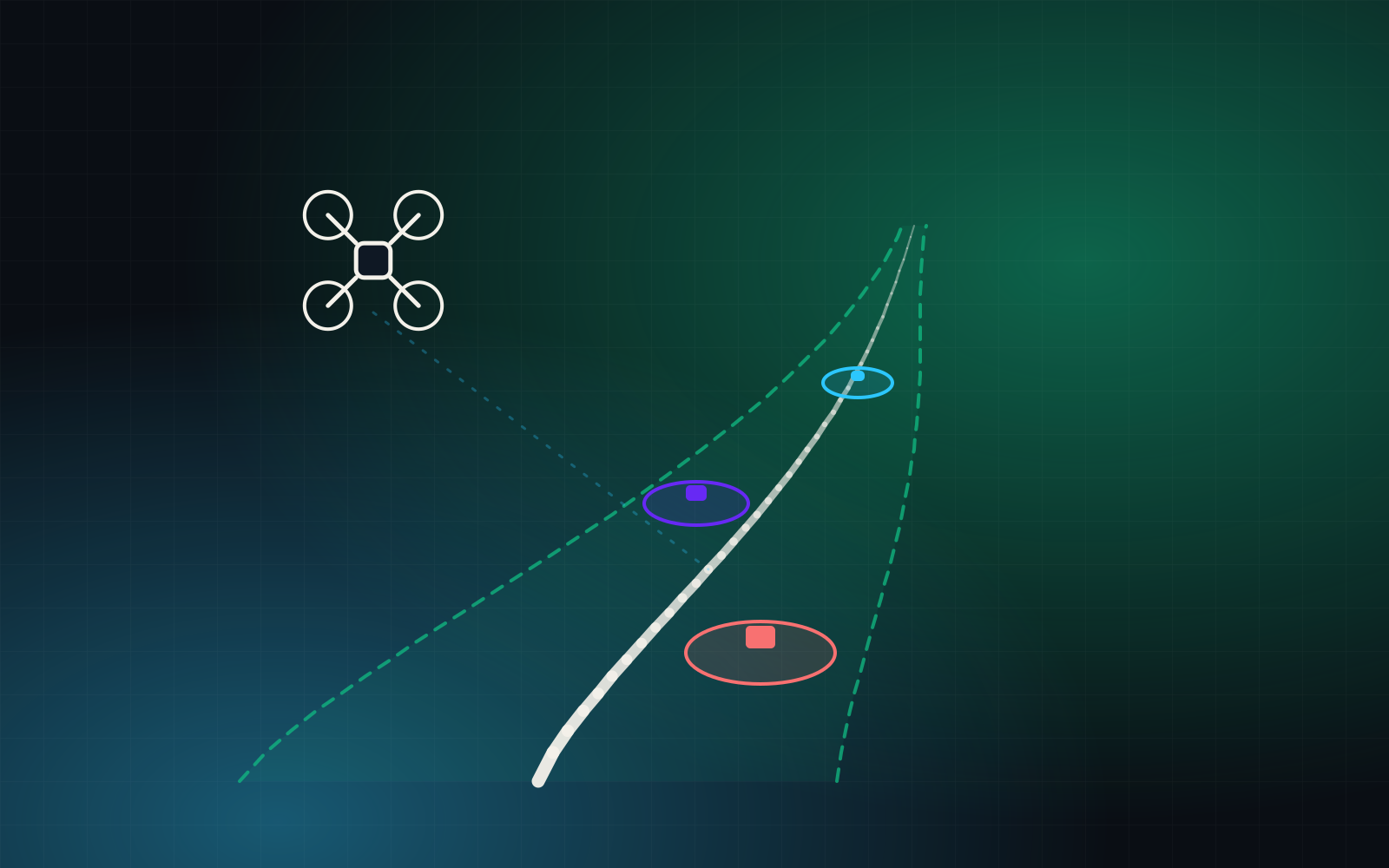
Distance, not just presence. A tree in the picture is not a finding. A tree inside the clearance is. The model needs the geometry of the scene, from more than one picture or from a sensor that measures range.
Which tower. Towers on a line look alike. A finding is only useful with the tower's number and the side of the tower it is on.
Small parts, both sides. An insulator is a small part of the frame and has a far side. The flight has to be planned so that each part is photographed from where it can be seen.
What it could not see. Fog, glare and leaves hide things. A model has to say which towers it could not read, not report them as clear.
Where would this job sit in our stack?
With Drashta, and it is not a job Drashta does today. Drashta (द्रष्टा, “the seer”) is ShepHertz’s machine-vision family. Today it reads satellite imagery offline and finds objects of interest, such as aircraft and buildings, handing analysts structured findings to review.
The Drashta page lists vision for inspection under what comes next, and says we are looking for design partners for it. That is where power-line inspection stands with us: next, with a partner, and not built.
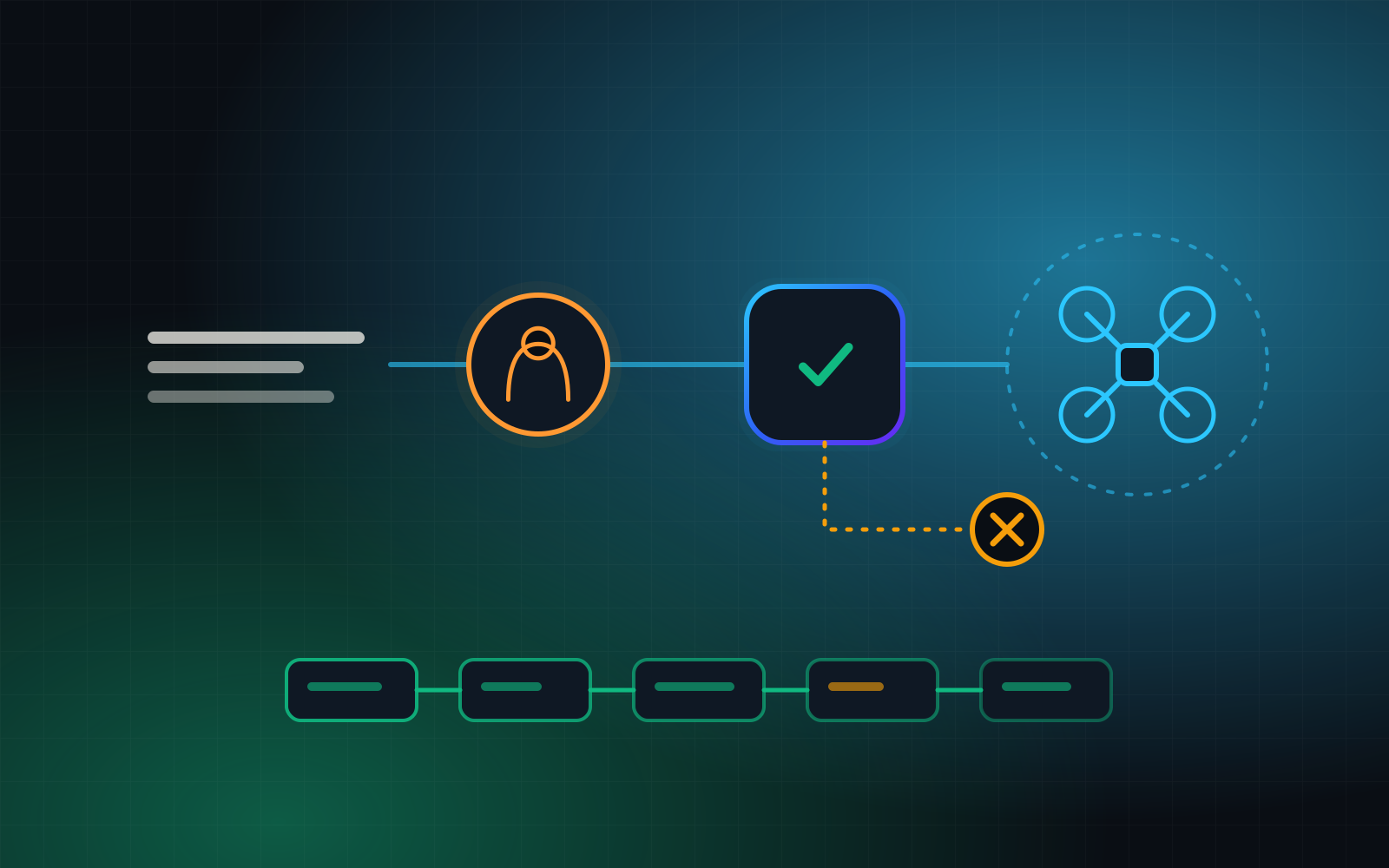
The shape would be the one Drashta has today. A model would hand a person structured findings, what it saw and where, and the person would check them and decide what they mean. For this job “where” means the tower number or the span, and the person is the one who signs the report.
Reading the pictures on the drone itself, while it flies, is further off. The same page calls perception on the machine next, not now.
The other two families do different jobs. Tatva turns plain language into exactly one machine command, and Sanjaya is fleet and telemetry intelligence. Neither reads pictures.
What exists today, and what does not
We have no trained model for power-line inspection; this demo is a picture of the job.
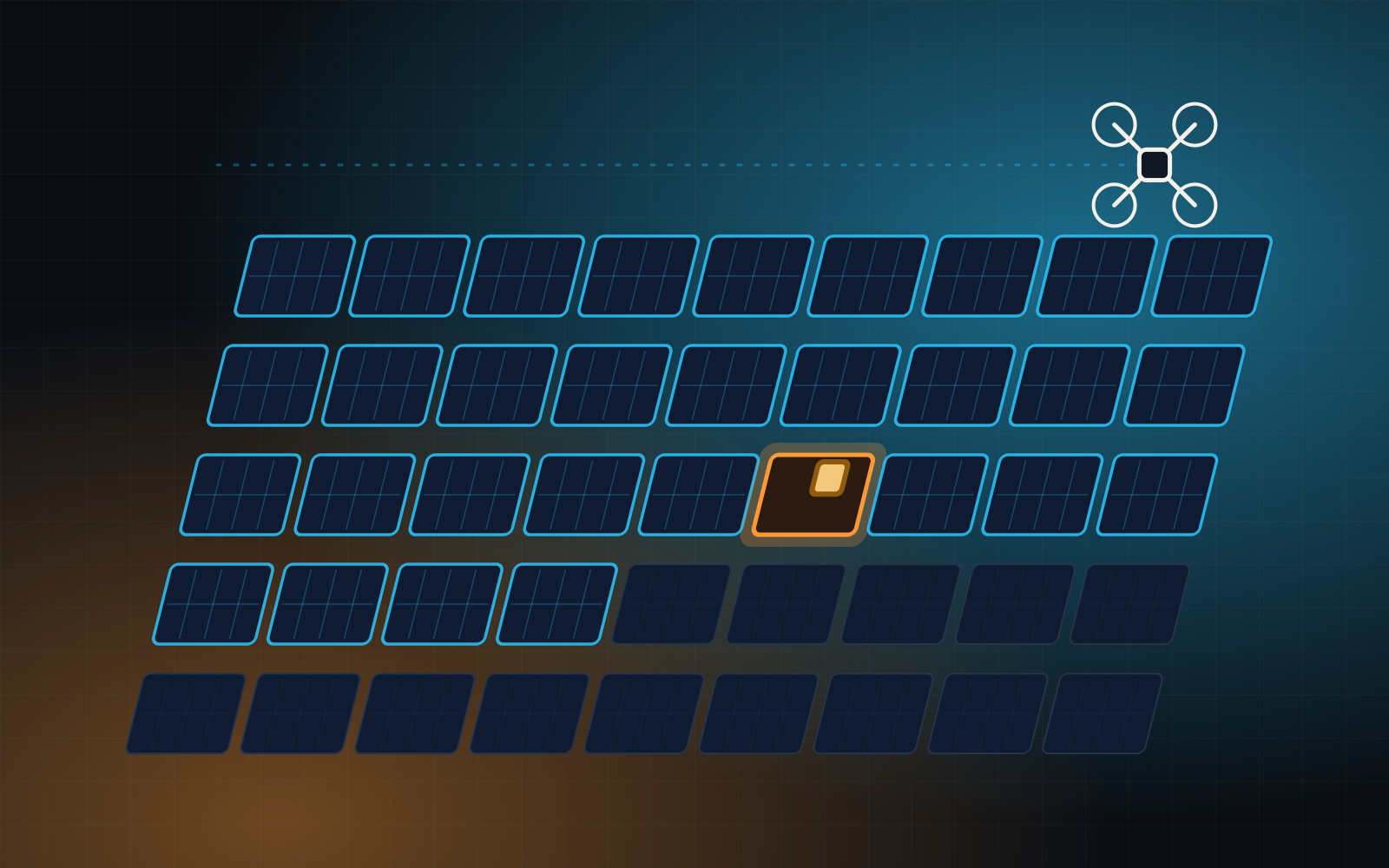
Our synthetic-scene work so far is on rooftop solar; the power-line scene was built for this demo. The post on solar panel inspection says what that work is.
So what exists for power lines is a scene and a list: an invented line, the findings we planted on it, and the patrol sheet they turn into. What does not exist is a model that finds a conductor in a picture, a measurement of any clearance, or any result from a real line.
The demo: a simulated patrol beside an invented line
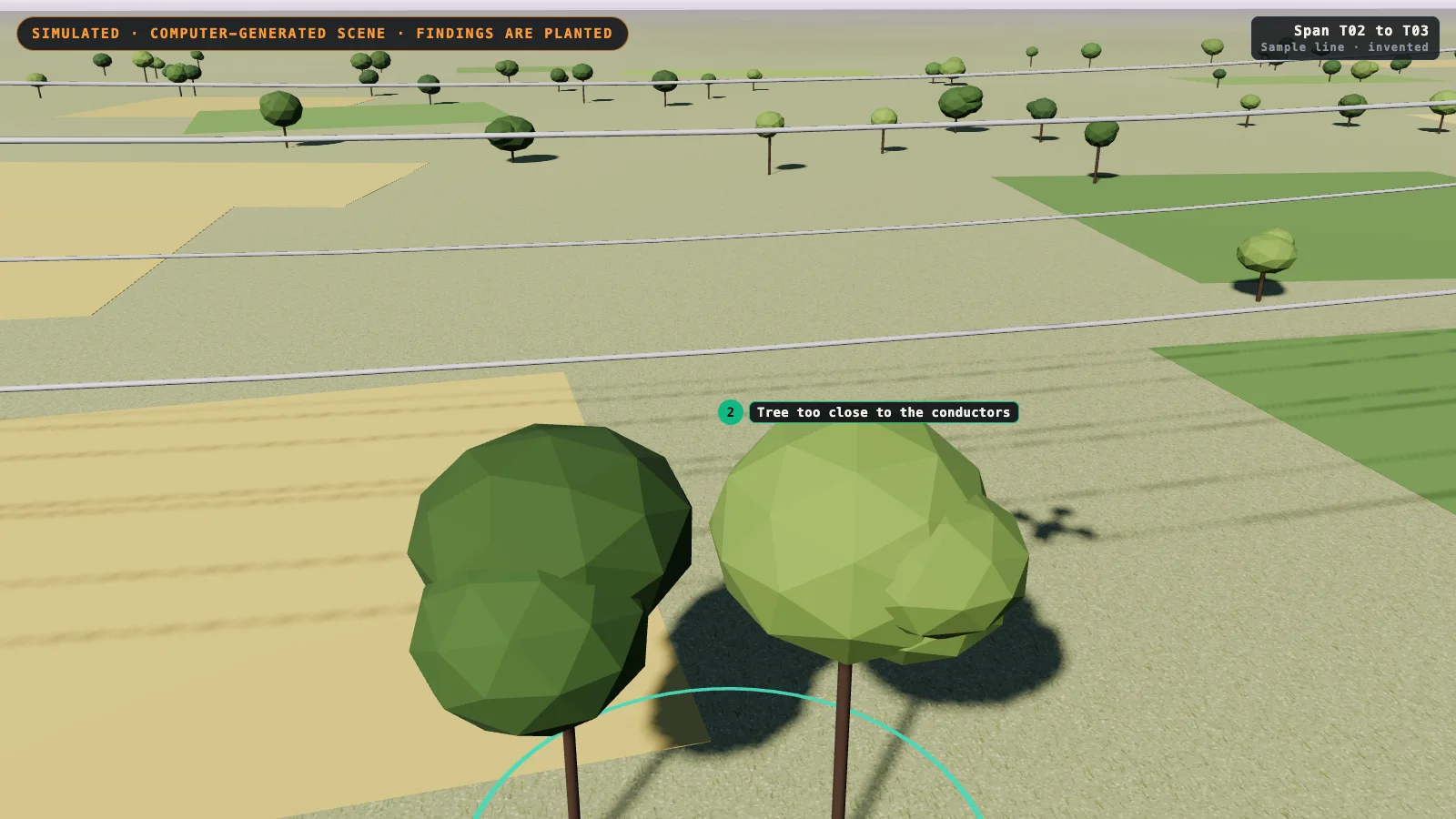
Simulated. The scene is computer-generated and the findings shown are the ones planted in it; no model produced them. You can open the simulated demo in a browser; the pictures here are stills from it, and each carries the tag “SIMULATED” inside the picture.
The demo is a simulated drone patrol beside an invented power line of six lattice towers, numbered T01 to T06, with five spans between them. The line carries two circuits of three conductors each and an earth wire on top, and every conductor hangs from a string of nine insulator discs. A row of five roadside poles, P01 to P05, runs beside one span. The scene models no voltage.
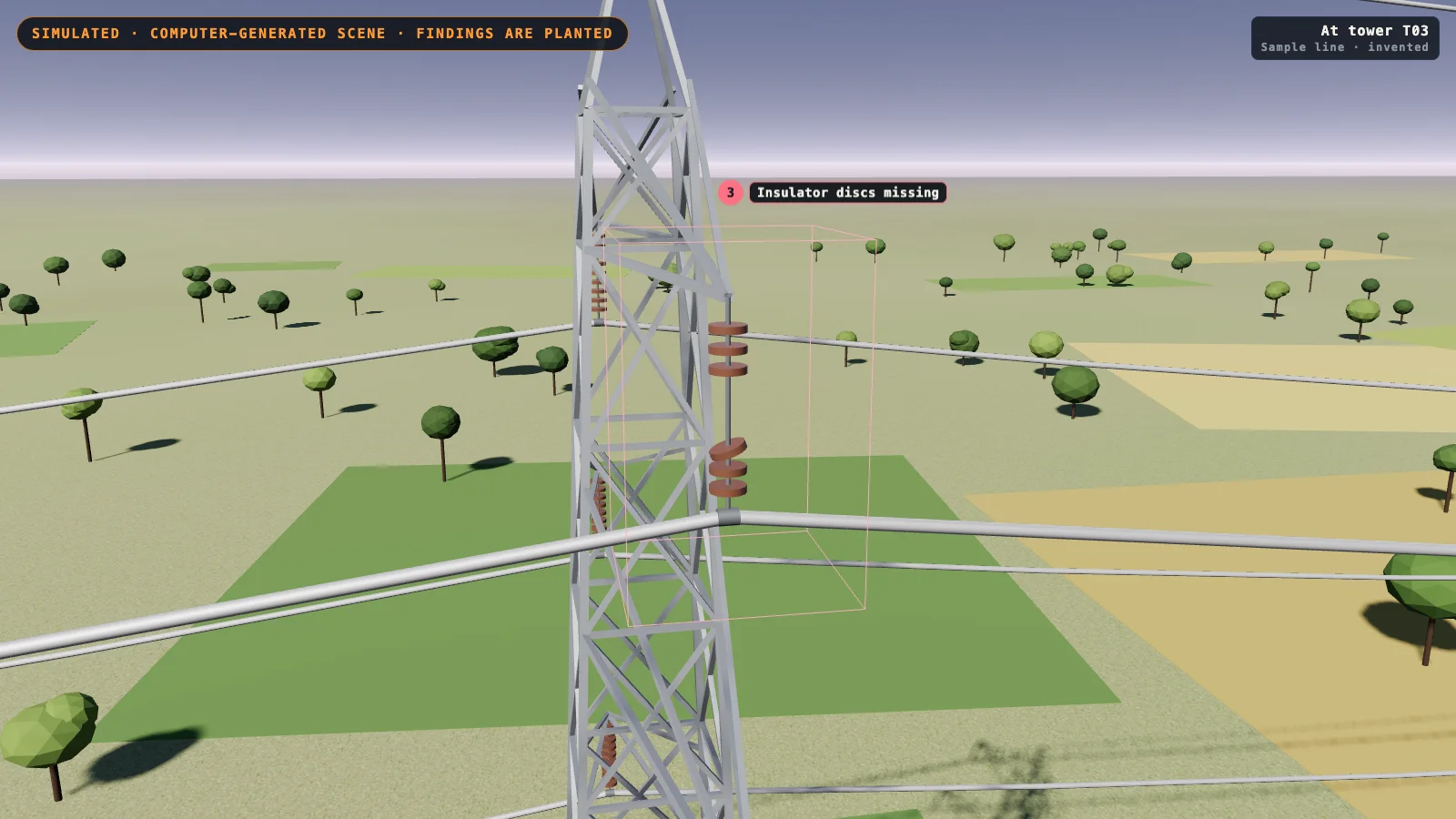
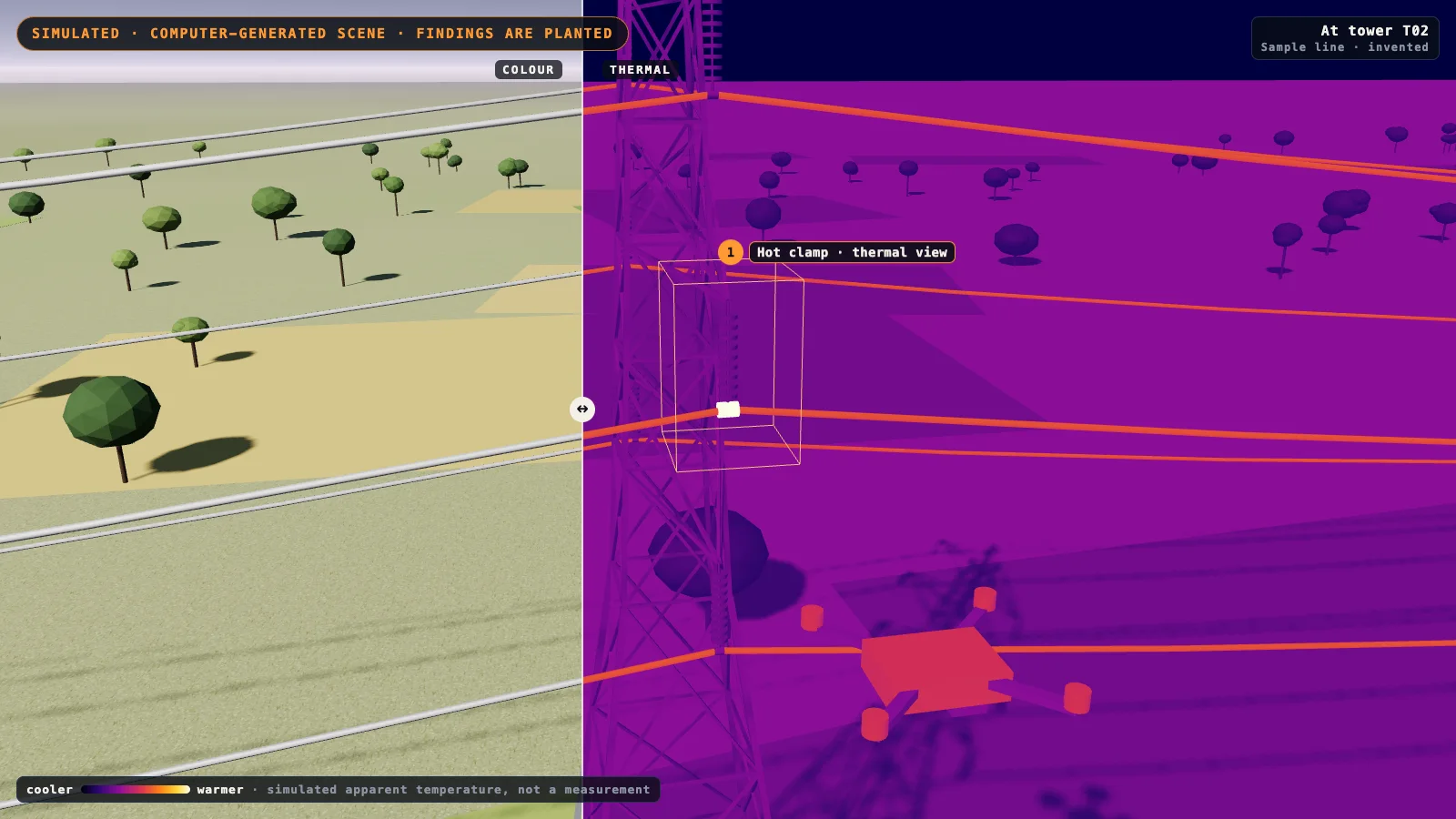
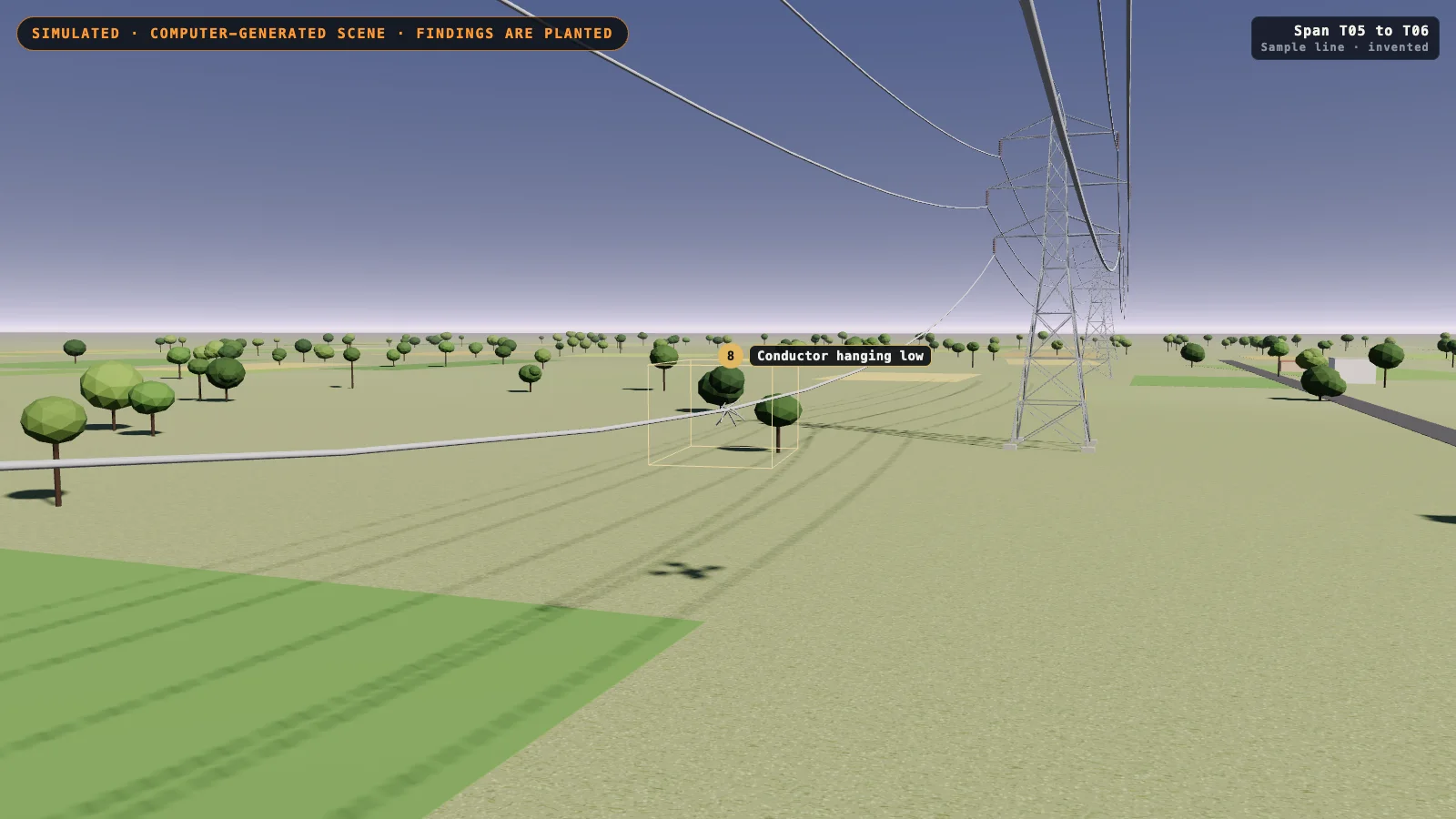
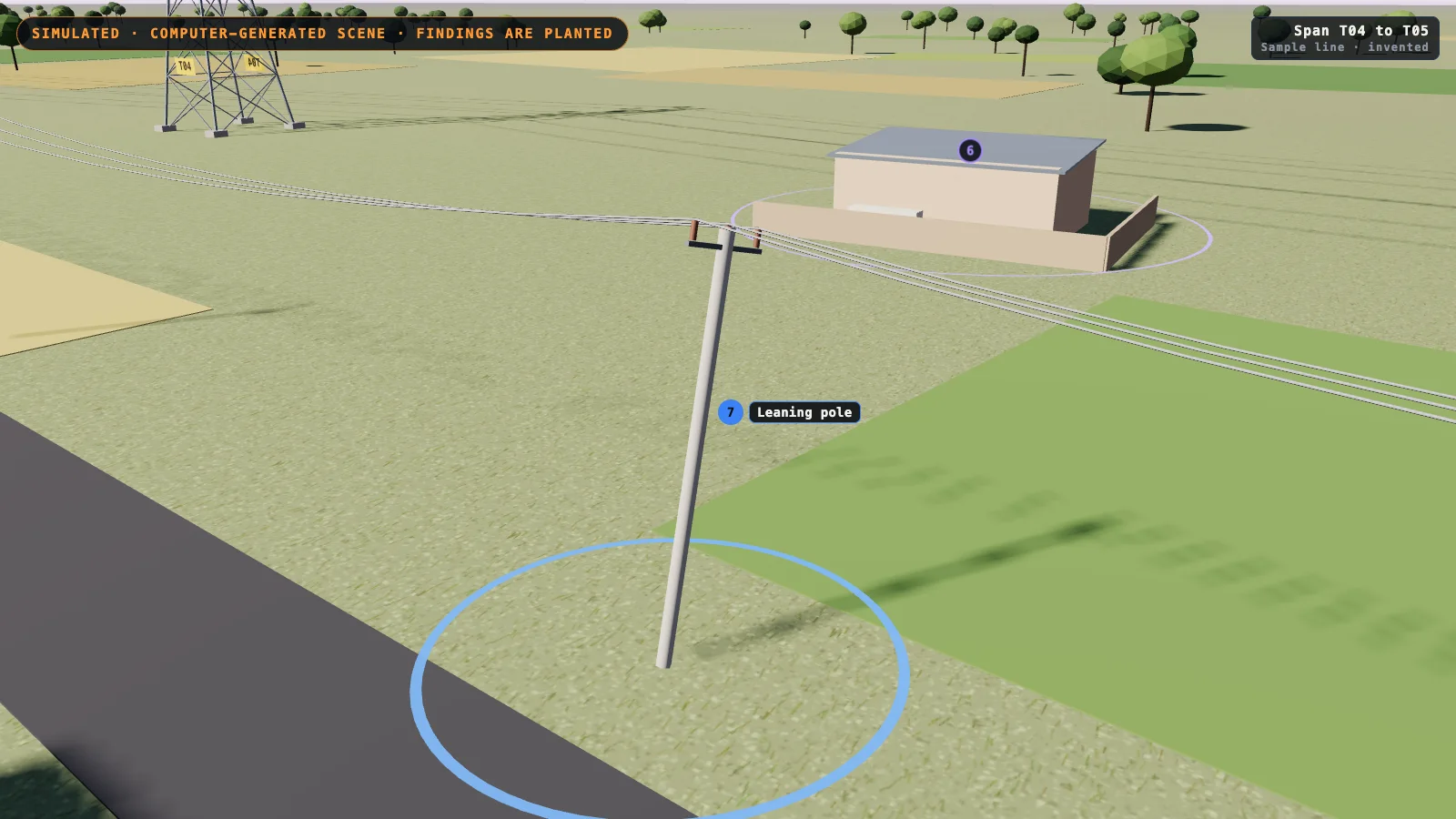
The demo plants eight findings of eight kinds. On the towers and poles, the planted findings are a gap in an insulator string where three of nine discs are gone, a nest on a cross-arm, a leaning pole, and a hot clamp. In the spans, the planted findings are two trees grown up under the lowest conductor, a shed built under the line, a kite caught on the earth wire, and a conductor hanging low with broken strands.
Not all of these are in the table above, which carries only what a rule we have read names. In general terms, trees and buildings too near the conductors are among the things a line patrol looks for, along with damaged conductors, nests and objects caught on the line, and leaning poles.
The hot clamp shows only in the thermal view. A joint or clamp that carries current badly runs hotter than the conductor beside it, which is why patrols use thermal cameras. Insulator strings hold the conductors away from the tower; a broken or missing disc weakens the string.
Every finding is listed by tower number or span, with the circuit and the phase where that applies. As the drone goes, the page counts towers passed, spans patrolled and insulator strings seen.
The visitor can switch between a normal-colour view, a thermal view, and a split view with a divider that can be dragged. The visitor can clear any planted finding, or plant it again, and the scene changes with it: the string is whole again, the pole stands straight, the conductor hangs with its neighbours. The list turns into a one-screen patrol sheet that can be printed, with a suggested next step for each finding.
What is simulated in the demo, and where does it stop?
The list of findings is read from the scene itself, not from the picture: the page placed each one, so it knows its tower or span. An inspection model has to do the reverse, which is why the demo shows the job and proves nothing about doing it.
The clearance under the tree and the extra sag of the low conductor are the scene's own geometry, not measurements. The demo measures neither.
The thermal view is a simple model, ambient temperature plus sunlight plus the heat we planted at one clamp, and it is not a measurement. The thermal view does not model electrical load, wind or reflections from the sky.
The line is invented and simplified: conductors and insulators are drawn thicker than life so that they read on a screen. The towers are all one design and the ground is flat; a real line crosses hills, rivers, roads and other lines.
The demo covers a little under 1 km of line in a little over a minute; the flight is shown fast, and the demo says nothing about range, battery, permissions, or how near a drone may fly to a live line.
Nothing in the demo was tested on a real power line. The whole demo runs in the visitor's browser and makes no request to any other server.
What rules apply to the flight in India?
The inspection is a flight, and in India a flight by a drone falls under the Drone Rules, 2021. The Ministry of Civil Aviation's release on those rules describes an airspace map on its Digital Sky platform with green, yellow and red zones 4.
No permission is required to operate a drone in a green zone, which the release defines as the airspace up to 400 feet, or 120 metres, that is not marked red or yellow, and up to 200 feet between 8 and 12 kilometres from the perimeter of an operational airport 4. A line crosses many places, and a stretch near an airport is the plainest case of one that may not be in a green zone.
The same release says a type certificate is required when a drone is to be operated in India, with exemptions it lists; research bodies flying in a green zone on their own premises are among those it exempts from the type certificate and from the unique identification number 4.
That release is from 2021 and the rules have been amended since. Check the current rules and the map before any flight; this section is a description, not advice.
What this is not
It is not a trained model of ours. ShepHertz does not have a trained power-line inspection model today: the demo on this page is computer-generated, the findings in it are the ones planted in the scene, and nothing has been run on a real line.
It is not what Drashta does today. Drashta is ShepHertz's machine-vision family. Today it finds aircraft and buildings in satellite imagery; inspecting solar plants, pipelines or power lines is not something it does yet.
It is not a full list of line defects, and it is not legal advice. The table above carries only what a regulation or standard we have read names. The regulations' own text governs, and an owner's obligations are for the owner and the Electrical Inspector.
It is not a measurement of clearance. A photograph shows that a tree is near a line. The distance has to be measured, and a person decides what is done about it.
It comes with no figure. We give no accuracy, speed, coverage or saving figure, because we have none to give for this work.
It is not a customer story. No line, utility or site is described here, and none has used our software for this.
Frequently asked questions
What does a drone look for on a power line?
It photographs the conductors, the insulators and each tower, and whatever is growing or built near the line. India's electricity safety regulations name buildings under or beside a line, trees grown below or near bare conductors, material stored or a fire under a line, the clearance of the lowest conductor above the ground, and anti-climbing devices on supports 5. The rules of other countries that we have read name vegetation too close to a conductor 123, a dead or diseased tree leaning towards a span 2, a building or structure too close 3, a conductor too low over the ground 3 and missing safety signs on a support 3.
How are transmission lines inspected by drone?
A drone flies along the line and around each tower with a colour camera and a thermal camera, close enough to photograph each span and each part. The pictures are then read, tower by tower, by a person or by software with a person checking.
Why do trees near power lines matter?
Because a line has to keep a distance from what grows near it, and the rules say so. In the United States the reliability standard for transmission vegetation management sets minimum clearance distances and an inspection at least once a year 1; California requires minimum clearances between conductors and vegetation and the removal of dead or diseased trees that could fall into a span 2; the United Kingdom requires that no supply be interrupted by too little clearance to a tree 3.
Can a drone find a hot joint on a power line?
A thermal camera is carried for that. A joint or clamp that carries current badly runs hotter than the conductor beside it, which is why patrols use thermal cameras. The simulated demo on this page plants one hot clamp, which shows only in its thermal view; that view is a simple model and not a measurement, and no model found the clamp.
Can a drone inspect insulators?
It can photograph them, from beside the tower and from both sides. Insulator strings hold the conductors away from the tower; a broken or missing disc weakens the string. In the simulated demo on this page one string has a planted gap where three of nine discs are gone; it was planted, not found by a model.
How close can a building be to a power line in India?
The Central Electricity Authority's safety regulations of 2023 say an overhead line is not to cross over an existing building as far as possible, and no building is to be constructed under an existing overhead line 5. Where a line does pass above or beside a building, regulation 62 sets, for lines up to 650 volts, a vertical clearance of 2.5 metres and a horizontal clearance of 1.2 metres; regulation 63 sets, for lines above 650 volts and up to 33 kilovolts, a vertical clearance of 3.7 metres, with a horizontal clearance of 1.2 metres up to 11 kilovolts and 2.0 metres above that; above 33 kilovolts it adds 0.3 metres to each for every further 33 kilovolts or part of it 5. Those are the regulations' figures, worked out at maximum sag and maximum deflection by wind; read the regulation itself before relying on them.
Does ShepHertz have a power line inspection model?
No. ShepHertz does not have a trained power-line inspection model today: the demo on this page is computer-generated, the findings in it are the ones planted in the scene, and nothing has been run on a real line.
Do you need permission to fly a drone near a power line in India?
It depends on where the line is. Under the Drone Rules, 2021, as the Ministry of Civil Aviation's release describes them, no permission is required to operate a drone in a green zone of the Digital Sky airspace map 4. A stretch outside a green zone is a different case, and the rules have been amended since 2021, so check the current rules and the map. The utility's own safety rules for working near a live line apply as well.
Sources
Sources as read on 13 October 2026. The rules of the United States, California and the United Kingdom are cited as examples from other countries. This is a description of what the texts say, not legal advice.
- 1Federal Energy Regulatory Commission, United States: Revisions to Reliability Standard for Transmission Vegetation Management, final rule, 78 FR 18817, 28 March 2013; the rule's published summary, on Reliability Standard FAC-003-2.
- 2California Public Utilities Commission: General Order 95, Rule 31.2, Inspection of Lines, and Rule 35, Vegetation Management.
- 3United Kingdom: The Electricity Safety, Quality and Continuity Regulations 2002, S.I. 2002/2665, regulations 5, 17, 18, 19 and 20A.
- 4Press Information Bureau, Ministry of Civil Aviation, Government of India: Ministry of Civil Aviation notifies liberalised Drone Rules, 2021, 26 August 2021.
- 5Central Electricity Authority, Government of India: Central Electricity Authority (Measures relating to Safety and Electric Supply) Regulations, 2023, Gazette of India, Extraordinary, Part III, Section 4, notification of 8 June 2023; regulations 32, 60, 62, 63, 65, 66 and 75, read in the gazette's English text.
Written by
AgentAnywhere Research
The team that builds the platform and the models
AgentAnywhere Research writes about the platform, the model families and the trust layer we build and run in India. Where a figure is ours, it says what it covers; where something is a demonstration, it says so.