
Three numbers, one budget
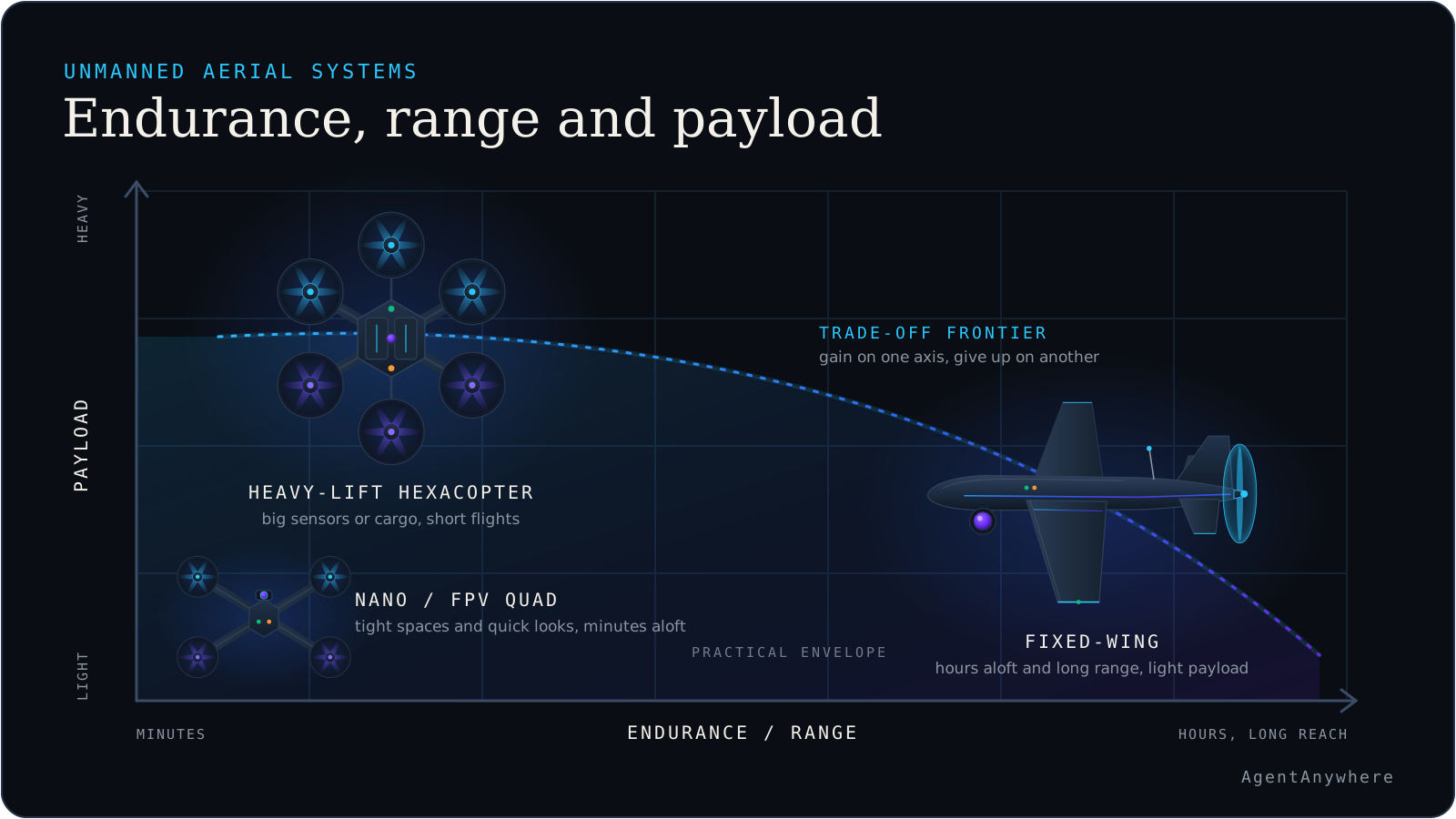
Endurance, range and payload are one budget spent three ways: spend more on one and you have less for the others.
Endurance is time aloft. It matters most when a drone has to stay somewhere: watching an incident, orbiting an area, inspecting a long structure slowly. Range is distance. It matters when the drone has to get somewhere and, usually, come back. Payload capacity is the mass of equipment the aircraft can carry in addition to itself: a camera, a sensor, a package.
The linking quantity is maximum take-off weight (MTOW), the heaviest the aircraft is designed and permitted to be at launch. MTOW is the sum of the airframe, the energy source, the avionics and the payload. Since MTOW is fixed by the structure and the lifting system, every gram given to the battery is a gram not available to the payload, and vice versa. That single constraint produces most of the trade-offs in drone design.
Range is more subtle than it looks. There is the aircraft's own range, how far it can fly on its energy. There is the link range, how far the radio link will reach, typically limited by line of sight and the transmitter and antenna. And there is the mission radius, how far it can go out and still return with a safe reserve. A drone that can physically fly tens of kilometres may be controlled at only a fraction of that unless the link is designed for it, which is why flights beyond the operator's visual line of sight (BVLOS) are as much a link and regulatory question as an energy one.
What sets endurance
Endurance is the energy on board divided by the power burned per hour, so it rises with a better energy source and a more efficient airframe.
Endurance comes down to two things: how much energy the aircraft carries, and how much power it burns per hour. Energy depends on the energy source and how much of it can be carried. Power depends on the aircraft type, its weight, its speed and the conditions.
On the energy side the gap between sources is large. Lithium-ion battery cells store energy on the order of a few hundred watt-hours per kilogram at best, and a complete flight pack stores less. Liquid hydrocarbon fuels hold more than an order of magnitude more energy per kilogram, even after allowing for engines that are far less efficient than electric motors. That is why battery drones stay up for minutes to hours while fuel-powered aircraft can stay up for many hours, and the largest long-endurance aircraft for a day or more.
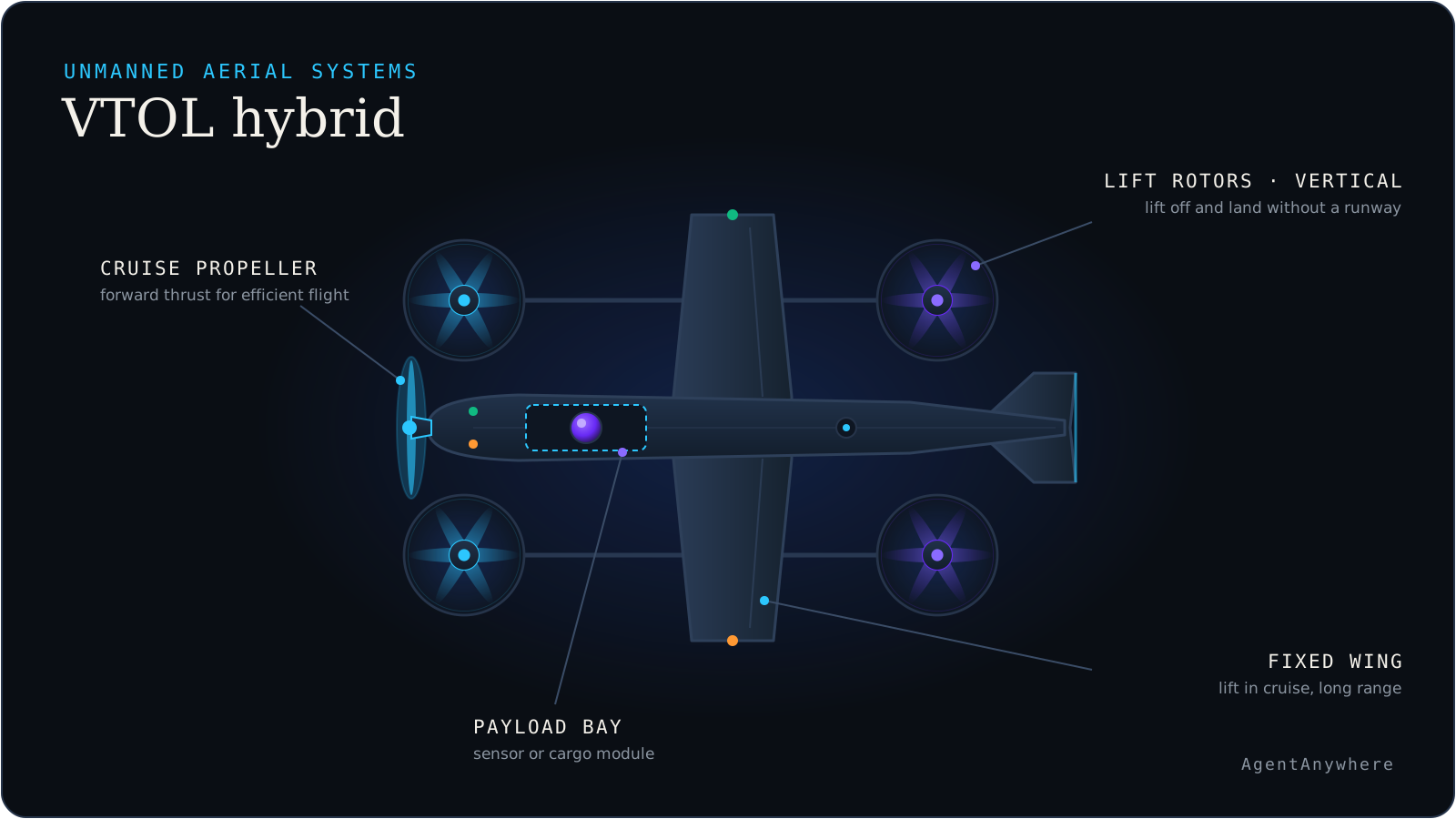
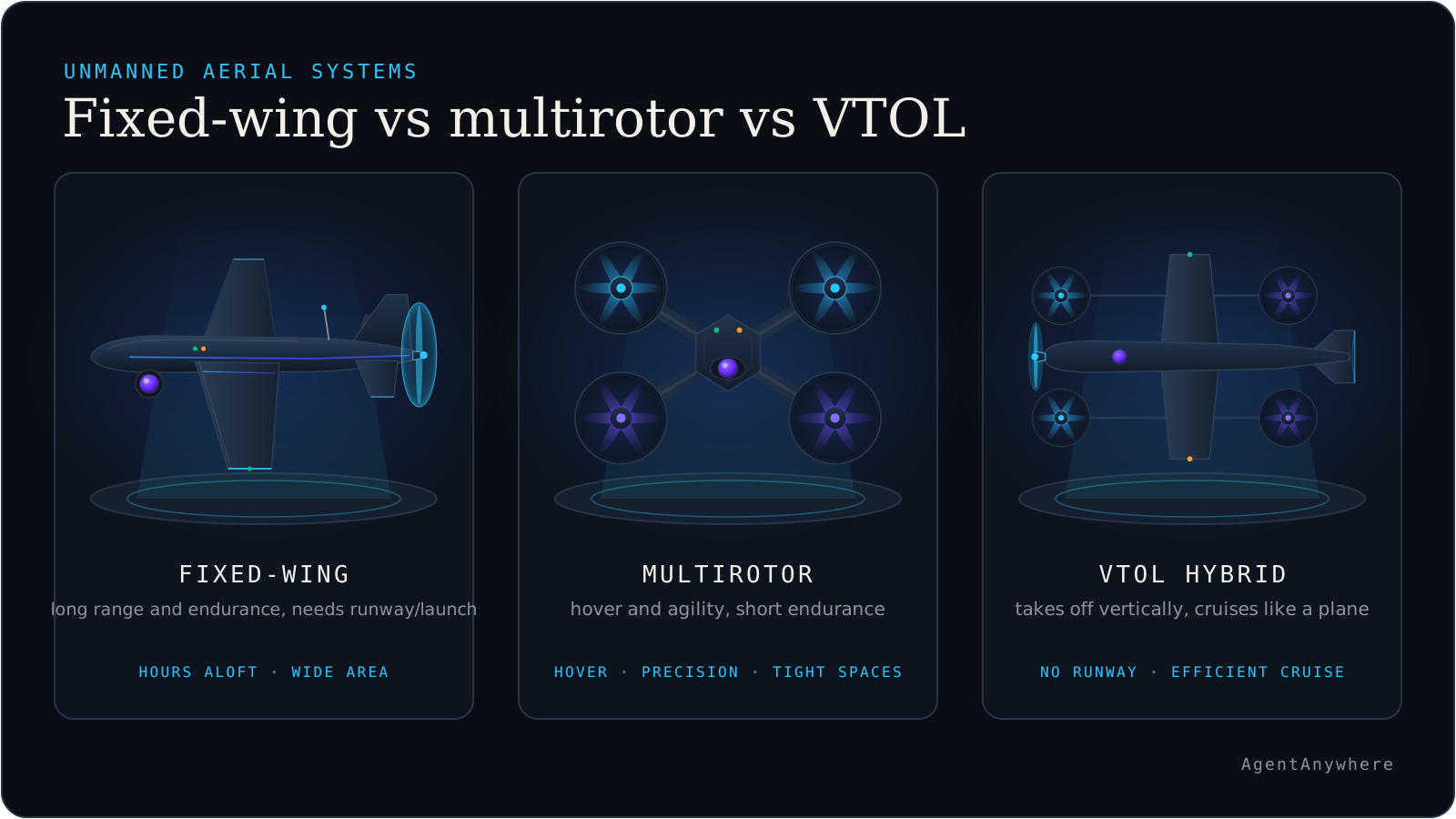
On the power side, the airframe matters most. As explained in fixed-wing vs multirotor vs VTOL, a wing generates lift efficiently while a rotor-borne aircraft pays continuously to hold itself up, which is why similar battery capacity buys hours for a fixed-wing and tens of minutes for a multirotor. Conditions then shift it further: cold reduces usable battery capacity, headwinds and gusts increase power draw, altitude thins the air and makes rotors work harder, and flying style matters, since aggressive manoeuvres burn energy faster than smooth cruising.
Energy sources and typical endurance
General field ranges for typical aircraft, to show the shape of the trade-off. They are not performance claims for any product, and individual aircraft vary widely.
| Energy source | Typical endurance class | Strengths | Limits |
|---|---|---|---|
| Energy source: Battery, multirotor | Tens of minutes. | Simple, quiet, cheap to run, quick to swap and recharge. | Short flights, sensitive to payload, wind and cold. |
| Energy source: Battery, fixed-wing or VTOL hybrid | One to several hours. | Efficient cruise, electric simplicity, low noise. | Battery weight caps range; VTOL lift hardware is dead weight in cruise. |
| Energy source: Hybrid (engine plus battery) | Several hours. | More energy per kilogram, with electric flexibility. | Heavier and more complex, with vibration, noise and fuel handling. |
| Energy source: Hydrogen fuel cell | Often a few hours, above equivalent batteries. | Quiet, more energy than batteries at similar weight. | Costly, needs hydrogen supply and handling infrastructure. |
| Energy source: Fuel engine, large aircraft | Many hours, up to a day or more for the largest. | Highest endurance and payload, long range. | Large, costly, needs an airfield and significant support. |
Endurance depends on payload, wind, temperature, altitude and the safety reserve held back, as well as the energy source.
Payload capacity and the trade-off in practice
The payload is the reason for the flight, so its weight is the number operators fight over. A rule that holds across drone design: the heavier the payload, the shorter the flight. The aircraft burns more power per hour to carry it, and the heavier it is, the faster it uses its energy. For a multirotor in particular, doubling the take-off weight does more than double the power needed to hover, so a heavy payload can shorten flight times dramatically.
That is why payloads are chosen together with the aircraft. A high-end camera, thermal gimbal or LiDAR can weigh as much as the rest of a small drone, which changes the endurance and the airframe class. Designers resolve it in one of three ways: accept shorter flights, add energy storage and accept a heavier aircraft, or choose a more efficient airframe, such as a fixed-wing instead of a multirotor. Nothing removes the trade-off, and the sensors themselves are covered in drone payloads explained.
There is also a distinction between what the aircraft can lift and what is wise to carry. Operating at the very edge of MTOW leaves no margin for wind, a missed landing approach or a degraded battery, so careful operators plan well inside the stated limit.
Plan the mission, not the maximum
Start from the mission and work backwards to the numbers. Decide what must be carried, how long the aircraft must stay on task, and how far it must go and still return with a reserve. Then ask which airframe and energy source can meet all three at once, rather than looking for the biggest figure on any one line of a spec sheet.
Common mistakes. Quoting maximum endurance, maximum range and maximum payload as if they were one configuration. Confusing link range with the aircraft's own range. Planning to the edge of maximum take-off weight, with no margin for wind or a degraded battery. Ignoring cold and altitude, which both cut usable endurance. Forgetting that the computer running on-device AI is part of the load.
The airframe choice that follows from these answers is covered in fixed-wing vs multirotor vs VTOL, and how the numbers show up across job categories in types of military and industrial drones. Our public page on AI for drones and UAVs describes the perception side.
How to read a spec sheet honestly
Treat a headline endurance or range as a ceiling, then ask what lies underneath it. With what payload? Many figures are quoted with no payload or a light one. In what conditions? Calm air, moderate temperature and sea level flatter the number. At what speed and altitude? Best endurance and best range occur at different speeds, so a figure for one cannot be assumed for the other. With what reserve? Responsible operators land with energy to spare, so usable endurance is less than total endurance. Measured how? A figure from an independent test or a real mission means more than a theoretical calculation.
The same scepticism applies to claims about AI. On-device models also draw power and add weight through the computer that runs them, so they are part of the same budget, which is another reason edge hardware is chosen deliberately. AgentAnywhere works on edge AI and perception that runs efficiently on the device and helps operators decide where to look, with a person in command. If the aircraft is the limit on how long a flight can last, the job of the software is to make each minute of that flight count.
More in this series
What is an unmanned aerial system?: the aircraft, the control station, the link and the people: the whole system.
UAV vs UAS vs drone: what each word actually covers, and why the difference matters.
Fixed-wing vs multirotor vs VTOL: three ways to stay in the air, and what each one trades away.
Types of military and industrial drones: the main categories by size and by job, described neutrally.
Drone payloads explained: EO, infrared, thermal and LiDAR: what each sensor sees and misses.
Frequently asked questions
What is the difference between drone endurance and range?
Endurance is how long a drone can stay in the air on one charge or tank of fuel, measured in time. Range is how far it can travel, measured in distance. They are related but different: a drone can have long endurance and short range if it loiters, and the radio link often limits how far it can be controlled before the aircraft's own range is reached.
What does payload capacity mean for a drone?
Payload capacity is the maximum weight a drone can carry in addition to its own airframe, battery and avionics, for example a camera, sensor or package. It is bounded by the aircraft's maximum take-off weight, so a heavier battery leaves less capacity for payload and a heavier payload leaves less for energy.
Why does a heavier payload reduce flight time?
Because the aircraft must produce more lift to carry the extra weight, and that takes more power every second. A heavier aircraft therefore uses its battery or fuel faster. For multirotors the effect is especially strong because the rotors must hold the whole weight up continuously. Endurance, range and payload all draw on the same energy and lift budget.
How long can a drone fly?
It depends on the type and energy source. As general field ranges, small battery multirotors commonly fly for tens of minutes, battery fixed-wing and VTOL aircraft often for one to several hours, hybrid and fuel-powered aircraft for many hours, and the largest long-endurance aircraft for a day or more. Payload, wind, temperature and safety reserves reduce real-world flight times.
What does BVLOS mean?
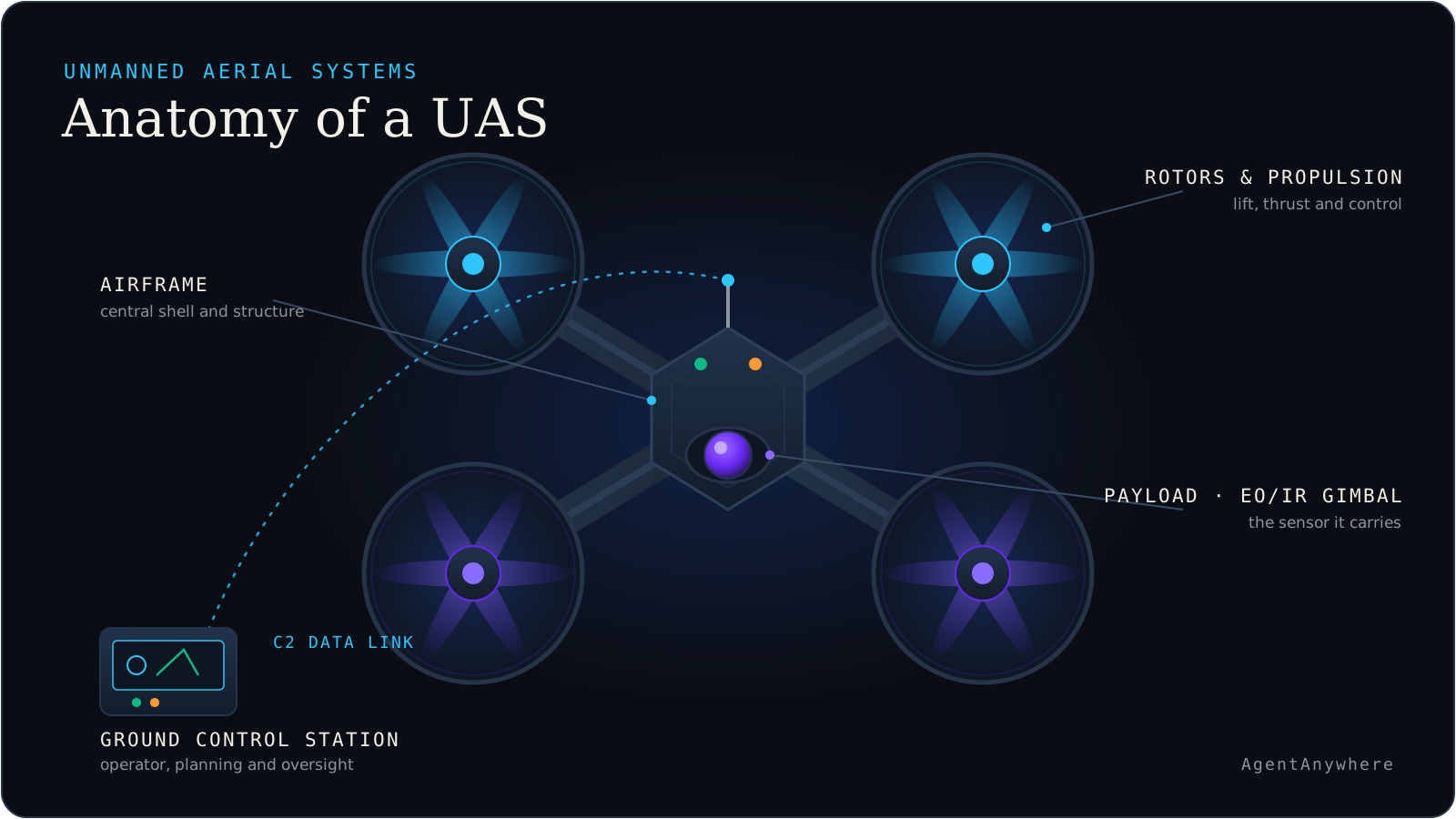
BVLOS means beyond visual line of sight. It describes flying a drone farther than the operator can see it, which is needed for long routes and large areas. It depends not only on the aircraft having enough range but also on a reliable command-and-control link, detect-and-avoid arrangements and regulatory permission, which varies by country.
Written by
AgentAnywhere Research
The team that builds the platform and the models
AgentAnywhere Research writes about the platform, the model families and the trust layer we build and run in India. Where a figure is ours, it says what it covers; where something is a demonstration, it says so.