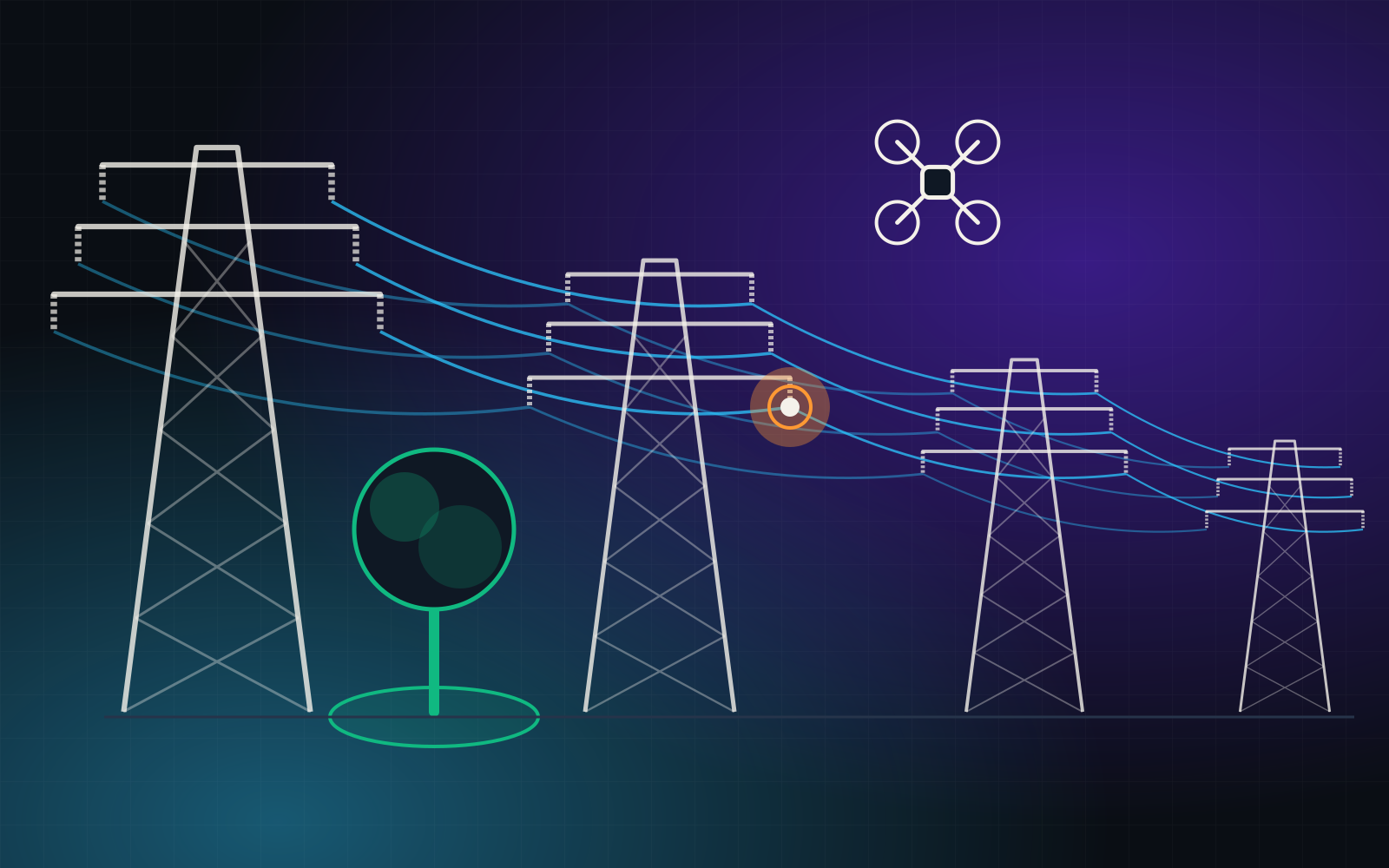

What is a wind turbine drone inspection?
It is a flight by a drone around a wind turbine, usually with the rotor stopped, to photograph each blade from root to tip on both sides. The pictures are then read, by a person or by software with a person checking, for damage and its position.
Blade. One of the turbine's long composite wings. A blade is among the largest composite structures made anywhere 2.
Leading edge. The front edge of the blade, the one that meets the air, the rain and the dust first.
Leading-edge erosion. Wear of that front edge. IEA Wind's research task on blade erosion names it the main factor substantially reducing both blade lifetime and energy output over time 1.
O&M. Operations and maintenance: the work of keeping a turbine running after it is built, from reading its alarms to sending a crew.
What can a drone find on a wind turbine blade?
One row per kind of damage that a research body we have read names. Each says whose source it is.
| The finding | What it looks like | Which camera shows it | Why it matters |
|---|---|---|---|
| The finding: Leading-edge erosion | Worn, pitted or stripped coating and material along the blade's front edge. | Colour | IEA Wind's blade-erosion task names it the main factor substantially reducing blade lifetime and energy output 1. Sandia's blade-reliability programme names wind-blown particulates as a cause of surface erosion 2. |
| The finding: Lightning damage | A scorched or broken area on the blade's surface. | Colour | Sandia's programme notes that lightning strikes can sometimes destroy blades, and counts lightning among the operational causes of premature blade failure 2. |
| The finding: A defect from manufacture, transport or installation | A flaw that shows on the surface. Much of this kind of damage does not show from outside. | Colour, where it shows on the surface | Sandia's programme traces many field failures back to the manufacturing floor and notes that blades can be damaged in transport and installation; it evaluates nondestructive inspection in both the factory and the field 2. |
The table says what an inspection looks for. It is not a list of what any product of ours finds; see “What this is not”.
Why is a wind turbine inspected from the air?
Because the part that wears is high up, long and hard to reach. Field repairs to blades are costly because of lost availability and difficult access and weather conditions 1, and every look that does not need a person on the blade saves a climb.
In India, the Central Electricity Authority's safety regulations require that any wind turbine worker exposed to a potential fall be supported by a certified fall arrest system, such as a full body safety harness 4.
There are many blades to look at. India had 59,201.07 megawatts of wind power installed as on 30 September 2026, by the Ministry of New and Renewable Energy's count 3.
We found no Indian rule that sets how often a turbine's blades must be inspected. We searched the Ministry's and the National Institute of Wind Energy's websites and read the Central Electricity Authority's safety regulations. Those regulations require wind energy generation systems to be as per relevant standards, and require the periodic inspection of electrical installations at intervals the government concerned directs, not exceeding five years 4.
What does a vision model have to see?
A model that is to help with this job is reading a long, curved surface from a camera that moves along it. Five things are hard.
Where on which blade. A finding is useful only with the turbine, the blade and the position from root to tip. The pictures have to be stitched back to the blade they came from.
Wear against dirt. Insects and dirt also collect on the leading edge. A mark that washes off is not erosion.
Small against large. An early pit is a small mark on a very long surface, photographed from a distance the drone can safely keep.
Light and angle. The same patch looks different in low sun, in shadow and from a different side.
What it cannot see. A camera sees the surface. Damage inside the laminate needs other methods, which is why nondestructive inspection is a field of its own 2. A model has to say what it could not see, not report it as sound.
How would a finding become a work order?
Finding the damage is half the job. The other half is deciding what to do about it, and that is where the AgentAnywhere platform comes in. An O&M workflow on the platform is designed to take five steps, with a person deciding.
1. An alarm starts a run. The turbine's own monitoring raises an alarm, and the alarm starts the workflow.
2. What bears on it is gathered. Agents bring together the turbine's recent readings and the latest drone findings for its blades.
3. A work order is drafted. A model drafts the order: what was found, where on which blade, and the suggested next step.
4. A named engineer approves. The run stops at an approval step. Nothing is sent to a crew until the engineer approves, changes or rejects the draft.
5. A record of the decision is kept. Who approved, when, and what the order said are kept with the run.
How steps, approvals and questions fit together in a workflow is in Orchestrating AI agents; what each run shows afterwards is in the observability post.
Where would this job sit in our stack?
With Drashta, and it is not a job Drashta does today. Drashta (द्रष्टा, “the seer”) is ShepHertz’s machine-vision family. Today it reads satellite imagery offline and finds objects of interest, such as aircraft and buildings, handing analysts structured findings to review.
The Drashta page lists vision for inspection under what comes next, and says we are looking for design partners for it. That is where wind turbine inspection stands with us: next, with a partner, and not built.
The shape would be the one Drashta has today. A model would hand a person structured findings, what it saw and where, and the person would check them and decide what they mean. For this job “where” means the turbine, the blade and the position from root to tip, and the person is the one who signs the report.
Reading the pictures on the drone itself, while it flies, is further off. The same page calls perception on the machine next, not now.
The other two families do different jobs. Tatva turns plain language into exactly one machine command, and Sanjaya is fleet and telemetry intelligence. Neither reads pictures.
What exists today, and what does not
What exists is a simulated demo of both halves of the job: a drone inspection of an invented turbine, and an O&M agent console that follows one alarm to a work order a named engineer approves.
In the console, the alarm, the readings, the weather and every word the agent writes are scripted for the demo; no model runs. Nothing in the demo was tested on a real turbine.
What does not exist is a trained model of ours that finds defects on a real blade, or one that writes a work order from a real turbine's readings. The steps around such a model are the platform's: an approval step that waits for a named person, and a record of each run.
The demo: a simulated inspection of an invented turbine
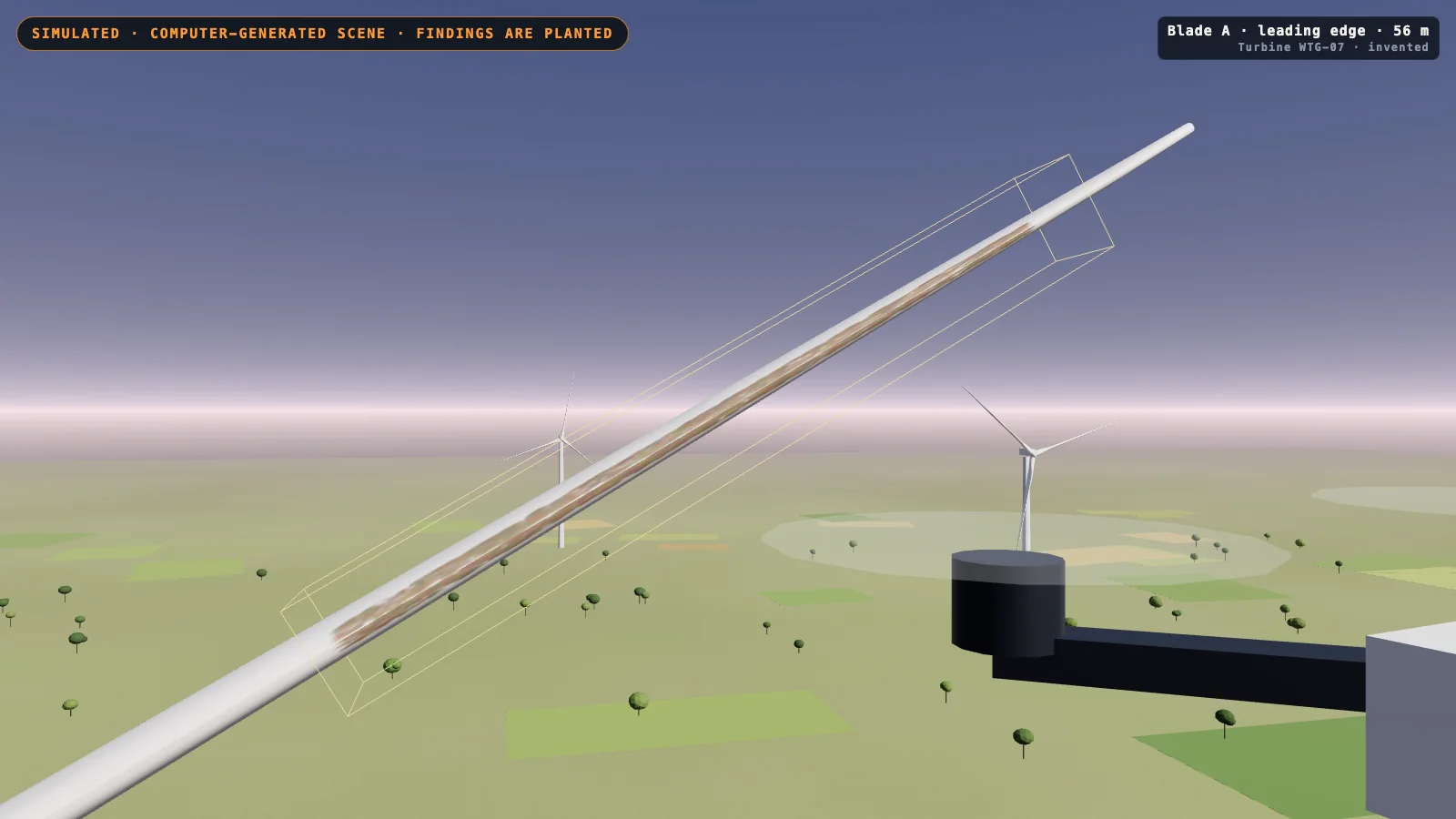
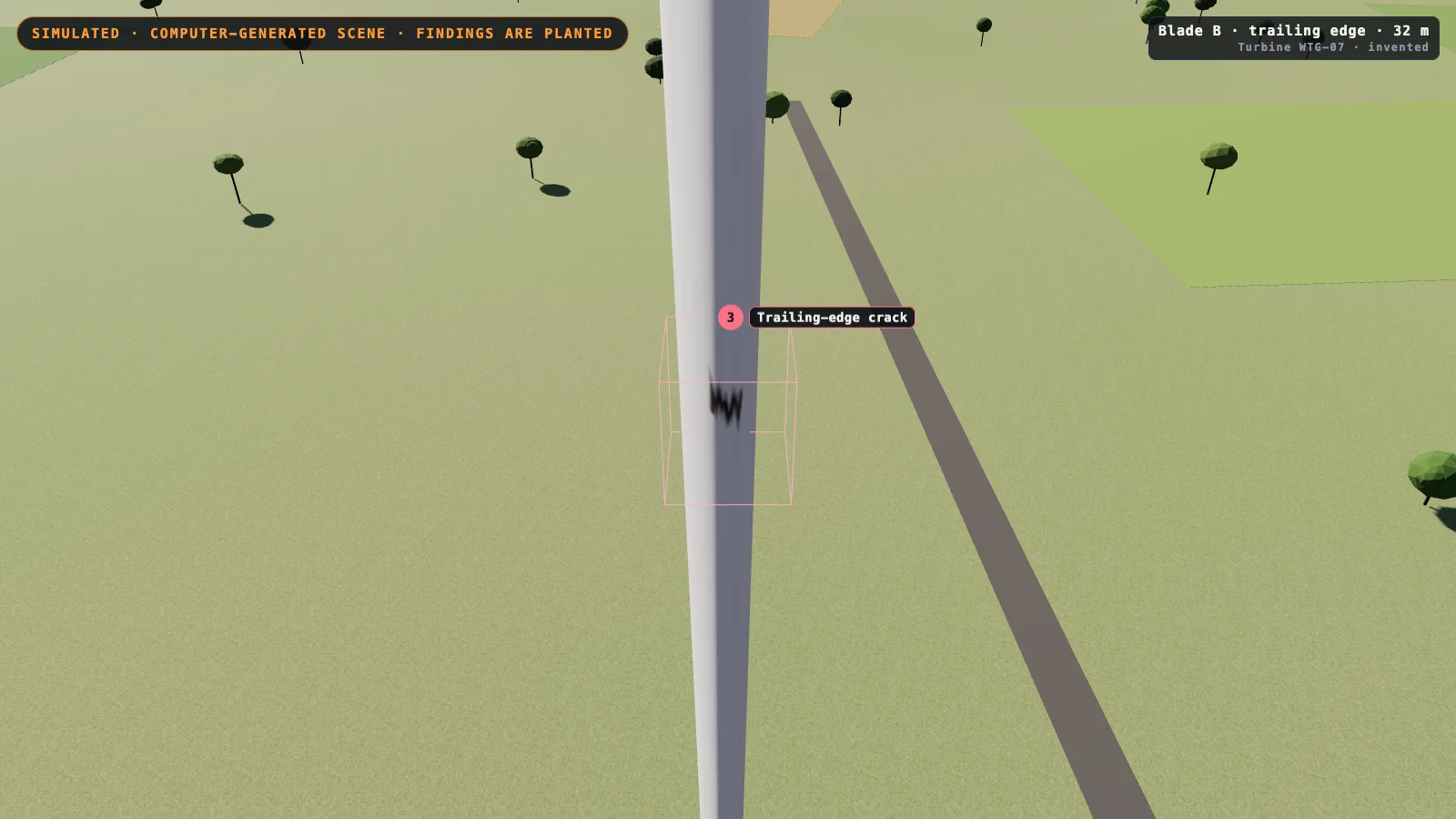
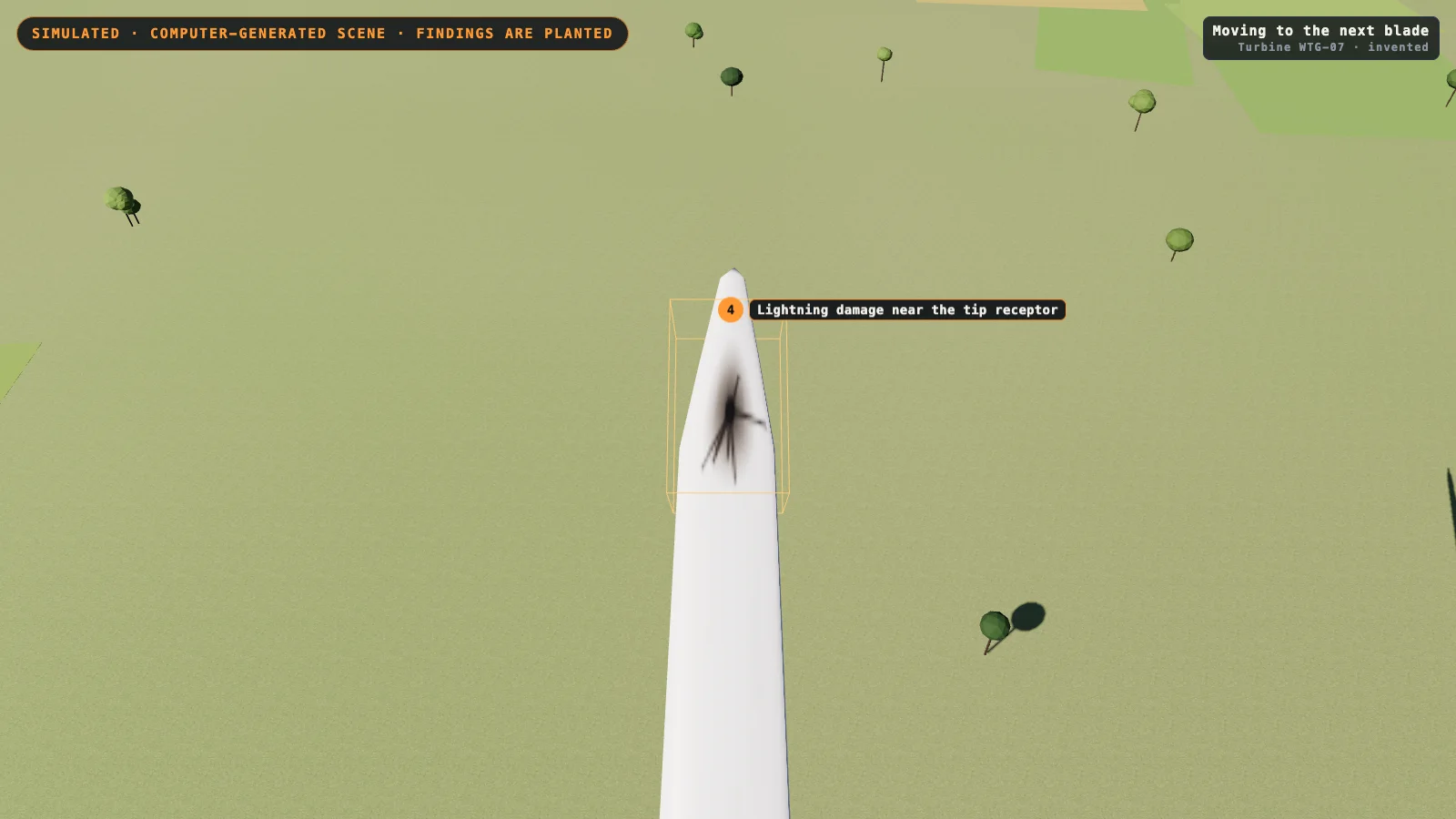
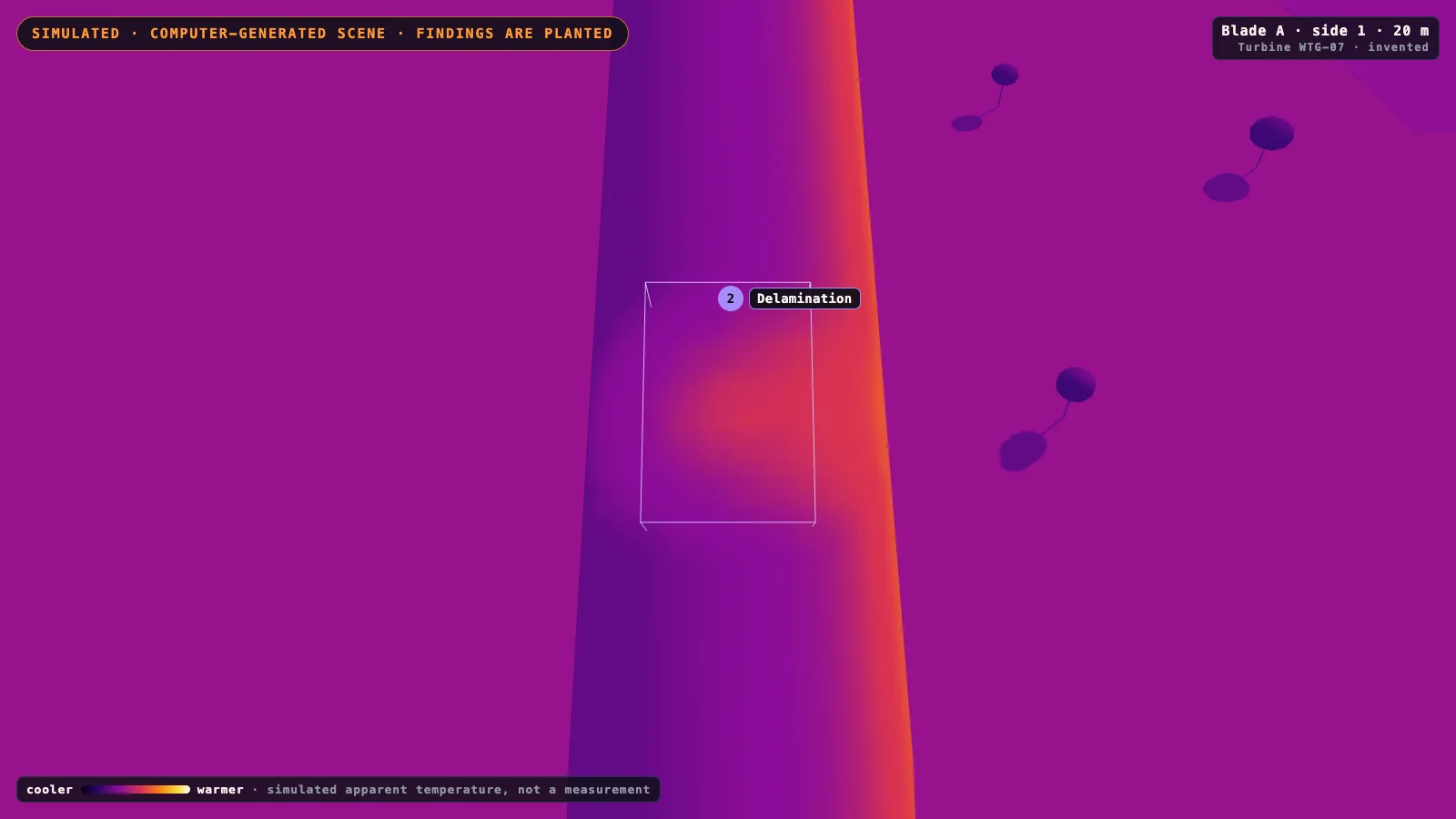
Simulated. The scene is computer-generated and the findings shown are the ones planted in it; no model produced them. The demo is something we show in a conversation; the pictures here are stills from it, and each carries the tag “SIMULATED” inside the picture.
The demo is a simulated drone inspection of an invented, generic three-blade wind turbine, with a rotor about 140 m across on a tubular tower. The rotor is stopped with the blades pitched, and one blade points straight down beside the tower.
The drone inspects each blade on four sides, the leading edge, both faces and the trailing edge, from root to tip, then the nacelle and the tower. As the drone goes, the page counts the blade sides covered (twelve in all), the blades done and whether the nacelle and tower are done.
Leading-edge erosion, cracks, lightning damage and delamination are among the defects blade inspections look for. The demo plants six findings, each with a place on the turbine and a severity: leading-edge erosion, a trailing-edge crack, lightning damage near the tip receptor, a delamination patch, an oil streak below the nacelle and corrosion at a tower flange.
Severity in the demo is its own three-step scale, low, medium and high; two of the six planted findings are high. Each finding is listed by component (blade A, B or C, tower top, tower), where on it (side and distance from the root, or height), and severity. The delamination patch shows more clearly in the thermal view than in the colour view.
The visitor can switch between a colour view, a thermal view and a split view, clear any planted finding or plant it again, and print a one-screen inspection sheet.
What does the O&M agent in the demo do?
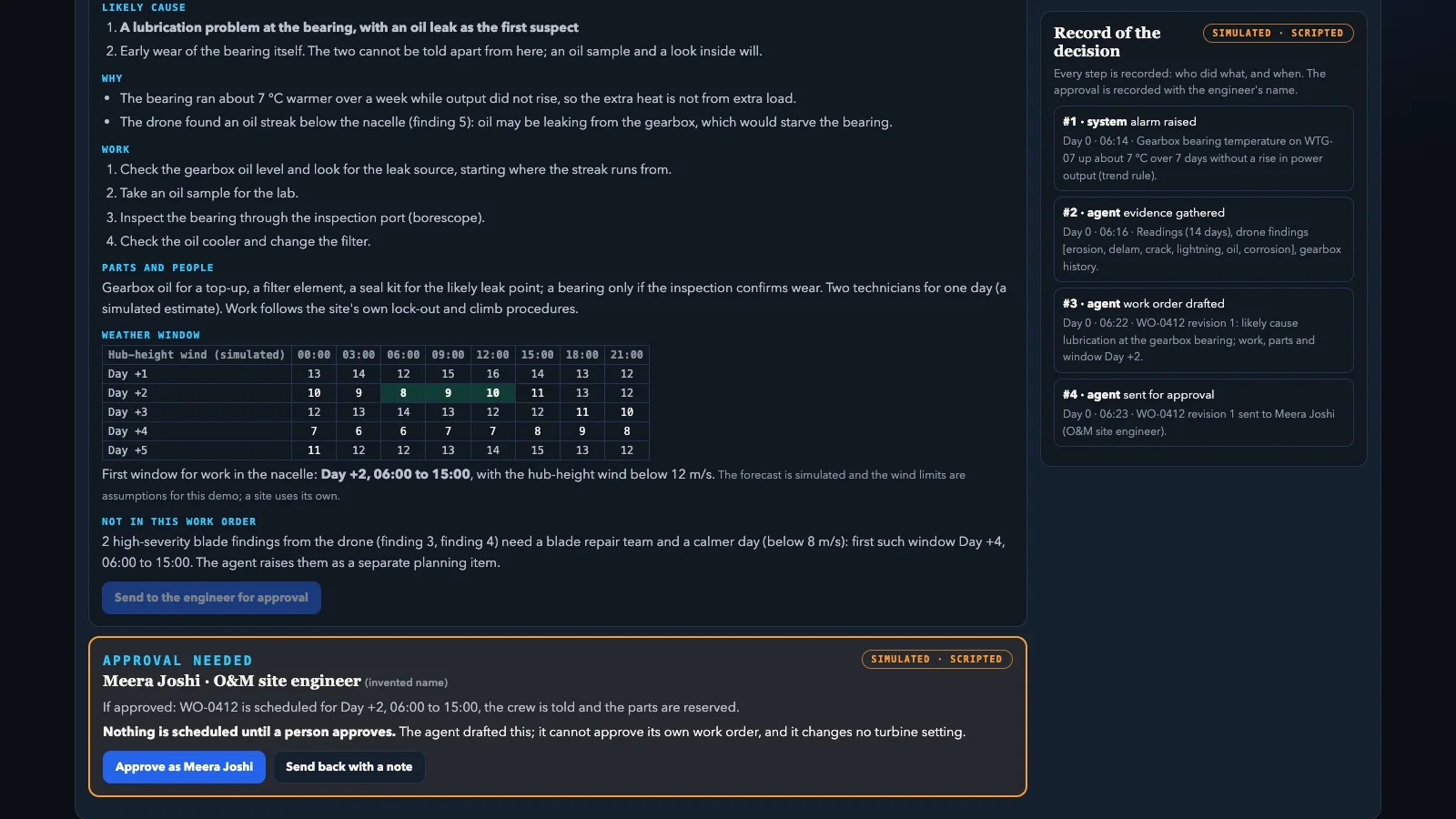
Below the 3D view, an O&M agent console follows one alarm through five steps: alarm, gather the evidence, draft a work order, approval, schedule. In the console, the alarm, the readings, the weather and every word the agent writes are scripted for the demo; no model runs.
The alarm is a gearbox bearing temperature trending up while the turbine's power output does not rise. A rising bearing temperature without a rise in output is a reason to look at lubrication and wear before the next scheduled visit.
The agent gathers the turbine's recent readings, the drone findings from the inspection above and the gearbox history, and shows each step it took. The drafted work order gives a likely cause and why, the work, the parts and people, and the first weather window for the job; blade repairs are raised as a separate item.
The draft is built from the drone findings that are planted at the time: clear the oil streak in the 3D view and the likely cause and its reasons change.
Nothing is scheduled until a named engineer approves; the engineer can approve or send the draft back with a note, and the agent cannot approve its own work order. A person approving a work order before it is scheduled keeps a named engineer responsible for what is done on the turbine.
Every step is recorded: who did what, and when; the approval is recorded with the engineer's name. The whole console runs in the visitor's browser and sends nothing anywhere.
What is simulated in the demo, and where does it stop?
The turbine is generic: no maker, model, logo or real site, and every name on the page, including the engineer's, is invented.
The thermal view is a simple model, ambient temperature plus sunlight plus planted heat, and it is not a measurement. The wind limits used for the weather window are assumptions for the demo; a real site uses its own.
The turbine and its findings are drawn larger and clearer than many real ones, so that they read on a screen. The demo shows a fast, idealised flight; it says nothing about flight time, battery, wind on the day, permissions, or how near a drone may fly to a blade.
The console follows one scripted case from one alarm; real O&M has many alarms, partial data and people to coordinate. The record in the demo is a plain list kept in the page for that visit; it is not stored anywhere.
Nothing in the demo was tested on a real turbine.
What rules apply to the flight in India?
The inspection is a flight, and in India a flight by a drone falls under the Drone Rules, 2021. The Ministry of Civil Aviation's release on those rules describes an airspace map on its Digital Sky platform with green, yellow and red zones 5.
No permission is required to operate a drone in a green zone, which the release defines as the airspace up to 400 feet, or 120 metres, that is not marked red or yellow, and up to 200 feet between 8 and 12 kilometres from the perimeter of an operational airport 5. A wind farm can sit near an airport or in a zone that is not green, so the map is the first thing to check for each site.
The same release says a type certificate is required when a drone is to be operated in India, with exemptions it lists; research bodies flying in a green zone on their own premises are among those it exempts from the type certificate and from the unique identification number 5.
That release is from 2021 and the rules have been amended since. Check the current rules and the map before any flight; this section is a description, not advice.
What this is not
It is not a trained model of ours. ShepHertz does not have a trained wind-turbine inspection model today: the demo on this page is computer-generated, the findings in it are the ones planted in the scene, and nothing has been run on a real turbine.
It is not what Drashta does today. Drashta is ShepHertz's machine-vision family. Today it finds aircraft and buildings in satellite imagery; inspecting wind turbines is not something it does yet.
It is not predictive maintenance. A drone flight records the state of the blades on the day it flies. It does not forecast when a blade will fail.
It is not an engineer. The workflow drafts a work order; a named engineer decides what is done.
It comes with no figure. We give no accuracy, speed, coverage or saving figure, because we have none to give for this work.
It is not a customer story. No turbine, wind farm, maker or operator is described here, and none has used our software for this.
Frequently asked questions
What is a wind turbine drone inspection?
A flight by a drone around a stopped wind turbine to photograph each blade from root to tip, so that damage can be found and placed on the blade without anyone climbing the tower.
What damage can a drone find on a wind turbine blade?
What shows on the surface: leading-edge erosion, which IEA Wind's blade-erosion task names as the main factor reducing blade lifetime and energy output 1; lightning damage; and defects from manufacture, transport or installation where they show from outside 2. Damage inside the laminate needs other inspection methods.
What is leading-edge erosion on a wind turbine blade?
Wear of the blade's front edge. IEA Wind's research task on blade erosion names it the main factor substantially reducing both blade lifetime and energy output over time, and notes that field repairs are costly because of lost availability and difficult access and weather 1.
Can lightning damage a wind turbine blade?
Yes. Sandia's blade-reliability programme notes that lightning strikes can sometimes destroy blades, and counts lightning among the operational causes of premature blade failure 2.
How often must wind turbines be inspected in India?
We found no Indian rule that sets how often a turbine's blades must be inspected. The Central Electricity Authority's safety regulations require wind energy generation systems to be as per relevant standards, require a certified fall arrest system for turbine workers exposed to a fall, and require periodic inspection of electrical installations at intervals the government concerned directs, not exceeding five years 4.
Is drone inspection the same as predictive maintenance?
No. A drone flight records the state of the blades on the day it flies. Predictive maintenance forecasts when a part will fail; a set of inspections over time can feed such work, but the flight itself does not forecast anything.
How does a blade finding become a work order?
On the AgentAnywhere platform, an O&M workflow is designed to start from a turbine alarm, gather the turbine's readings and the latest drone findings, draft a work order, and stop until a named engineer approves it. A record of the decision is kept with the run.
Does ShepHertz have a wind turbine inspection model?
No. ShepHertz does not have a trained wind-turbine inspection model today: the demo on this page is computer-generated, the findings in it are the ones planted in the scene, and nothing has been run on a real turbine.
Sources
Sources as read on 16 October 2026.
- 1DTU Wind and Energy Systems: IEA Wind TCP Task 46: Erosion of Wind Turbine Blades, project page.
- 2Sandia National Laboratories: Blade Reliability Collaborative.
- 3Ministry of New and Renewable Energy, Government of India: Physical Achievements, wind power, cumulative achievement as on 30.09.2026.
- 4Central Electricity Authority, Government of India: Central Electricity Authority (Measures relating to Safety and Electric Supply) Regulations, 2023, regulations 32 and 122, read in the gazette's English text.
- 5Press Information Bureau, Ministry of Civil Aviation, Government of India: Ministry of Civil Aviation notifies liberalised Drone Rules, 2021, 26 August 2021.
Written by
AgentAnywhere Research
The team that builds the platform and the models
AgentAnywhere Research writes about the platform, the model families and the trust layer we build and run in India. Where a figure is ours, it says what it covers; where something is a demonstration, it says so.