
How each type stays in the air
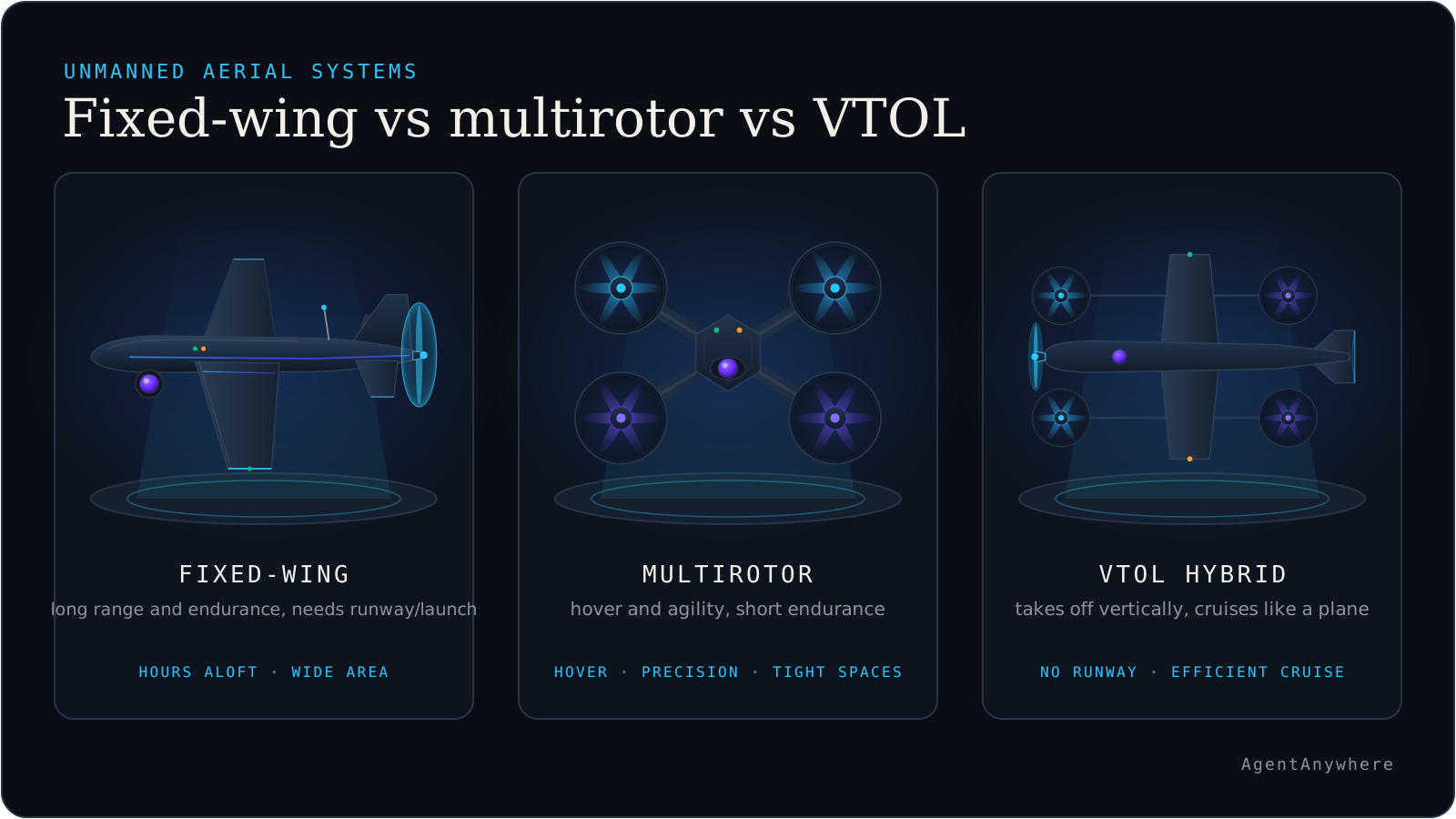
Fixed-wing drones lift with wings, multirotors lift with rotors, and VTOL hybrids use rotors to leave the ground and wings to travel.
A fixed-wing drone gets lift from air flowing over its wings. As long as it keeps moving forward fast enough, the wing generates lift with very little effort, which is why a glider can stay up for hours and why an aeroplane carries far more weight per unit of fuel than a helicopter. The motor only has to overcome drag, not lift the whole aircraft. The price is that the wing stops working if the aircraft stops, so it cannot hover, and it needs room to take off and land.
A multirotor gets lift directly from its rotors. A quadcopter has four, a hexacopter six, an octocopter eight, and the flight controller varies each rotor's speed to tilt, climb and turn. There are no moving control surfaces and few moving parts, which makes multirotors mechanically simple, cheap and forgiving to fly. But the rotors must push down on enough air to hold the whole aircraft up every second it is airborne, hovering included. That is an energy-hungry way to stay aloft.
A VTOL (vertical take-off and landing) hybrid uses both principles. Common layouts are the lift-plus-cruise quadplane, which has fixed wings and a separate pusher or tractor propeller for cruise plus vertical rotors for take-off and landing; the tilt-rotor, where the same rotors tilt from vertical to forward; and the tail-sitter, which takes off on its tail and tips forward into flight. Each is a way of getting vertical convenience without paying the full multirotor energy cost for the whole flight.
The three types side by side
Broad tendencies, not hard limits: individual aircraft vary widely. The ranges are general field facts for small and medium electric systems, not performance claims for any product.
| Property | Fixed-wing | Multirotor | VTOL hybrid |
|---|---|---|---|
| Property: Source of lift | Wings, while moving forward. | Spinning rotors, always. | Rotors for take-off and landing, wings for cruise. |
| Property: Take-off and landing | Runway, hand launch, catapult; landing by belly, net or parachute. | Vertical, from almost any small clearing. | Vertical, then transitions to forward flight. |
| Property: Hover | No. Must keep moving. | Yes. Holds a point for close inspection. | Yes in the VTOL phase, but inefficiently. |
| Property: Typical endurance (small electric) | Often one to several hours. | Often tens of minutes. | Often an hour or more, below a pure fixed-wing. |
| Property: Range and area coverage | Best of the three. Suited to long routes and large areas. | Limited by short flights. | Good, with some penalty for lift hardware. |
| Property: Mechanical complexity | Moderate. Few motors, control surfaces. | Low. Simple, many identical motors. | Highest. Both systems plus the transition. |
| Property: Typical jobs | Mapping large areas, pipelines, long surveillance runs. | Close inspection, filming, short surveys, deliveries. | Long routes from sites with no runway. |
Endurance depends heavily on battery or fuel, payload, wind and temperature. See the post on endurance, range and payload capacity.
The core trade-off: efficiency against flexibility
Everything in the table follows from one physical fact. Wings are efficient; rotors are flexible. Put it as a rule you can repeat: wings buy distance, rotors buy position, and VTOL buys a launch site. A wing makes lift almost for free once the aircraft is moving, so fixed-wing drones convert their energy into distance. Rotors can hold still, climb straight up and turn on a spot, but pay for it in every second of flight.
That is why a battery-powered multirotor typically stays up for tens of minutes while a similarly sized fixed-wing running on the same battery capacity can often stay up for hours. It is also why the two are used for different jobs. A multirotor is the tool for looking closely at one thing: a wind turbine blade, a roof, a bridge joint, an accident scene. A fixed-wing is the tool for looking at a lot of ground: a pipeline corridor, a farm, a forest, a coastline.
Wind matters differently too. A fixed-wing aircraft flies through the air at speed and tends to cope well with moderate wind, while a small, light multirotor has to fight it by tilting and spending extra power, which shortens its flight further. Larger multirotors are more resistant. As always, the specific aircraft decides.
Launch and recovery: where the real constraint often is
For many operators the deciding constraint is not performance in the air but where the aircraft can launch and land.
For many operators the question is not which aircraft is best in the air but which one can be flown from where they are. A multirotor needs a patch of clear ground. A fixed-wing drone needs more thought: small ones can be thrown by hand and landed on a belly or into a net, while larger ones use a launch rail or catapult and recover with a parachute, a net or a runway. These systems add equipment, space and training.
VTOL exists largely to remove that constraint. A hybrid that takes off and lands vertically lets a team operate from a clearing, a vessel deck or a remote site, then still cover long routes. The cost is that the aircraft carries rotors, motors and batteries that do nothing during cruise, so its payload, endurance and reliability margins are tighter than a purpose-built fixed-wing, and the transition between the two flight modes is the most delicate part of the flight.
How to choose, and where AI fits
A short checklist usually settles it. Do you need to hover and inspect up close? Multirotor. Do you need to cover a lot of ground, or fly far? Fixed-wing, or VTOL if you have no launch space. How much do you need to carry, and for how long? Check endurance against payload, since both come from the same energy budget, as explained in endurance, range and payload capacity. Who flies it and where? Launch, recovery and crew skill often decide the question before the aerodynamics do.
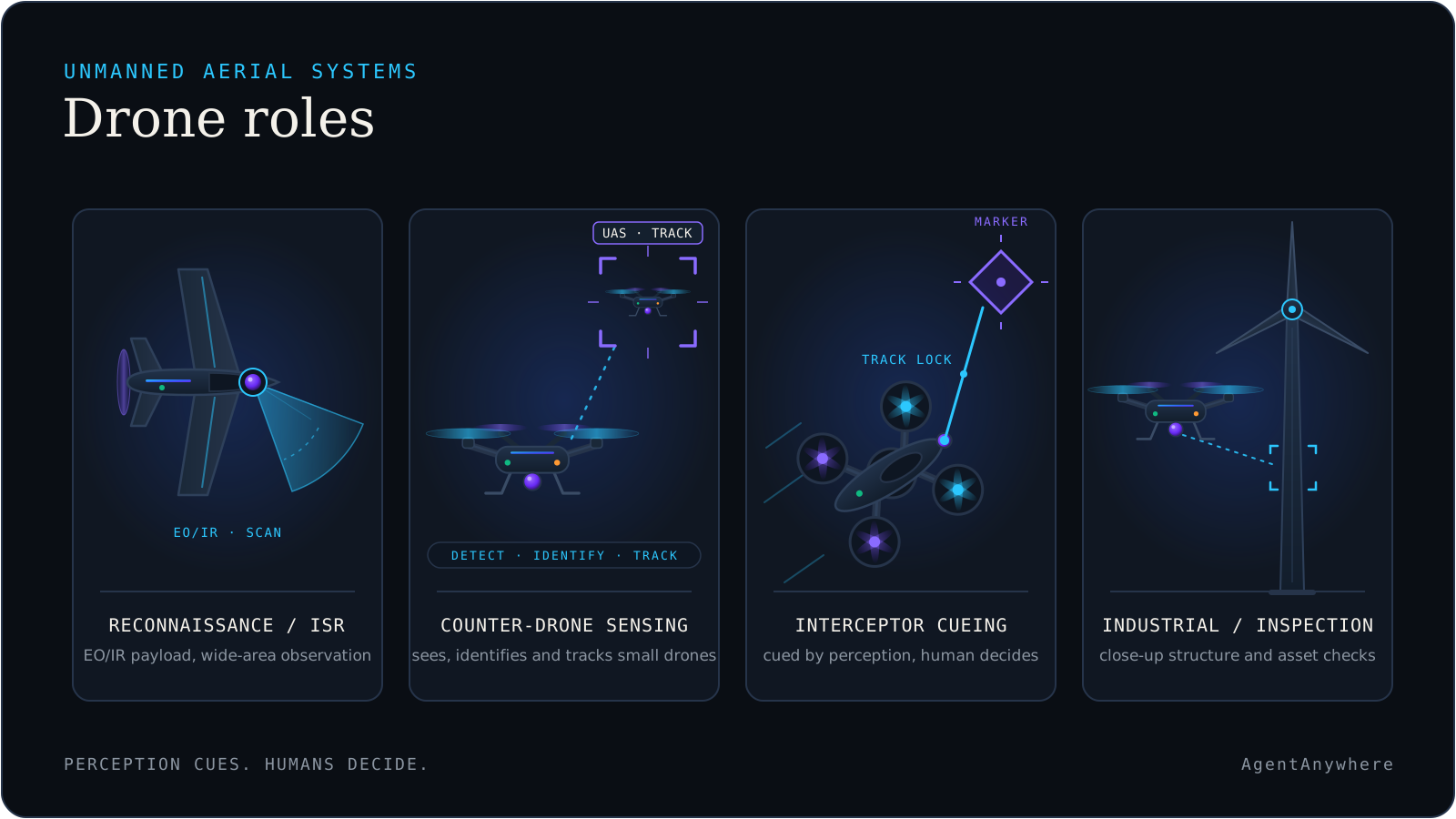
Airframe choice also shapes the AI. A hovering multirotor gives an operator time to look at one object, so on-device perception can help review a single structure in detail. A fixed-wing flying a long route produces a huge volume of imagery that nobody can watch live, so edge models that flag the few frames worth a human's attention are especially useful. In both cases AgentAnywhere's interest is perception that assists the operator, with a person in command; see the sensors those aircraft carry next. In inspection work the same split shows up: long corridors such as pipelines and power lines tend to favour wings, while close structure work such as wind turbines tends to favour multirotors. Our page on AI for drones and UAVs covers the perception side.
Common mistakes when choosing an airframe
Choosing on headline endurance. Quoted flight times assume a light payload and calm air, so check endurance against the sensor you actually need to carry and the wind you actually fly in.
Treating VTOL as the best of both. A hybrid is a compromise: the lift rotors are dead weight in cruise, so it carries less and flies a little less far than a purpose-built fixed-wing.
Leaving launch and recovery until after the purchase. If the aircraft cannot be launched and recovered where the work is, its endurance does not matter.
Matching the airframe to the wrong job. A multirotor on a long corridor spends its battery on getting there, and a fixed-wing cannot hover over a single joint or blade.
More in this series
What is an unmanned aerial system?: the aircraft, the control station, the link and the people: the whole system.
UAV vs UAS vs drone: what each word actually covers, and why the difference matters.
Types of military and industrial drones: the main categories by size and by job, described neutrally.
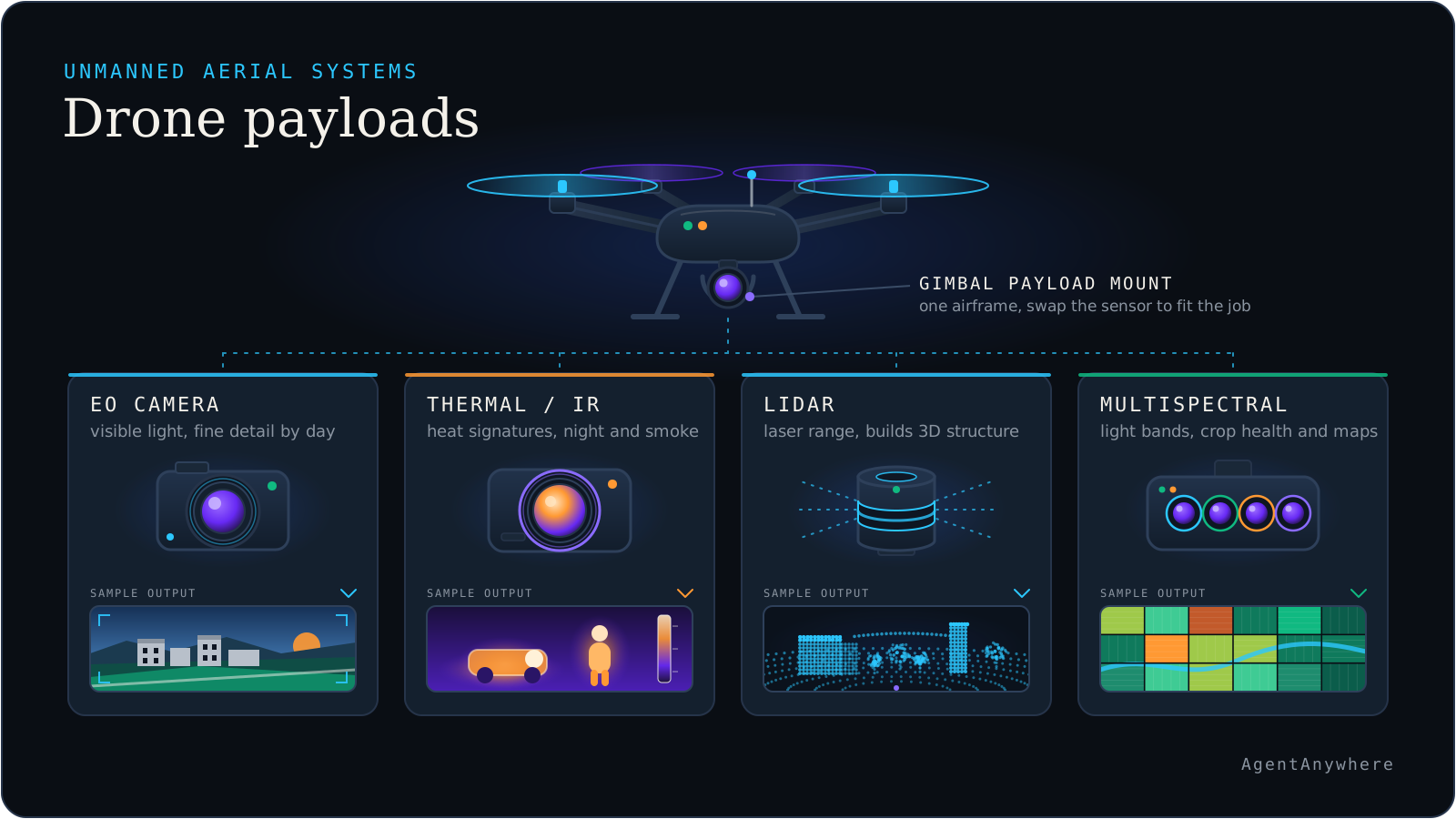
Drone payloads explained: EO, infrared, thermal and LiDAR: what each sensor sees and misses.
Endurance, range and payload capacity: the three numbers on every spec sheet, and why they pull against each other.
Frequently asked questions
What is the difference between a fixed-wing and a multirotor drone?
A fixed-wing drone gets lift from its wings while moving forward, so it is efficient, flies for long periods and covers large areas, but it cannot hover and needs a runway, launcher or recovery method. A multirotor gets lift from spinning rotors, so it takes off vertically and hovers, but it uses much more energy and typically flies for far shorter periods.
What does VTOL mean for drones?
VTOL stands for vertical take-off and landing. A VTOL drone takes off and lands vertically using rotors, then transitions to wing-borne forward flight for efficient cruising. Common designs are the quadplane with separate lift rotors and a cruise propeller, the tilt-rotor, and the tail-sitter. It combines runway-free operation with long endurance, at the cost of weight and complexity.
Which is better, fixed-wing or multirotor?
Neither is better in general; they suit different jobs. Multirotors are better for hovering, close inspection and operating from small spaces. Fixed-wing aircraft are better for covering large areas and flying long distances efficiently. The right choice depends on whether the task needs hovering or range, and on where the aircraft can be launched and recovered.
Why do multirotor drones have short flight times?
Because their rotors must push air downward to support the whole weight of the aircraft at every moment, including while hovering. That is an energy-intensive way to stay airborne, whereas a wing generates lift efficiently when the aircraft moves forward. As a result, small battery-powered multirotors commonly fly for tens of minutes, while comparable fixed-wing aircraft often fly for hours.
Why choose a VTOL hybrid drone?
A VTOL hybrid is chosen when an operator needs the range and endurance of a fixed-wing aircraft but has no runway or space for a launcher. It lifts off and lands vertically on rotors and cruises efficiently on its wings. The trade-off is extra weight and mechanical complexity, because the lift rotors are dead weight during cruise.
Written by
AgentAnywhere Research
The team that builds the platform and the models
AgentAnywhere Research writes about the platform, the model families and the trust layer we build and run in India. Where a figure is ours, it says what it covers; where something is a demonstration, it says so.