
Drone: the everyday word, and why it is slippery
Drone is the word almost everyone uses, and it is not a technical term. In aviation history it was used for pilotless target aircraft, and it later became shorthand for any remotely flown or automated aircraft. It also carries baggage: in some contexts it is associated with military use, and in others it simply means a consumer quadcopter.
The word is also stretched beyond aircraft. People say underwater drone, ground drone or delivery drone for vehicles that do not fly at all, and use it for machines that are not unmanned in any strict sense. Because it is so broad, drone is fine in speech and marketing but a weak choice in a contract, a regulation or a safety document, where you need to say exactly what is covered.
UAV and UAS: the aircraft versus the system
UAV stands for unmanned aerial vehicle. It names the flying machine itself: airframe, propulsion, flight controller and onboard electronics. It is a thing you can hold or load onto a truck. A closely related term, unmanned aircraft (UA), is the formal version favoured in aviation regulation, since the machine is legally an aircraft.
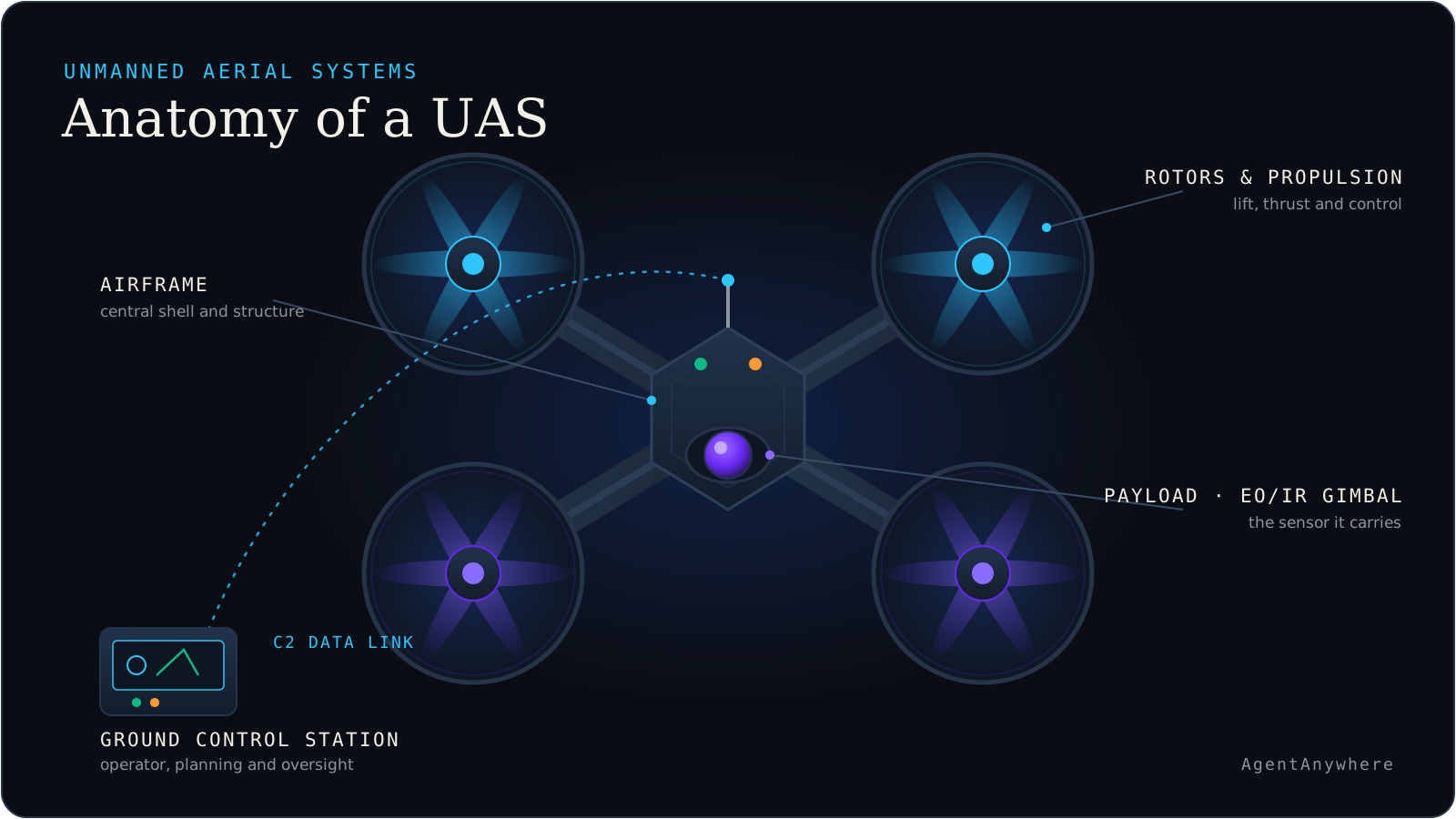
UAS stands for unmanned aerial system or unmanned aircraft system. It deliberately widens the frame to include the control station, the command-and-control link, the payload, any launch and recovery equipment, and the people and procedures. The widening is not pedantry. A pilotless aircraft is only as safe as the link that commands it, the station that shows its state and the operator who supervises it, so safety rules and certification have to cover all of them together.
That is why you will usually see UAS in regulation, defence and public-safety procurement, and in safety assessments, while UAV tends to appear in technical specifications of the aircraft alone. If you are buying or approving a capability, you are almost always buying a UAS, not a UAV.
The terms side by side
Each word draws the boundary in a slightly different place. This table sorts the common ones.
| Term | What it refers to | Includes the control station, link and people? | Where you usually see it |
|---|---|---|---|
| Term: Drone | Casual word for an unmanned aircraft; sometimes any unmanned vehicle. | No, not by default. | News, consumer products, everyday speech. |
| Term: UAV | Unmanned aerial vehicle: the pilotless aircraft itself. | No. | Aircraft specifications, technical and academic writing. |
| Term: UA | Unmanned aircraft: the formal regulatory name for the aircraft. | No. | Aviation regulation and standards. |
| Term: UAS | Unmanned aerial or aircraft system: aircraft plus the rest of the system. | Yes. | Regulation, safety cases, defence and public-safety procurement. |
| Term: RPAS | Remotely piloted aircraft system: a UAS with a remote pilot in the loop. | Yes, and it stresses the remote pilot. | International civil aviation documents and some national rules. |
| Term: sUAS | Small UAS: a UAS under a regulator's small-aircraft weight limit. | Yes. | Regulations that set rules for small systems, such as those in the United States. |
Usage varies by country and by regulator. Where a rule matters, read the definition the regulator itself uses.
The boundary test
Drone describes the aircraft. UAS describes the capability. When you meet any of the four words, ask where it draws its boundary. Drone and UAV stop at the airframe. UAS and RPAS keep going: the control station, the data link, the payload and the people.
That one question settles most arguments about terminology, and it tells you what a sentence is really about. A claim about a drone's weight or endurance is a claim about a UAV. A claim about whether it can be approved, operated or certified is a claim about a UAS.
Why the distinction matters in practice
The distinction matters because rules, tenders and safety cases attach to the system, not to the airframe.
Regulation. Aviation rules attach to the system and its operator, not just the aircraft. Registration, remote pilot competence, permitted airspace and operating conditions all depend on how the whole system is configured and used. Regulators also classify by size: many national rules sort aircraft into weight classes, such as nano, micro, small, medium and large, with obligations that grow with weight and risk. India's Drone Rules, 2021, for example, use five such classes. Always check the current rule for the country you fly in, because definitions and limits change.
Procurement and safety. A tender for a drone invites a debate about airframes. A tender for a UAS invites the right questions: how does the link behave when it degrades, what does the operator see, how is the aircraft recovered, who trains the crew, what happens in a failure? The answers decide whether a capability works in the field, and none of them is in the airframe specification.
AI and software scope. Software lives in different places in the system. A flight controller runs inside the aircraft. A perception model might run on the aircraft's companion computer or on the ground station. Naming the UAS, not just the UAV, makes it clear where a model runs, what it can see and who sees its output, which is the first question to ask of any claim about AI on a drone.
Common mistakes with drone terminology
Using drone in a contract. Drone has no formal definition, so a tender that says drone leaves the link, the station and the crew unspecified.
Calling a UAV a system. If a statement says nothing about the link, the control station or the operator, it describes the aircraft only.
Assuming sUAS has one weight limit everywhere. The small-aircraft threshold depends on the country's rules, so check the regulator's own definition.
Reading RPAS as a synonym for autonomous. RPAS stresses a remote pilot in the loop, while UAS also covers highly automated operations.
Which word should you use?
A simple rule works well. In conversation or general writing, drone is fine. Everyone understands it. When you mean the aircraft specifically, such as its weight, endurance or airframe type, use UAV. When you mean the capability, such as what is bought, approved, operated or certified, use UAS. In a regulatory or international context, use whatever term that document uses, including RPAS.
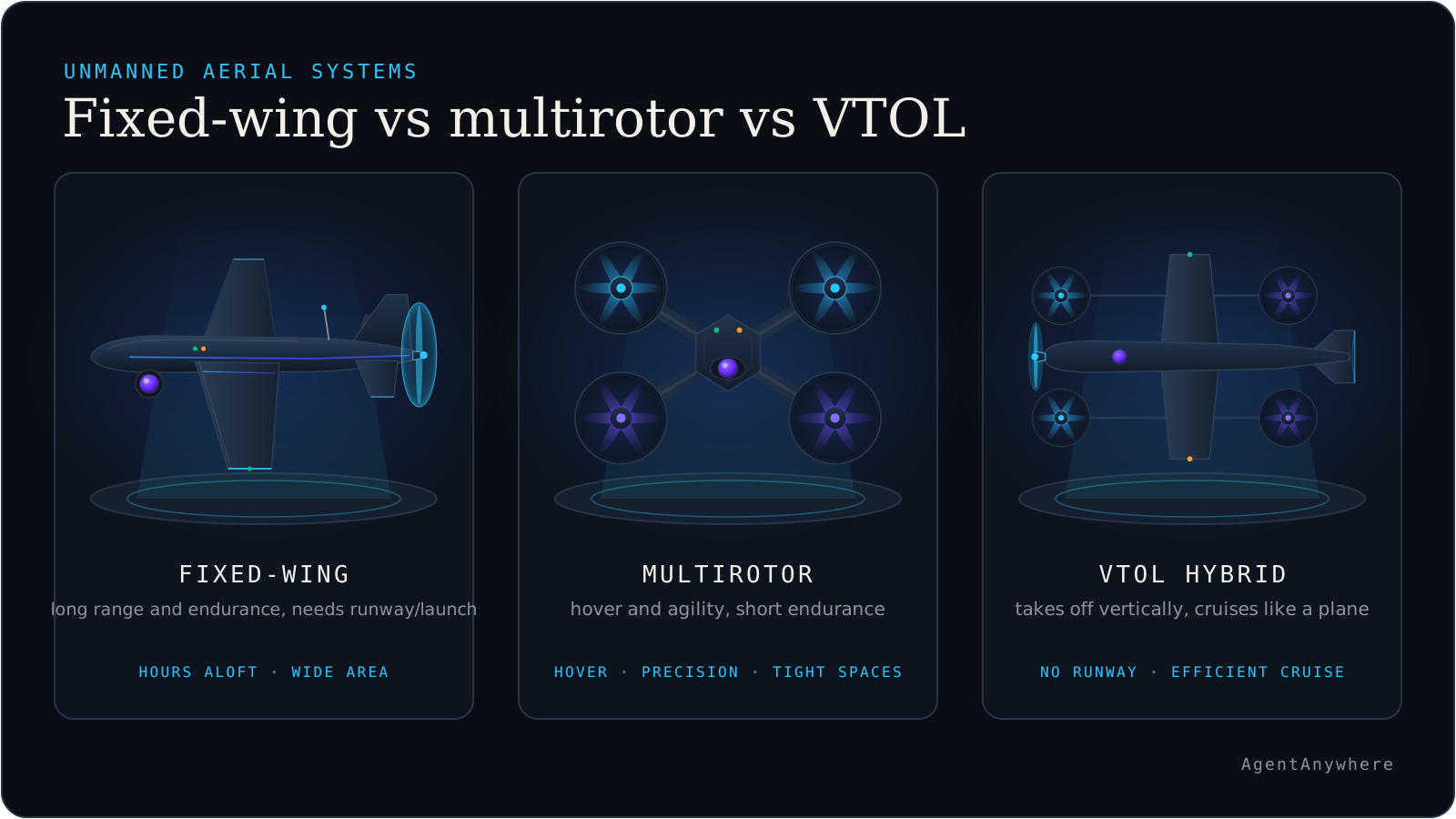
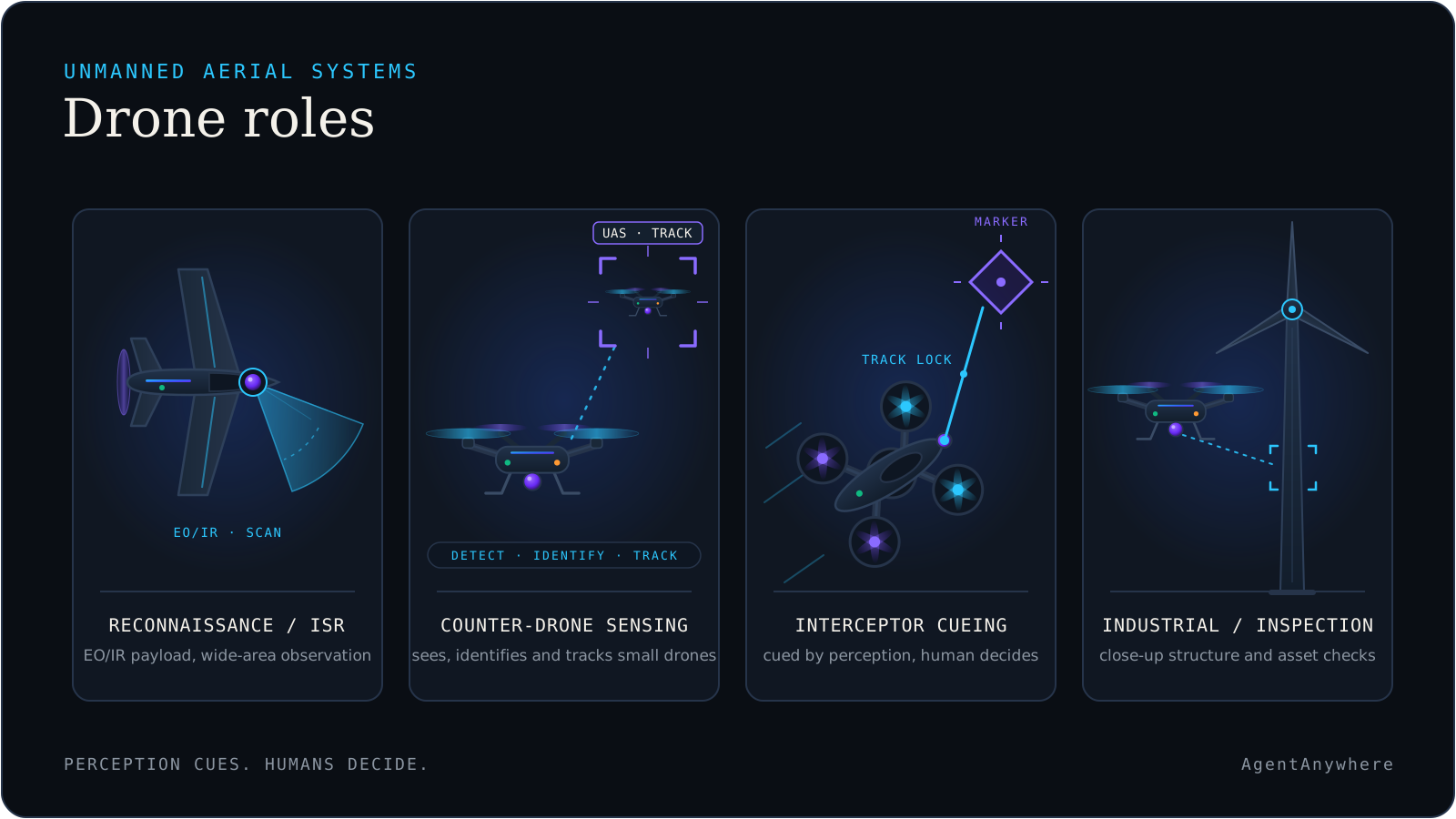
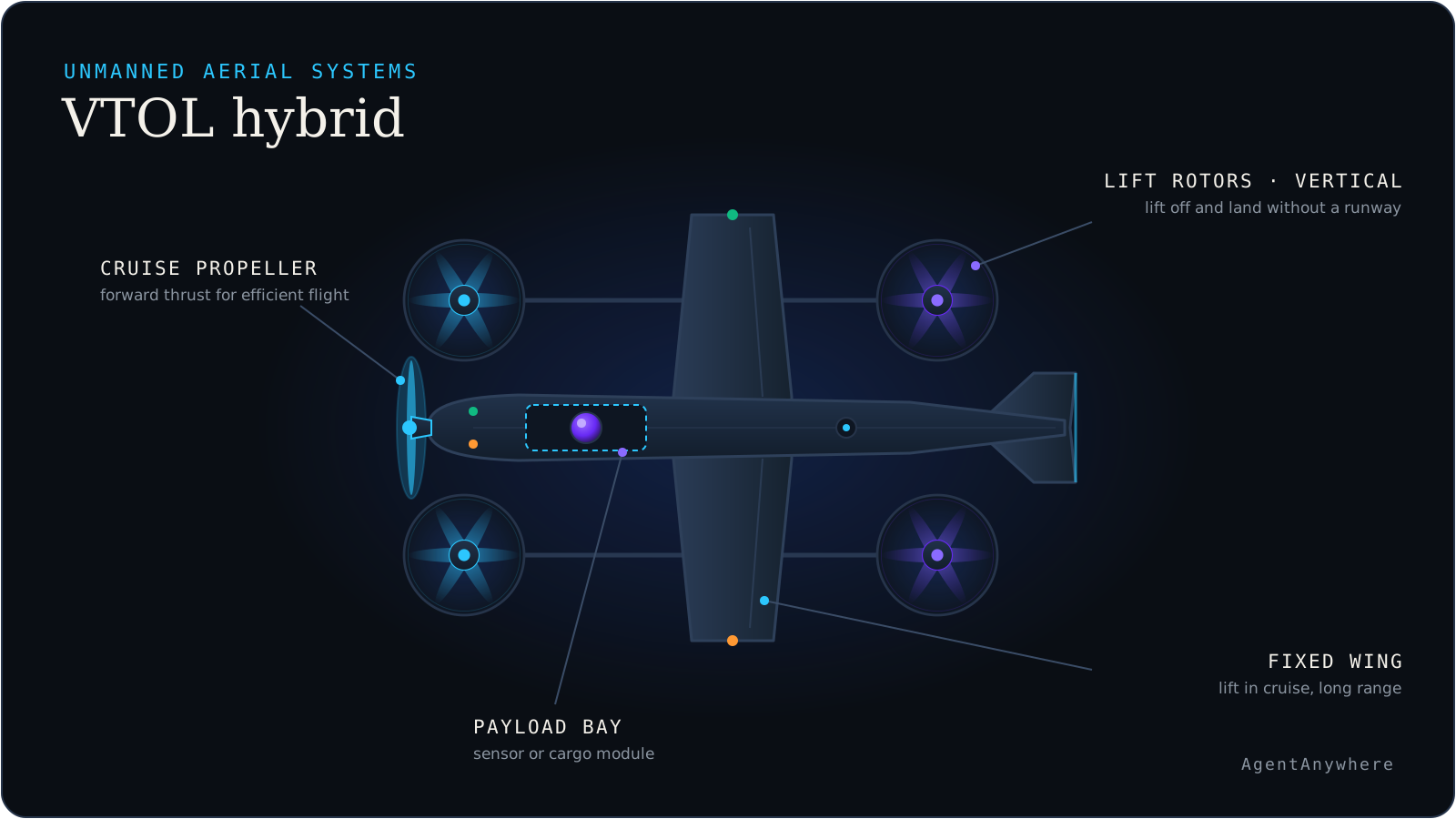
It also helps to ask what is being left out. If a statement about a drone says nothing about the link, the control station or the operator, it is describing a UAV and calling it a system. The next two posts go deeper on the aircraft side: fixed-wing vs multirotor vs VTOL and the main types of military and industrial drones. For how on-device perception fits into a UAS, see our page on AI for drones and UAVs.
More in this series
What is an unmanned aerial system?: the aircraft, the control station, the link and the people: the whole system.
Fixed-wing vs multirotor vs VTOL: three ways to stay in the air, and what each one trades away.
Types of military and industrial drones: the main categories by size and by job, described neutrally.
Drone payloads explained: EO, infrared, thermal and LiDAR: what each sensor sees and misses.
Endurance, range and payload capacity: the three numbers on every spec sheet, and why they pull against each other.
Frequently asked questions
What is the difference between a UAV and a UAS?
A UAV, or unmanned aerial vehicle, is the pilotless aircraft itself. A UAS, or unmanned aerial system, is the whole system: the aircraft plus the control station, the command-and-control data link, the payload, any launch and recovery equipment, and the people and procedures that operate it. Regulations and procurement use UAS because safety depends on all of it.
Is a drone the same as a UAV?
In everyday use, yes. Drone is the casual word for an unmanned aircraft and UAV is the more technical name for the aircraft. Drone is looser: it is sometimes stretched to cover unmanned boats, underwater vehicles and ground vehicles, and it has no formal regulatory definition, so contracts and rules prefer UAV, unmanned aircraft or UAS.
What does RPAS stand for?
RPAS stands for remotely piloted aircraft system. It is a term used by international civil aviation bodies and some national rules for a UAS in which a remote pilot is in the loop and responsible for the flight. It emphasises the pilot, whereas the broader term UAS also covers highly automated operations.
What does sUAS mean?
sUAS means small unmanned aircraft system. It refers to a UAS whose aircraft is below a regulator's small-aircraft weight threshold, and it appears mainly in regulations that set a separate and lighter rulebook for small systems. The exact weight limit depends on the country's rules.
Why do regulators use UAS rather than drone?
Because safety and legal responsibility depend on the whole chain, not just the airframe. Using UAS makes the control station, the data link, the payload and the operator part of what is regulated, certified or procured. Drone is a casual word with no precise definition, which makes it a poor basis for a rule or a contract.
Written by
AgentAnywhere Research
The team that builds the platform and the models
AgentAnywhere Research writes about the platform, the model families and the trust layer we build and run in India. Where a figure is ours, it says what it covers; where something is a demonstration, it says so.