
What is a counter-UAS (C-UAS) system?
A counter-UAS system is the set of sensors, software and procedures used to detect uncrewed aircraft near a protected area, work out what they are and whether they are a threat, and give an authorised operator what they need to respond. UAS stands for uncrewed aircraft system, the drone plus its controller and links; the small, cheap, widely available ones are often written sUAS. Counter-UAS is also written C-UAS or, loosely, counter-drone.
Every C-UAS system is built from the same functional chain: detect, identify, track, classify, decide, and respond. It is useful to draw a clear line through the middle of that chain. Everything up to and including the decision is about building an accurate, trusted picture and handing it to a person. The response, from a warning and a geofence to the physical mitigation options a government may authorise, is a separate half governed by law, rules of engagement and human authority.
That line is where AgentAnywhere sits. We work on the sense-and-decide half: the perception and decision-support layer that turns raw sensor returns into an identified, tracked, classified contact and cues a human in time to act. We do not build effectors, we are not in a fire-control path, and we make no engagement decision. Naming the line plainly is the point: a counter-drone capability is far more than its response, and the part that most often fails is the seeing.
Why small drones are so hard to detect
The uncomfortable truth of counter-drone work is that detection, not response, is the bottleneck. A small multirotor is a hard target for three compounding reasons, usually summarised as small, slow and low.
Small means a tiny radar cross-section. Air-defence radar was tuned over decades to find aircraft and missiles, objects orders of magnitude larger and faster. A plastic-and-carbon quadcopter reflects very little energy, so its return sits down near the noise floor where a fixed detection threshold either misses it or, if lowered, floods the operator with false alarms. This is why radar struggles with small drones: the physics that makes a fighter easy makes a hobby drone nearly invisible.
Slow and low make it worse. A drone hovering or creeping along at rooftop height moves like the background, not against it, so the Doppler and motion cues that help a radar separate a real target from clutter barely apply. Down low, the sky is full of competing returns from terrain, buildings, vehicles and weather, and, most awkwardly, from birds. A bird and a small drone can occupy the same patch of sky at the same speed and size, which is why telling the two apart is one of the signature problems of the field. Learned classifiers lean on the one stable difference, the micro-Doppler signature of spinning rotor blades, which a bird's wingbeat does not produce. For a deeper treatment of the detection physics, see detecting low-observable and low-flying targets and why radar sees clutter, noise and false targets.
Drone detection technologies: radar vs RF vs EO/IR vs acoustic
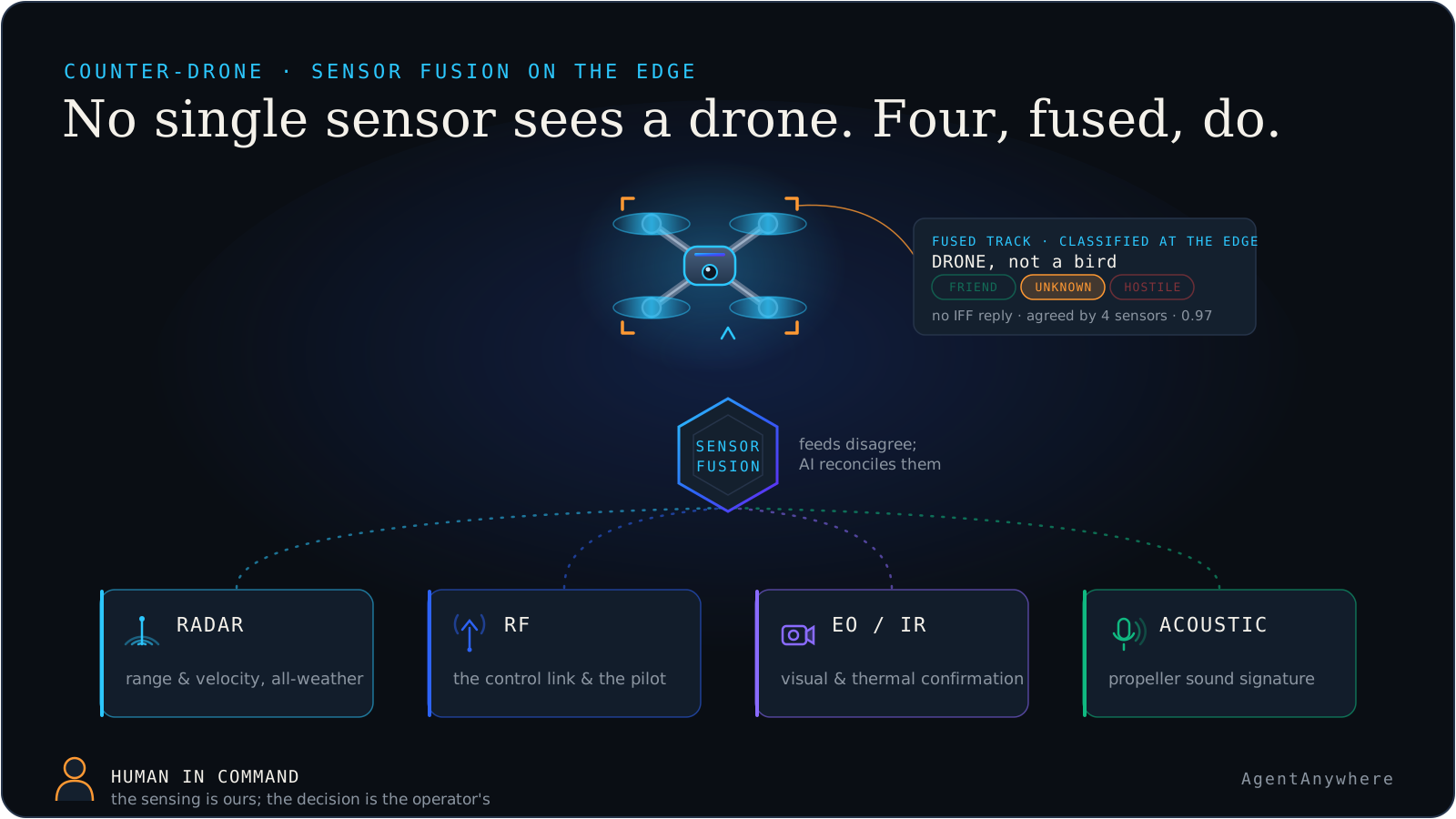
No single sensor detects every drone in every condition. Each sees a different slice of the problem, and each has a way it can be defeated. This is why modern counter-drone systems fuse several, and why the AI that reconciles them matters as much as the sensors themselves.
| Sensor | How it detects a drone | Strengths | Limits |
|---|---|---|---|
| Sensor: Radar | Transmits a pulse and reads the reflection for range, bearing and speed; micro-Doppler can reveal spinning rotors. | All-weather, day or night; gives precise position and velocity; works against non-emitting drones. | Small, slow, low drones give a tiny return in heavy clutter; confuses with birds without learned classification. |
| Sensor: RF (radio-frequency) | Listens for the control and video links between the drone and its operator and fingerprints the signal. | Can detect and sometimes locate both drone and pilot; often cues other sensors early and cheaply. | Blind to autonomous or pre-programmed drones that transmit nothing, and to fibre-tethered drones; crowded RF confuses it. |
| Sensor: EO/IR (camera) | Electro-optical and infrared cameras see the drone visually and by heat, for identification and confirmation. | Confirms what a radar or RF cue found; reads payload and intent; infrared works at night. | Narrow field of view, so it needs cueing; degraded by fog, rain, glare and smoke; short effective range. |
| Sensor: Acoustic | Microphone arrays recognise the distinctive sound signature of drone propellers and motors. | Passive and cheap; can catch low, close drones that other sensors miss; no emissions of its own. | Short range; defeated by ambient noise and wind; weak against quiet or fast-moving drones. |
The practical answer to 'which sensor is best for detecting drones' is 'more than one, fused'. The comparison above is a field reference, not a product specification.
Sense and decide: the counter-drone decision pipeline
This is the pipeline shown in the figure above, and the honest boundary of what AgentAnywhere builds. Each step turns raw sensor data into a little more certainty, so that the person who finally decides is acting on an identified, tracked, classified contact rather than a blip.
1 · Detect
Pull a real contact out of the noise. Learned detectors separate a faint drone return from ground, sea and weather clutter, catching the small and low without drowning the operator in false alarms.
2 · Identify
Decide it is a drone and not a bird, an airliner or a scrap of clutter. Micro-Doppler from spinning rotors and cross-sensor agreement are what make this call reliable.
3 · Track
Hold the contact's identity as a single path through crossings, manoeuvres and short sensor dropouts, instead of losing it and re-acquiring it as a brand-new unknown.
4 · Classify
Propose the type and size of the airframe, with a stated confidence and the reasons behind it, so the picture can be inspected rather than trusted blindly.
5 · Cue the operator
Alert a human with the full picture: what it is, where it is going, how sure the system is, and why. The response, and every consequential call, stays with the operator.
Why counter-drone AI belongs at the edge, and in-country
A counter-drone classifier that lives in the cloud has a fatal flaw: the drone threats that matter most arrive precisely when the network cannot be trusted. Jamming, a cut backhaul, a spoofed GPS signal, a contested or remote site with no reliable link, these are the normal conditions of the job, not the exceptions. If the AI stops working when the link drops, it is not a counter-drone capability, it is a demo.
So serious systems run the model at the edge, on the sensor site itself, where detection, tracking and classification continue when the link is gone. Running locally also answers the question every government and critical-infrastructure operator eventually asks: where does the sensor data go. When the perception runs in-country on hardware the operator owns, the air picture never leaves the site, so there is nothing to intercept and nothing to export. For why this matters beyond drones, see the pillar on AI in radar and air surveillance and how radar, IFF and EO/IR are fused into one trusted track.
This is the same argument India has already won one layer down, for its identity and payment rails, applied to the AI that watches its skies. Sovereign counter-drone perception means the model, the tuning, the serving and the data all stay in the country, under the operator's control, independent of any foreign service that could change its terms or its access overnight.
The bright line: detection and decision support, not weapons
Counter-drone is a field where being precise about what you do, and do not, build is a matter of responsibility, not marketing. So here is the line, stated plainly. AgentAnywhere builds the sense-and-decide layer: perception and decision support, human-in-command. We detect, identify, track, classify and cue. We are not a weapons vendor. We do not build effectors or mitigation hardware, we are not in a targeting or fire-control path, and we make no engagement decision. The physical response half of C-UAS is governed by law, by rules of engagement, and by human authority, and it stays there.
Two principles hold across everything we do here. First, a human stays in command: the AI recommends with its reasons, a person decides. Second, the system must be auditable: every classification and every cue should carry its confidence and a tamper-evident record, so a decision can be reconstructed and defended afterwards. An air-defence or security operator cannot act on a verdict they cannot inspect, and should never be asked to.
That discipline is not a limit on usefulness. It is what makes the capability trustworthy enough to field. The value of counter-drone AI is giving a small sovereign team the reach of a large one, resilient when contested, honest about its own confidence, and answerable after the fact.
Where AgentAnywhere fits: sovereign edge AI for counter-drone sensing
AgentAnywhere builds Sanjaya, a sovereign edge-AI family for telemetry, anomaly detection and prediction, the kind of model that scores a live sensor feed, flags the contact that does not belong, and holds a track through the moments a simple detector would lose it. It is designed to run inside your perimeter on hardware you own, with the data staying local, the properties counter-drone work actually needs when the network is the first thing an adversary attacks.
Around the model sits the AgentAnywhere trust layer, so every classification and cue carries a signed, inspectable record, and a commander or operator approves every consequential step. The posture is deliberate and unchanging: decision support and ISR, observe-and-assist, with no targeting and no weapon release in the loop.
If you are evaluating sovereign AI for counter-drone sensing, airspace monitoring or critical-infrastructure protection, you can read the honest status of every model family on the sovereign model portfolio, see the deployment scenarios on the use-cases page, and start from the basics with what an uncrewed aircraft system is.
More in this series
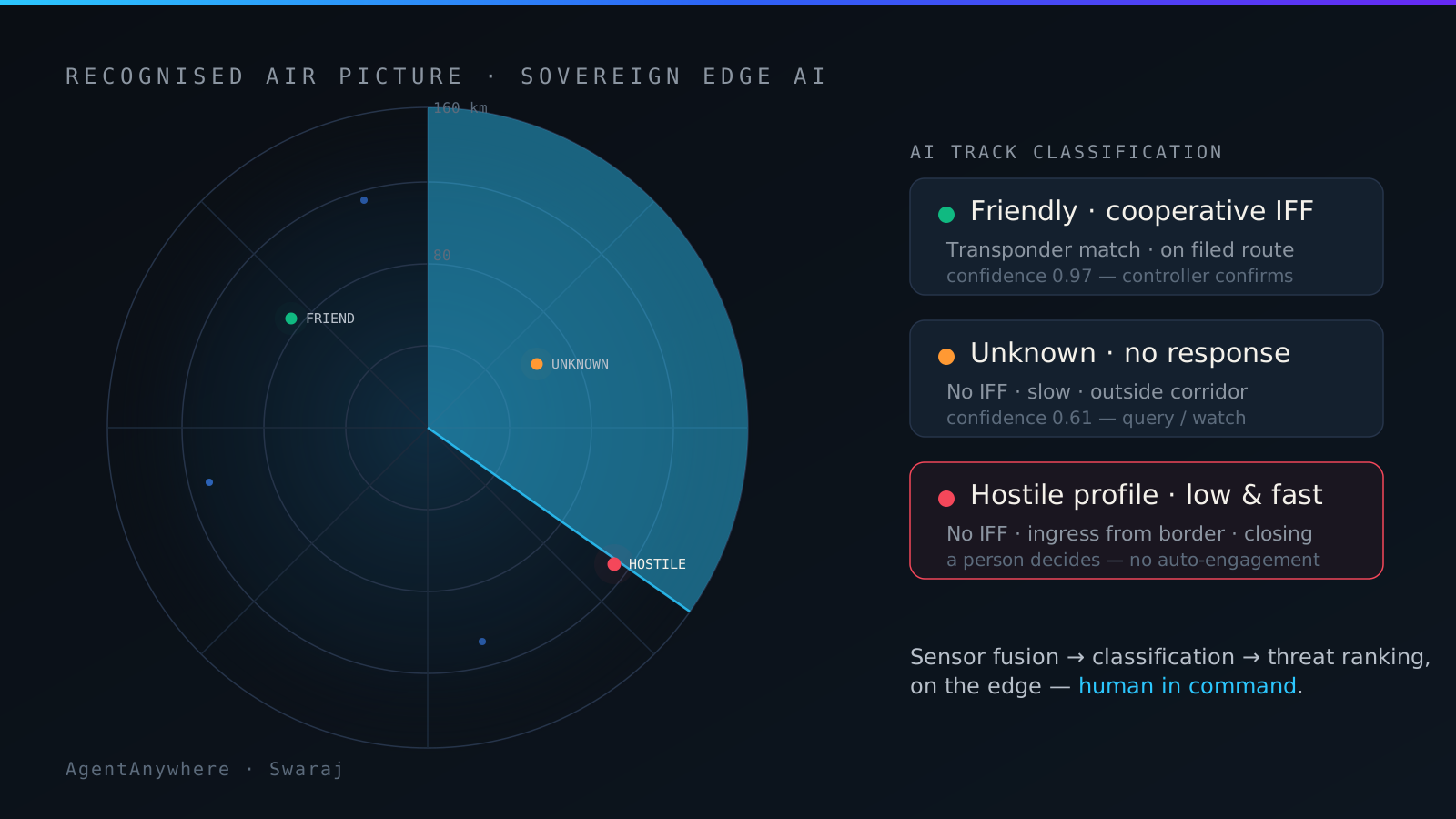
AI in radar & air surveillance — the pillar: how AI turns raw returns into a recognised air picture.
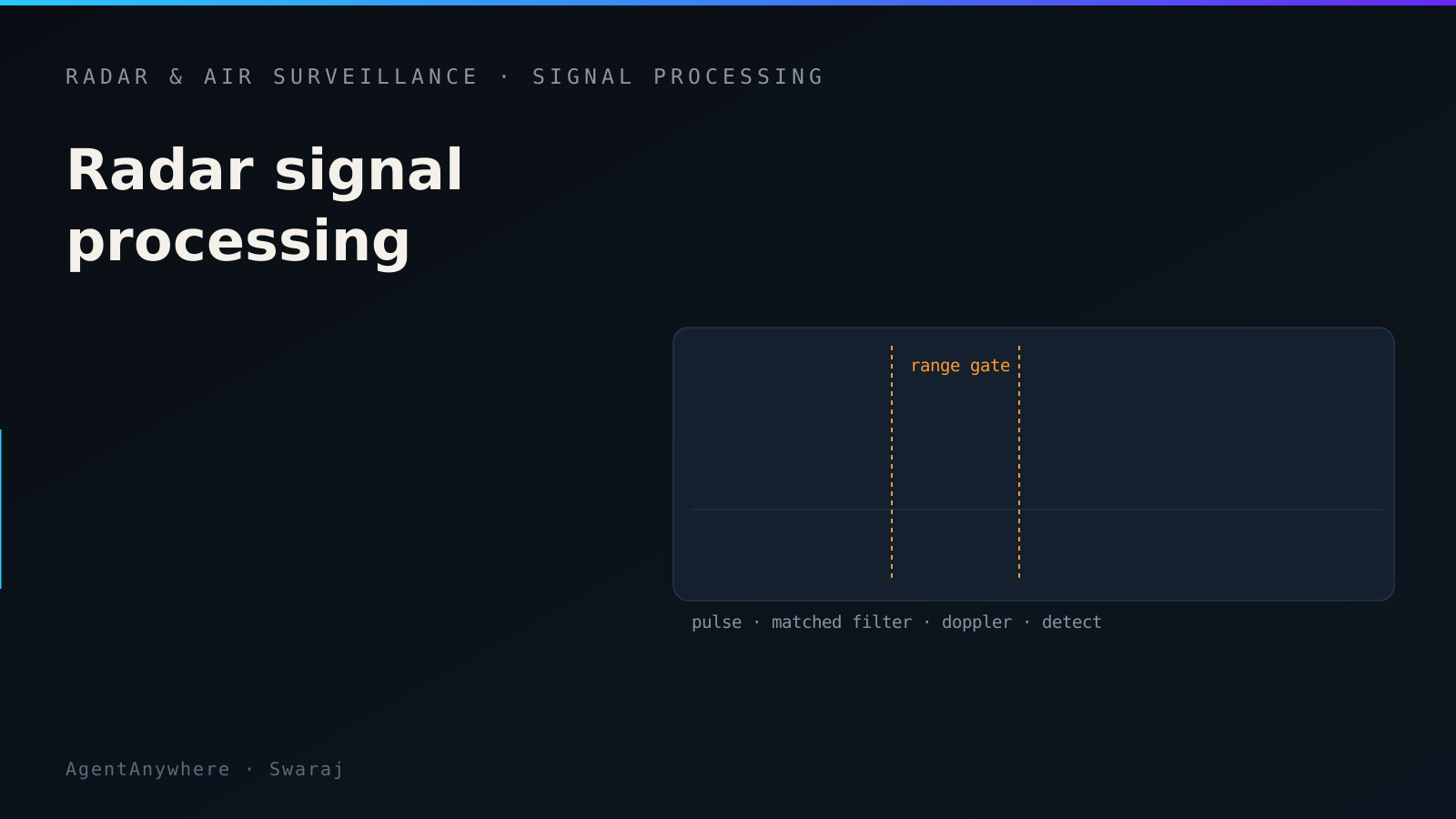
Radar signal processing — what happens to the echo — detection, Doppler, CFAR and tracking.
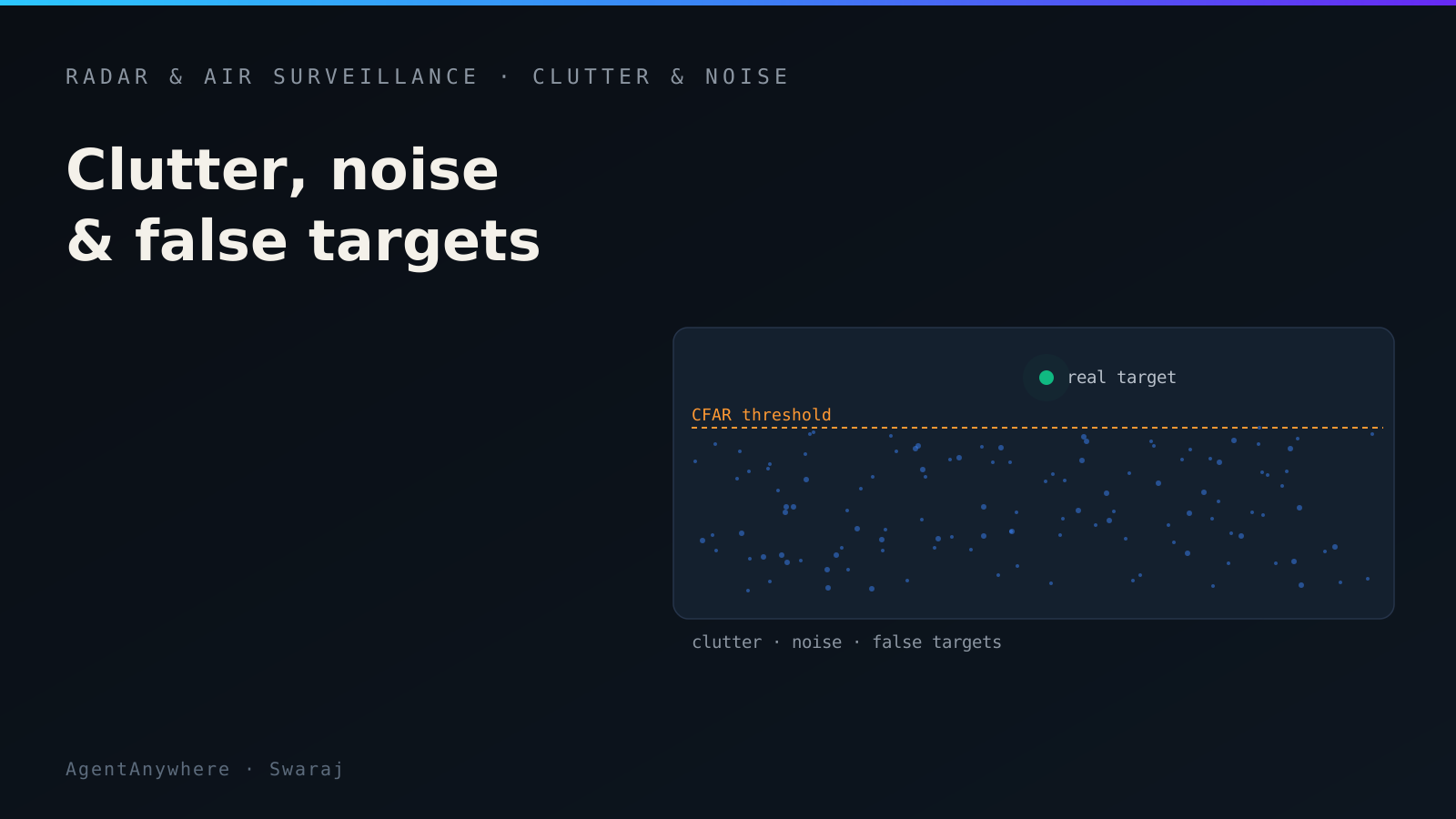
Clutter, noise & false targets — why radar sees things that aren't there, and how it is cleaned up.
Multi-sensor fusion — turning radar, IFF and EO/IR that disagree into one trusted track.
Radar + EO/IR fusion — how a radar cue and a camera confirmation work as one picture.
AI in signal processing — learned detection, recognition and ECCM beyond fixed thresholds.
Low-observable & low-flying targets — why small, slow, low drones are hard — and how AI pulls them out.
Frequently asked questions
What is an AI counter-drone system?
An AI counter-drone system, or counter-UAS (C-UAS) system, uses machine learning to detect uncrewed aircraft near a protected area, identify whether a contact is a drone rather than a bird or clutter, track its path, classify the airframe, and cue a human operator with a confidence and the reasons behind it. It splits into two halves: the sense-and-decide half that builds the picture, and the response half that acts on it. The AI does the heavy lifting in the first half; a person makes the consequential decision.
Why are small drones so hard to detect?
Small drones are hard to detect because they are small, slow and low. A small multirotor has a tiny radar cross-section, so its return sits near the noise floor where a fixed threshold either misses it or triggers constant false alarms. Flying slowly at low altitude, it moves like background clutter rather than against it, and it shares that airspace with birds of similar size and speed. Learned classifiers separate drones from birds mainly by the micro-Doppler signature of spinning rotor blades, which a bird's wingbeat does not produce.
What is the best technology for detecting drones: radar, RF or EO/IR?
There is no single best sensor; the reliable answer is to fuse several. Radar gives all-weather position and velocity but struggles with small, low, slow drones in clutter. RF sensing detects the control link and can locate the pilot, but is blind to autonomous or tethered drones that transmit nothing. EO/IR cameras confirm and identify visually, day or night, but have a narrow field of view and need cueing. Acoustic sensors are cheap and passive but short-range. Modern counter-drone systems combine them and use AI to reconcile the feeds into one trusted track.
How do you tell a drone apart from a bird?
Telling a small drone from a bird is one of the signature problems of counter-drone detection, because the two can occupy the same airspace at similar size and speed. The most reliable discriminator is the micro-Doppler signature produced by a drone's spinning rotor blades, which differs clearly from a bird's wingbeat. Fusing that radar cue with an electro-optical or infrared camera confirmation, and with the kinematics of the track, lets a learned classifier make the call with a stated confidence rather than a guess.
Does AgentAnywhere build counter-drone weapons?
No. AgentAnywhere is a sovereign edge-AI company, not a weapons vendor. We build the sense-and-decide layer of counter-UAS: detection, identification, tracking, classification and cueing a human operator, with decision support and a human in command. We do not build effectors or mitigation hardware, we are not in a targeting or fire-control path, and we make no engagement decision. The physical response half of a counter-drone system is governed by law, rules of engagement and human authority.
Can counter-drone AI keep working if GPS or the network is jammed?
That is the reason counter-drone AI is moving to the edge. When the model runs on the sensor site itself rather than in the cloud, detection, tracking and classification continue even when the backhaul is jammed or cut and when GPS is denied or spoofed, which is exactly when a drone incursion is most likely. Running locally also keeps the air picture in-country, so nothing is exposed to interception or export. Replay protection in contested settings can use message counters rather than GPS time so a GPS-denied environment does not break it.
Written by
AgentAnywhere Research
The team that builds the platform and the models
AgentAnywhere Research writes about the platform, the model families and the trust layer we build and run in India. Where a figure is ours, it says what it covers; where something is a demonstration, it says so.