
Why one sensor is never enough
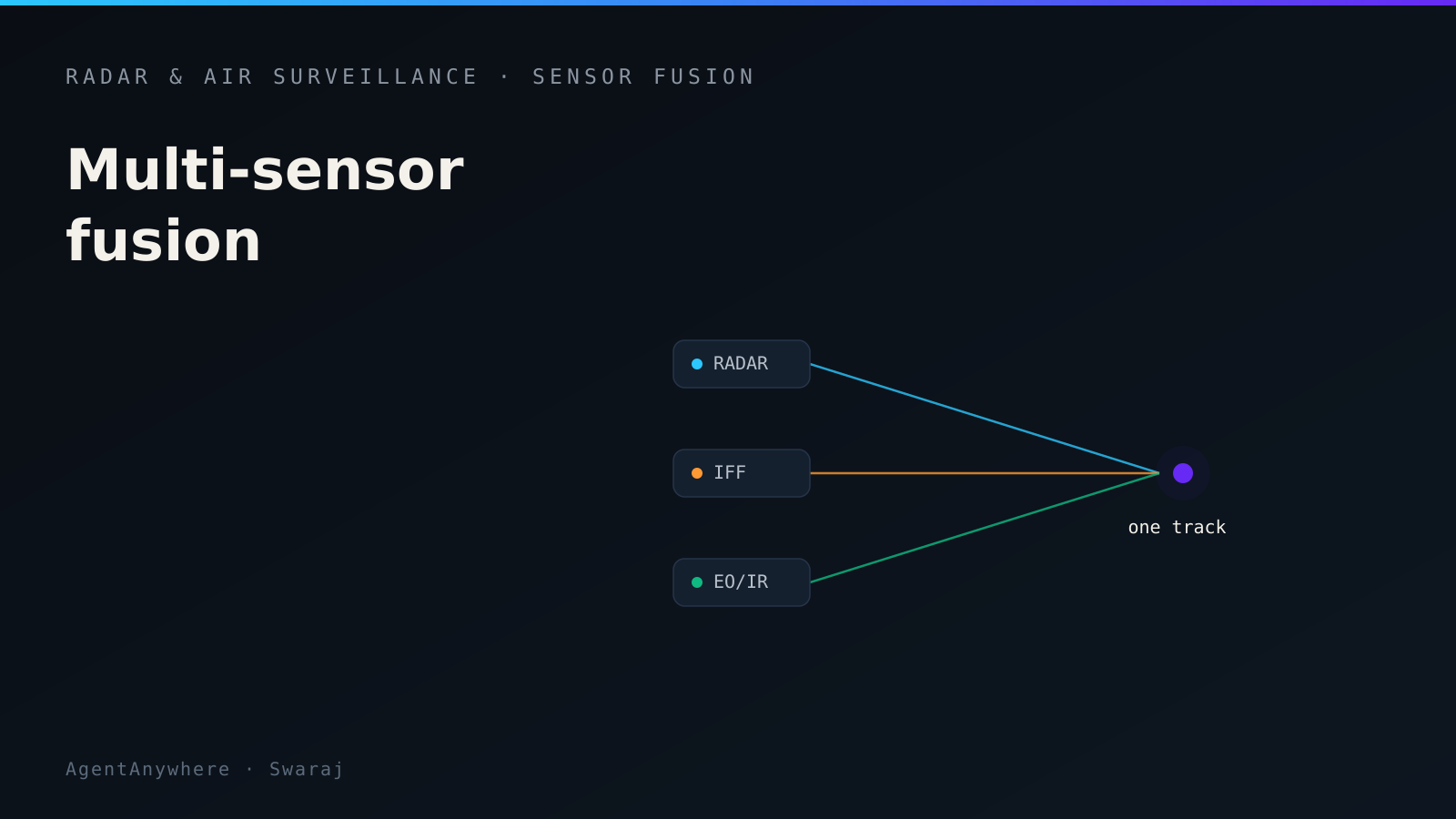
Primary radar measures range and bearing by reflection, so it sees anything with a radar cross-section — but it does not know what it is seeing. Secondary surveillance radar / IFF interrogates a transponder and gets an identity and often altitude back — but only from aircraft that are equipped and choose to reply. EO/IR cameras give a visual or thermal confirmation a human can trust — through a narrow field of view that has to be cued to where to look. ADS-B, passive RF and acoustic sensors each add another partial view.
The feeds disagree, update at different rates, and are noisy — and in a contested environment an adversary's whole aim is to make them disagree more, by jamming the radar or spoofing the transponder. Fusion is what turns that into a single trusted picture instead of a pile of contradictions.
Who sees what
Each sensor is strong at one thing and blind at another. Fusion is how the blind spots get covered.
| Sensor | Gives you | Blind spot |
|---|---|---|
| Sensor: Primary radar | Range, bearing, velocity of anything reflective | No identity; clutter-limited for small/low targets |
| Sensor: Secondary radar / IFF | Identity and altitude from a transponder | Only cooperative aircraft; spoofable |
| Sensor: EO/IR camera | Visual / thermal confirmation a human trusts | Narrow field of view; must be cued; weather-limited |
| Sensor: ADS-B | Reported position and identity | Only cooperative aircraft; can be falsified |
| Sensor: Passive RF / acoustic | Emissions and sound without transmitting | Lower precision; environment-dependent |
The levels of fusion
Fusion can happen at several stages. Signal-level fusion combines raw data from multiple sensors before detection — powerful but demanding. Object- or feature-level fusion combines detections. Track-level (or decision-level) fusion combines each sensor's established tracks into one fused track, and is the most common approach in air surveillance because it is robust and lets heterogeneous sensors contribute. A classic way to describe these stages is the JDL data-fusion model, which separates object assessment from the higher-level situation and threat assessment built on top of it.
The hard part at every level is association — deciding that this radar track, that IFF reply and this camera detection are the same aircraft, when they disagree on position and arrive at different times. Get association wrong and you either split one aircraft into two ghost tracks or merge two aircraft into one. This is where learned methods increasingly help, holding association together as the sensor mix changes or a feed drops out.
From fused tracks to a decision
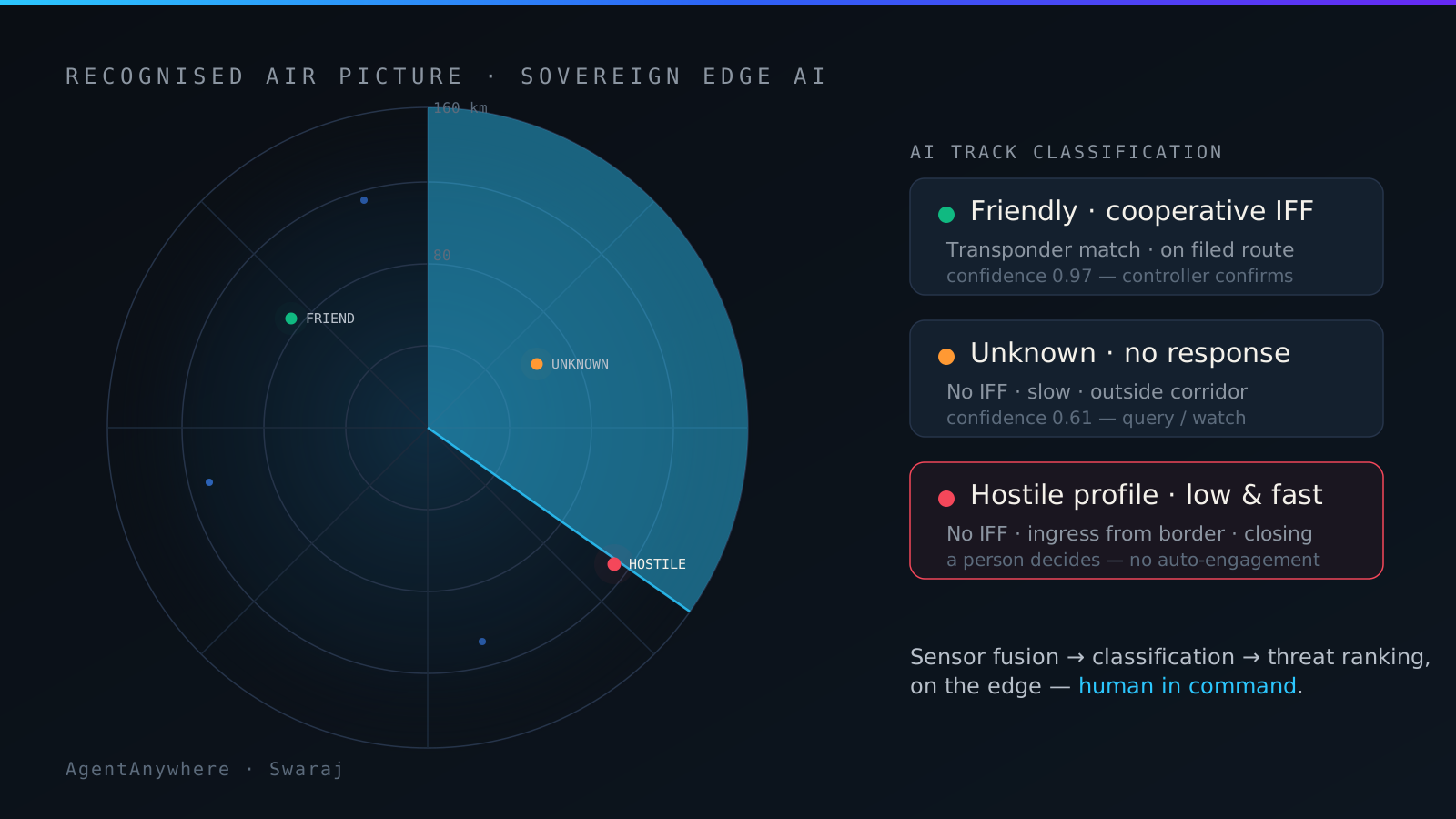
Fusion produces the clean input — one track per object with an identity and a confidence — on which the rest of the air picture is built: classifying each track friendly, hostile or unknown with its reasons, ranking the threats, and raising the alert. A concrete pairing of sensors is covered in radar and EO/IR sensor fusion, and the full picture — classification, threat ranking and why it increasingly runs at the edge — is in the air-surveillance pillar.
Throughout, the discipline AgentAnywhere builds to is constant: the AI fuses, classifies and recommends with its reasons; a human makes the consequential call; and every recommendation carries an inspectable record.
More in this series
AI in radar & air surveillance — the pillar: how AI turns raw returns into a recognised air picture.
Radar signal processing — what happens to the echo — detection, Doppler, CFAR and tracking.
Clutter, noise & false targets — why radar sees things that aren't there, and how it is cleaned up.
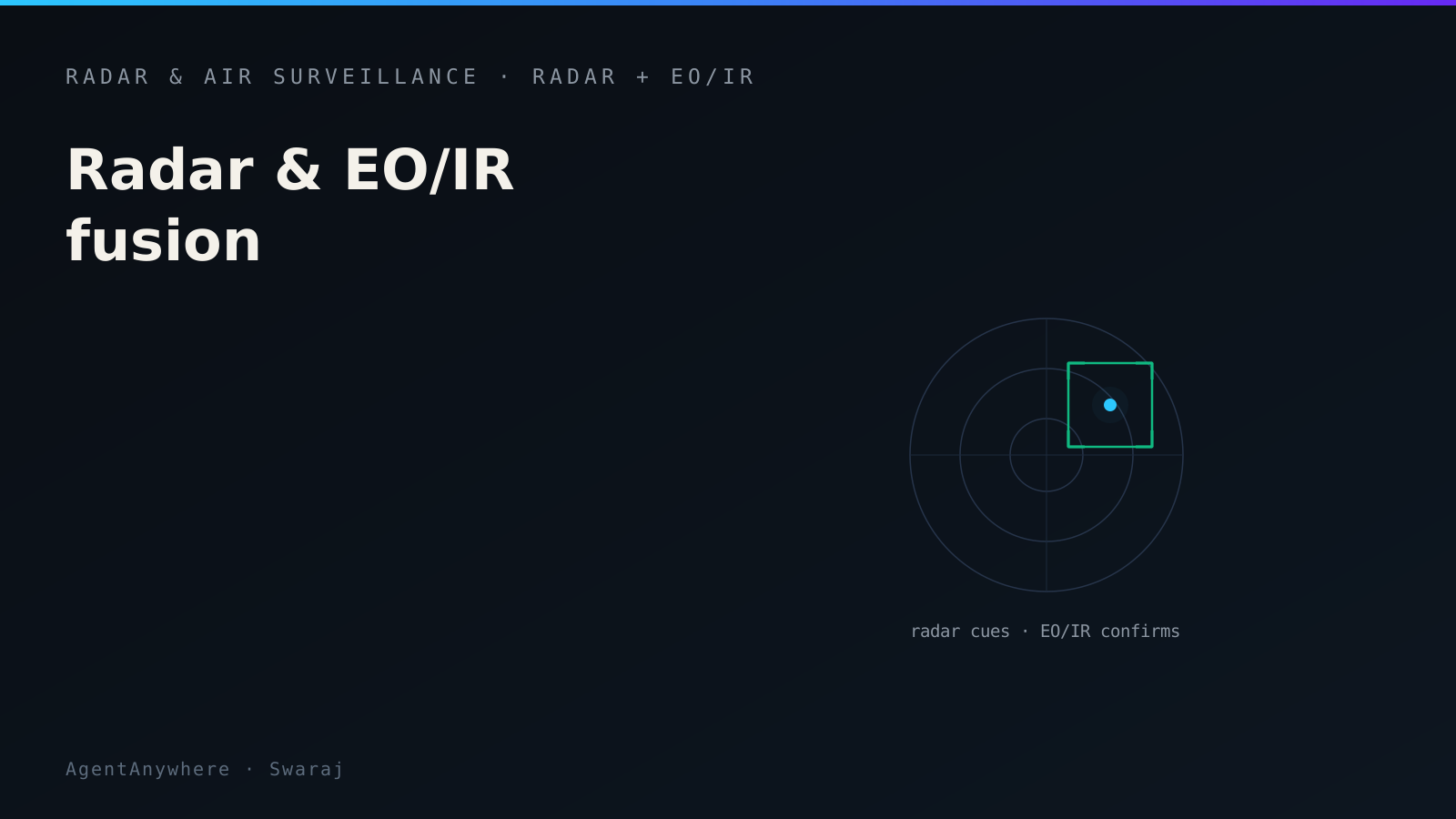
Radar + EO/IR fusion — how a radar cue and a camera confirmation work as one picture.
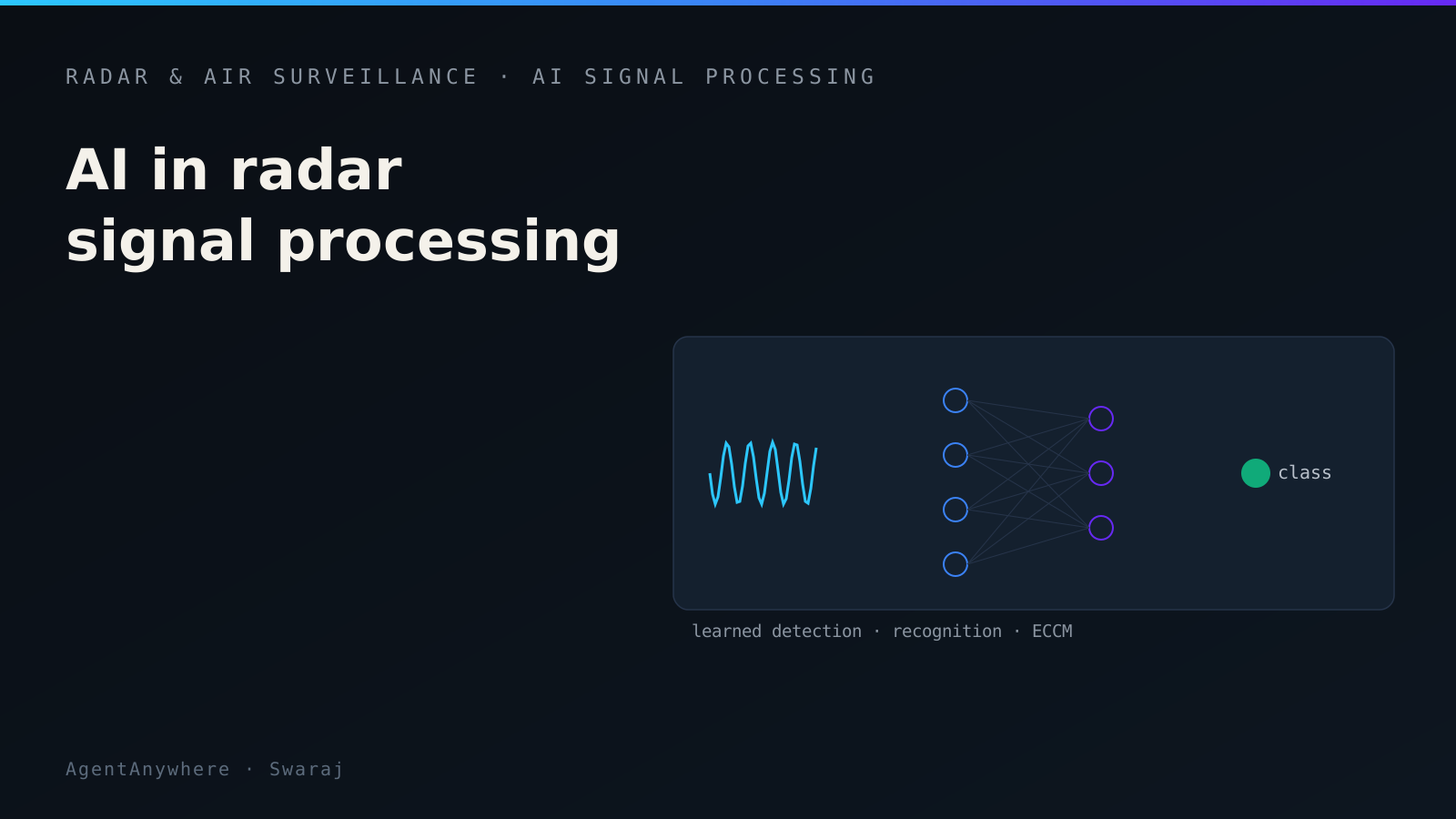
AI in signal processing — learned detection, recognition and ECCM beyond fixed thresholds.
Low-observable & low-flying targets — why small, slow, low drones are hard — and how AI pulls them out.
Frequently asked questions
What is multi-sensor fusion in air surveillance?
Multi-sensor fusion is the process of combining several surveillance sensors — primary radar, secondary radar/IFF, EO/IR cameras, ADS-B, passive RF and others — into one coherent view, with a single track per real aircraft that carries an identity and a confidence. It is the core task behind a recognised air picture, because no single sensor provides position, identity and visual confirmation at once.
Why is sensor fusion necessary — isn't radar enough?
Radar measures where something is but not what it is. A transponder gives identity but only from cooperative aircraft. A camera confirms visually but through a narrow field of view that must be cued. Each sensor is strong at one thing and blind at another, and in contested conditions an adversary tries to make them disagree. Fusion plays the strengths against the weaknesses so the system sees what no single sensor could.
What are the levels of sensor fusion?
Fusion can occur at the signal level (combining raw data before detection), the object or feature level (combining detections), and the track or decision level (combining each sensor's established tracks). Air surveillance most commonly uses track-level fusion because it is robust and lets heterogeneous sensors contribute. The JDL data-fusion model is a common way to describe these stages and the higher-level situation and threat assessment built on them.
What is the hardest part of multi-sensor fusion?
Association — correctly deciding that a radar track, an IFF reply and a camera detection belong to the same aircraft, even though they disagree on position and arrive at different rates. Wrong association either splits one aircraft into two ghost tracks or merges two aircraft into one. Learned methods increasingly help hold association together as the sensor mix changes or a feed drops out.
How does AI improve sensor fusion?
AI helps mainly with association and robustness: keeping one coherent track per object as sensors disagree, fill in or drop out, and attaching a calibrated confidence to the result. On top of fused tracks, learned classification and threat ranking turn the picture into a prioritised view — while a human still makes every consequential decision in responsible systems.
Written by
AgentAnywhere Research
The team that builds the platform and the models
AgentAnywhere Research writes about the platform, the model families and the trust layer we build and run in India. Where a figure is ours, it says what it covers; where something is a demonstration, it says so.