
Where false returns come from
Four different problems that all end up looking like a target if nothing is done.
| Source | What it is | Typical fix |
|---|---|---|
| Source: Ground / sea clutter | Strong reflections from terrain, buildings and waves. | MTI / Doppler processing to remove the near-zero-velocity background. |
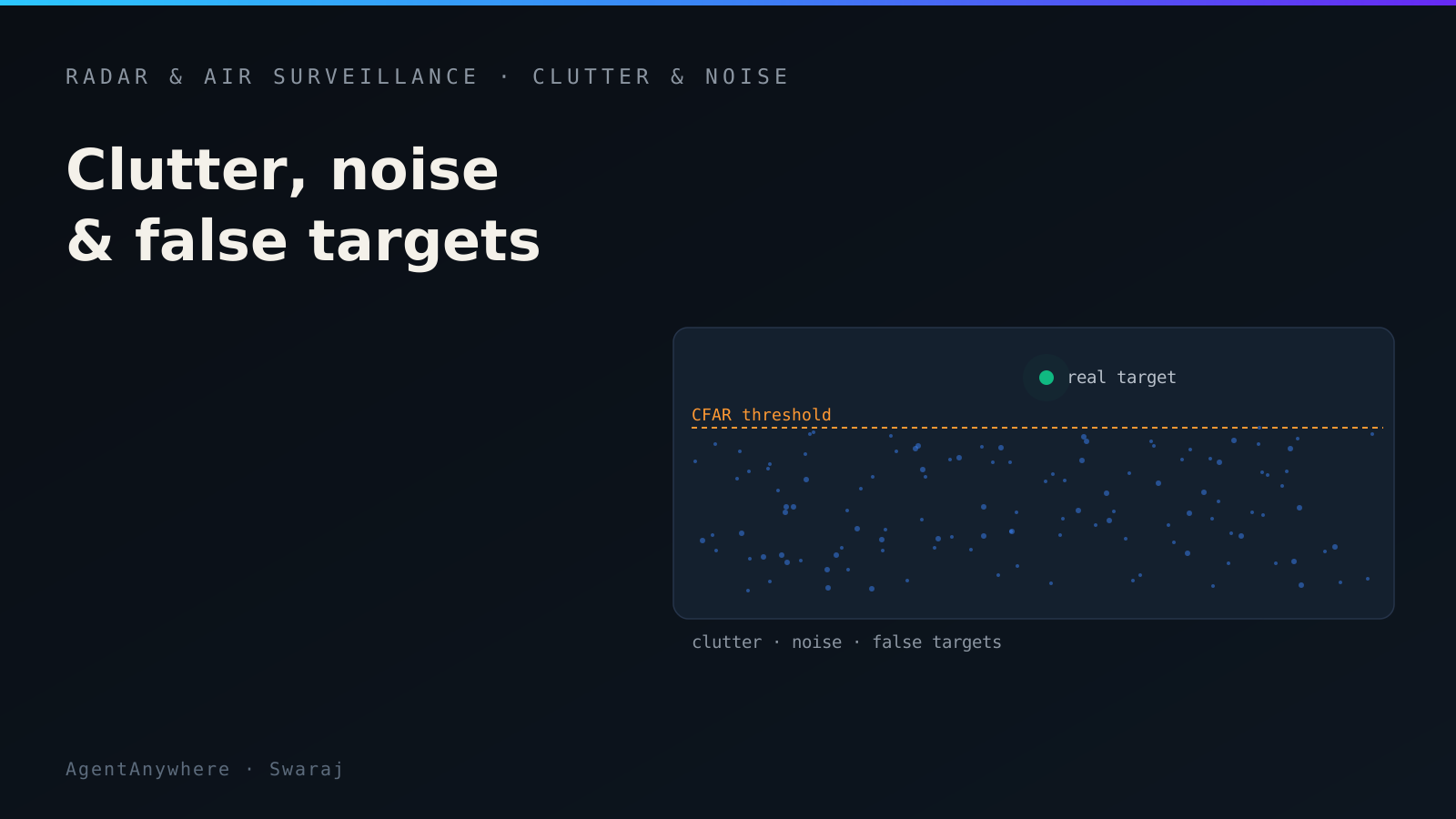
| Source: Receiver noise | Random thermal fluctuation in the electronics. | Matched filtering for SNR; CFAR thresholding. |
| Source: Multipath / ghosts | The signal bounces off a surface and arrives late, as a phantom at the wrong range. | Geometry checks, track logic, and learned rejection. |
| Source: Birds, weather, interference | Real objects or signals that aren't the target of interest. | Doppler and kinematic signatures; learned classification. |
The motion trick, and where it breaks
The single most powerful idea in clutter rejection is motion. Most clutter — the ground, the buildings, the clutter-filled coastline — does not move, so it sits at (or near) zero Doppler, while an aircraft is shifted away from it. MTI and pulse-Doppler processing exploit exactly this to strip the static background out.
It breaks in two ways that matter for air surveillance. Slow targets — a hovering or creeping drone — sit close to the clutter in velocity, so removing the clutter risks removing the target with it. And moving clutter — sea waves, rain, swaying vegetation — has its own Doppler spread, so it isn't neatly at zero. Both cases leave residue that a detector can mistake for a target, which is the root of many false alarms.
Why AI reduces false alarms without going blind
There is a fundamental trade in any fixed detector: lower the threshold to catch faint targets and you accept more false alarms; raise it to suppress false alarms and you miss the faint ones. CFAR manages this trade adaptively but still reasons about one cell against its neighbours.
A learned detector instead judges a return against the pattern of real targets versus real clutter — texture, shape, Doppler spread, behaviour over time — so it can keep a weak, slow drone return while rejecting a clutter spike of the same amplitude. In practice this means fewer false alarms and better detection of the hard targets, rather than trading one for the other. The flip side — making sure the system flags when its input has been degraded by jamming rather than silently passing a wrong picture — is a core part of how we think about trustworthy edge AI, covered in the air-surveillance pillar and in detecting low-observable and low-flying targets.
More in this series
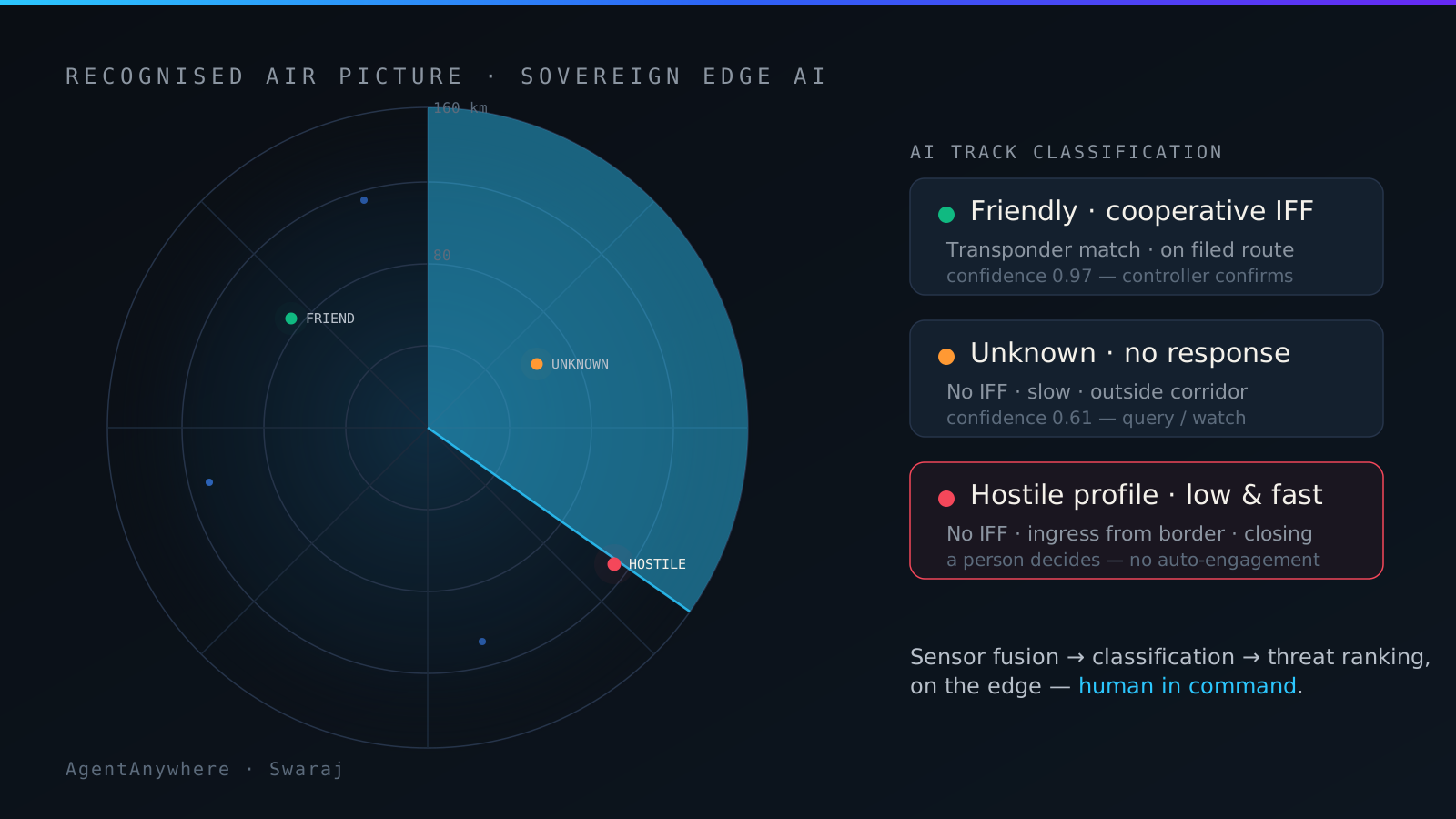
AI in radar & air surveillance — the pillar: how AI turns raw returns into a recognised air picture.
Radar signal processing — what happens to the echo — detection, Doppler, CFAR and tracking.
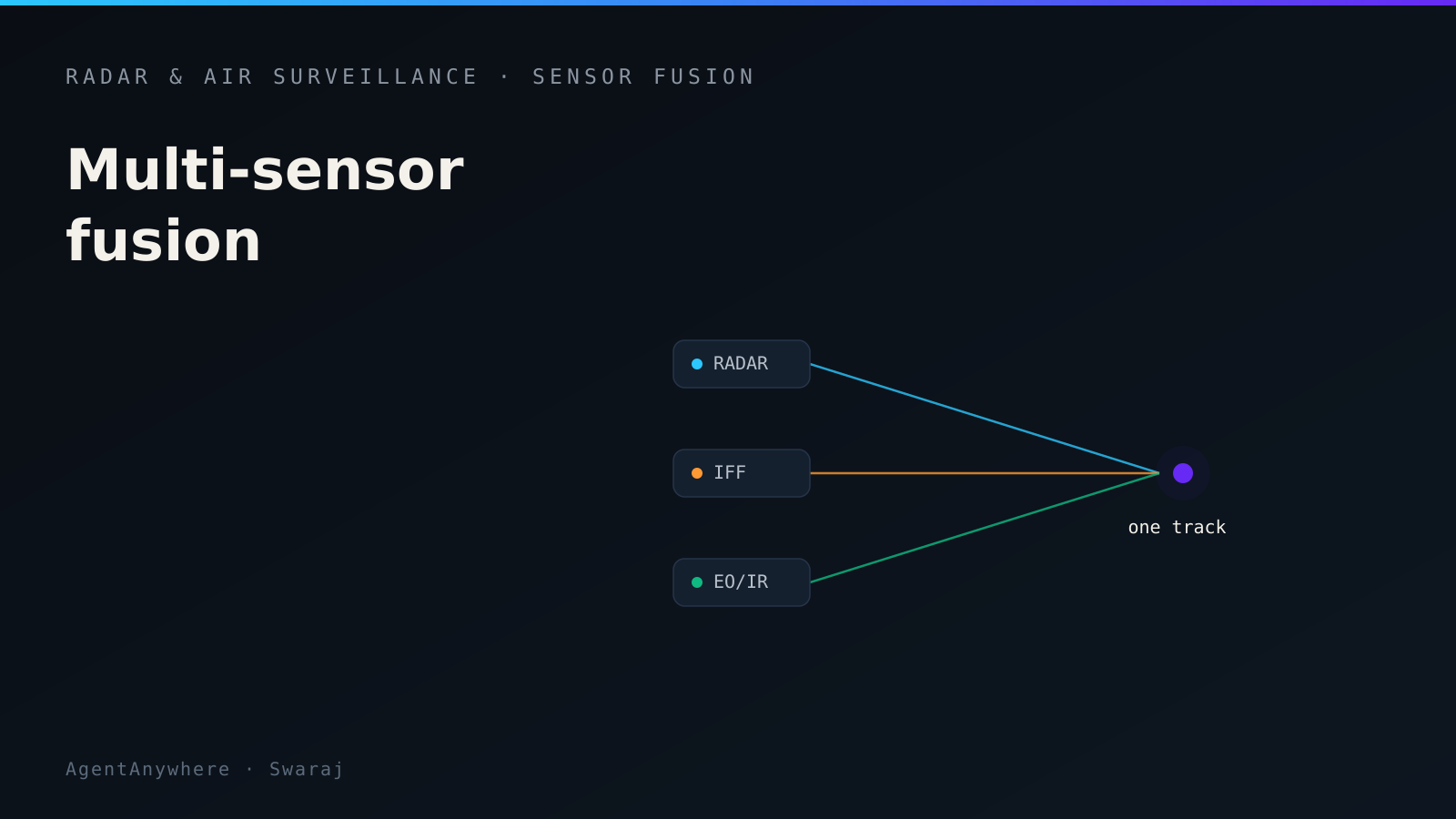
Multi-sensor fusion — turning radar, IFF and EO/IR that disagree into one trusted track.
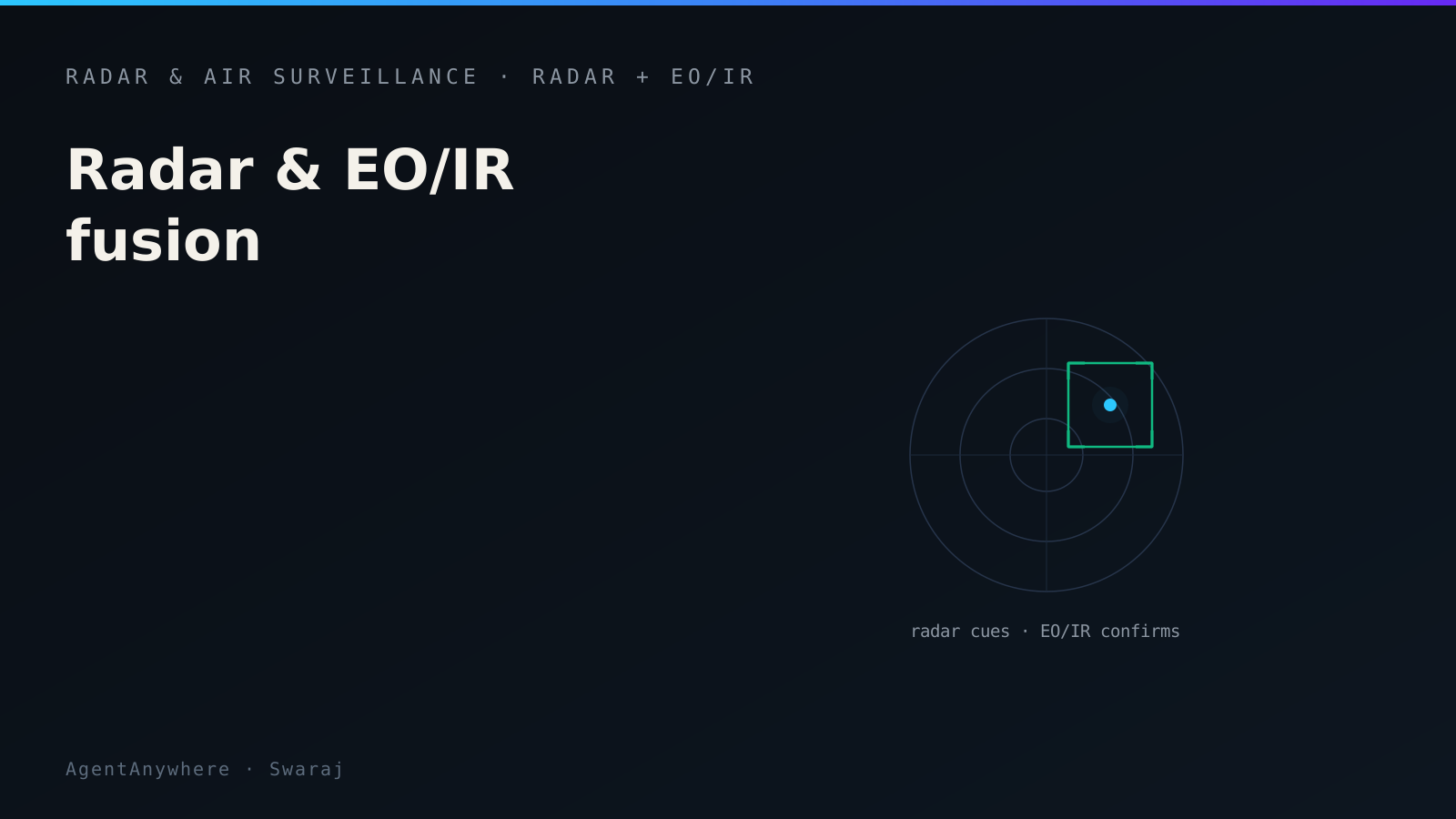
Radar + EO/IR fusion — how a radar cue and a camera confirmation work as one picture.
AI in signal processing — learned detection, recognition and ECCM beyond fixed thresholds.
Low-observable & low-flying targets — why small, slow, low drones are hard — and how AI pulls them out.
Frequently asked questions
What is radar clutter?
Radar clutter is unwanted but genuine reflected energy from objects that are not the target of interest — the ground, the sea, buildings, rain, and even flocks of birds. It is different from noise, which is random electrical fluctuation in the receiver. Clutter is the dominant problem in air surveillance because it can be far stronger than the echo from a small aircraft.
What causes false targets on radar?
False targets come from several sources: strong clutter spikes that cross the detection threshold, multipath reflections that create a phantom at the wrong range, electronic interference or jamming, and real non-target objects such as birds or weather. Signal processing reduces them with Doppler and MTI processing, CFAR thresholding, geometry and track logic, and increasingly with learned classification.
How is radar clutter reduced?
The main tool is motion. Most clutter is stationary and returns near zero Doppler, so moving-target indication (MTI) and pulse-Doppler processing remove the static background and leave moving targets. CFAR then sets an adaptive detection threshold. These methods struggle with slow targets, which sit close to clutter in velocity, and with moving clutter such as sea and rain — cases where learned detection helps.
Why are slow and low-flying targets hard to detect?
A slow target, such as a hovering or creeping drone, has a radial velocity close to that of the surrounding clutter, so the very processing that removes clutter can remove the target too. Low-flying targets also sit in the strongest ground or sea clutter. Separating them requires detection that reasons about the pattern of target versus clutter rather than velocity or amplitude alone.
Does AI remove the trade-off between missed targets and false alarms?
It improves it rather than removing it entirely. A fixed threshold forces a direct trade: catch faint targets at the cost of more false alarms, or suppress false alarms at the cost of missing faint targets. A learned detector judges returns by the pattern of real targets against real clutter, so it can keep weak, slow targets while rejecting clutter spikes of similar strength — reducing false alarms and improving hard-target detection together.
Written by
AgentAnywhere Research
The team that builds the platform and the models
AgentAnywhere Research writes about the platform, the model families and the trust layer we build and run in India. Where a figure is ours, it says what it covers; where something is a demonstration, it says so.