
How artificial intelligence is transforming radar surveillance
A classical radar is an echo machine. It transmits a pulse, listens for the reflection, and from the timing and Doppler shift it computes how far away something is, which way, and how fast it is moving. Everything after that — is that one aircraft or two? friend or stranger? the threat, or a flock of birds? — has traditionally been a human job, done off a screen of undifferentiated blips.
AI in radar systems moves that interpretation into software. Instead of only measuring returns, a machine-learning layer learns the patterns in them: the signature of a multirotor drone versus a bird, the track behaviour of an airliner versus something manoeuvring to stay unseen, the difference between a genuine return and clutter bouncing off terrain, sea or weather. The radar stops handing the operator raw echoes and starts handing them labelled, prioritised tracks.
This is why AI is not a bolt-on feature but a shift in what radar is for. The hardware still detects; the AI decides what the detection means, how confident that reading is, and whether a human should look now. The result is fewer missed contacts, far fewer false alarms, and an operator who spends attention on judgement rather than on triage.
The role of AI in modern air surveillance systems
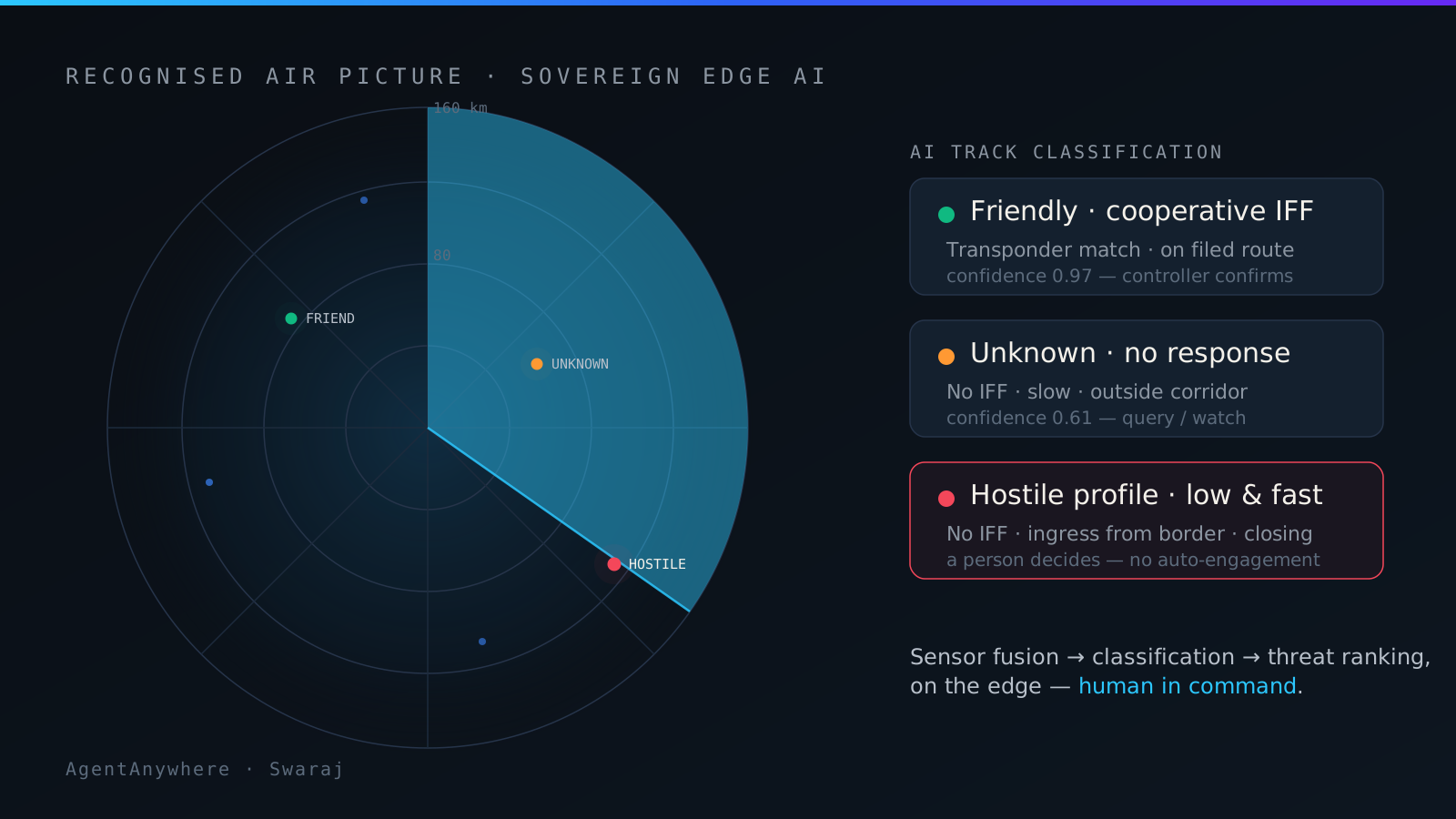
Air surveillance is the job of maintaining a recognised air picture — a single, trusted view of everything flying in a volume of airspace, with each track identified and prioritised. Controllers, coastal-surveillance teams and counter-drone units all depend on it, and it is hard for one structural reason: no single sensor sees everything.
Primary radar gives range and bearing but not identity. A transponder — IFF or secondary surveillance radar — gives identity, but only from cooperative aircraft that choose to reply. An EO/IR camera can confirm visually but through a narrow field of view. ADS-B, acoustic sensors and passive RF each add a piece. The feeds disagree, arrive at different rates, and are noisy — and an adversary's whole aim is to make them disagree more.
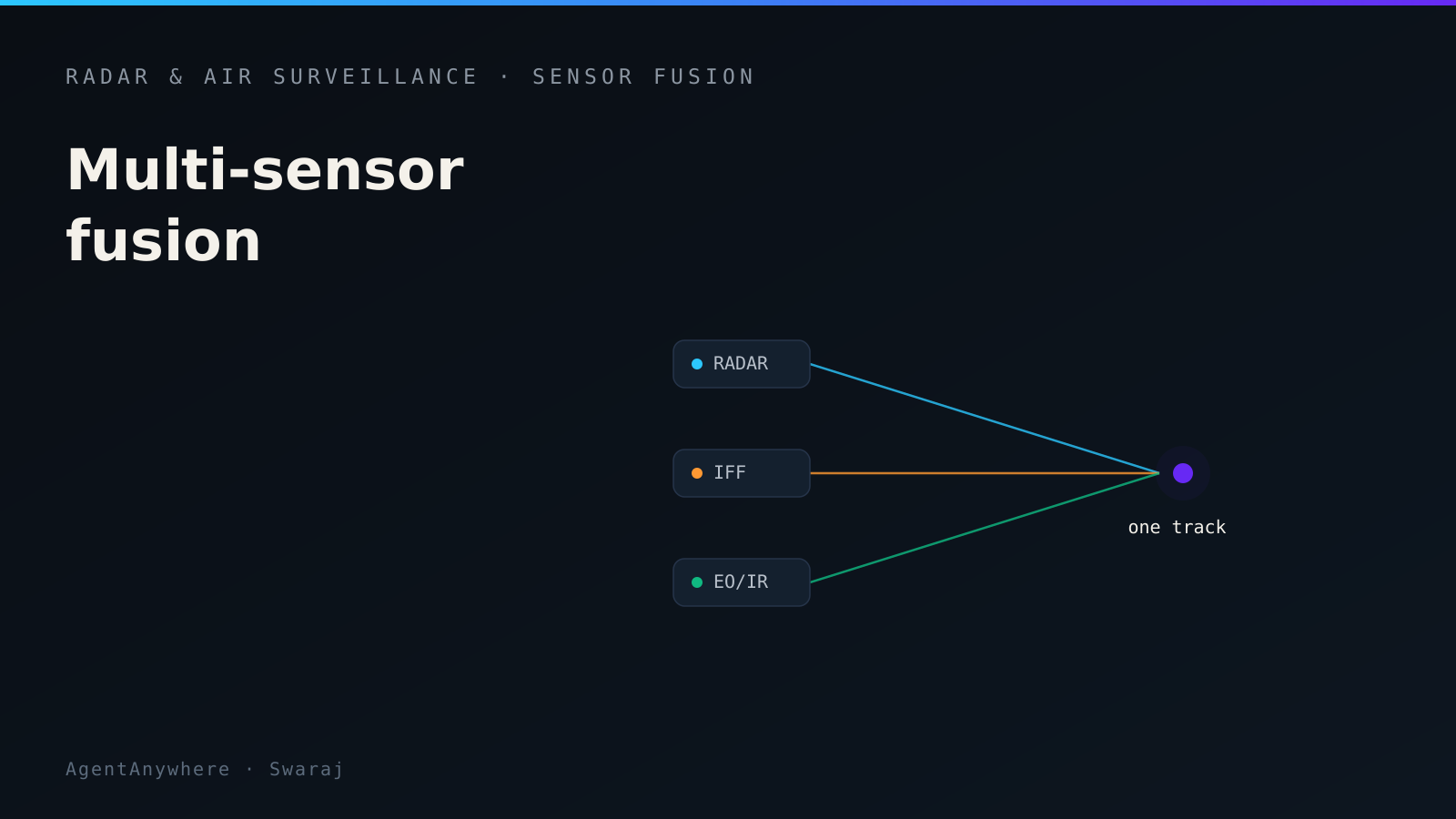
Sensor fusion is where AI earns its place in air surveillance: it reconciles those feeds into one coherent track per real object, resolves the contradictions, fills short gaps when one sensor drops, and attaches a confidence to the result. On top of fusion sit classification (friend / unknown / hostile, with reasons) and threat ranking (which track, closing which asset, in what time). That pipeline — fuse, classify, rank, alert — is the role of AI in a modern air-surveillance system, and it is what lets a small team hold a large, busy, contested sky.
How AI improves radar target detection and tracking
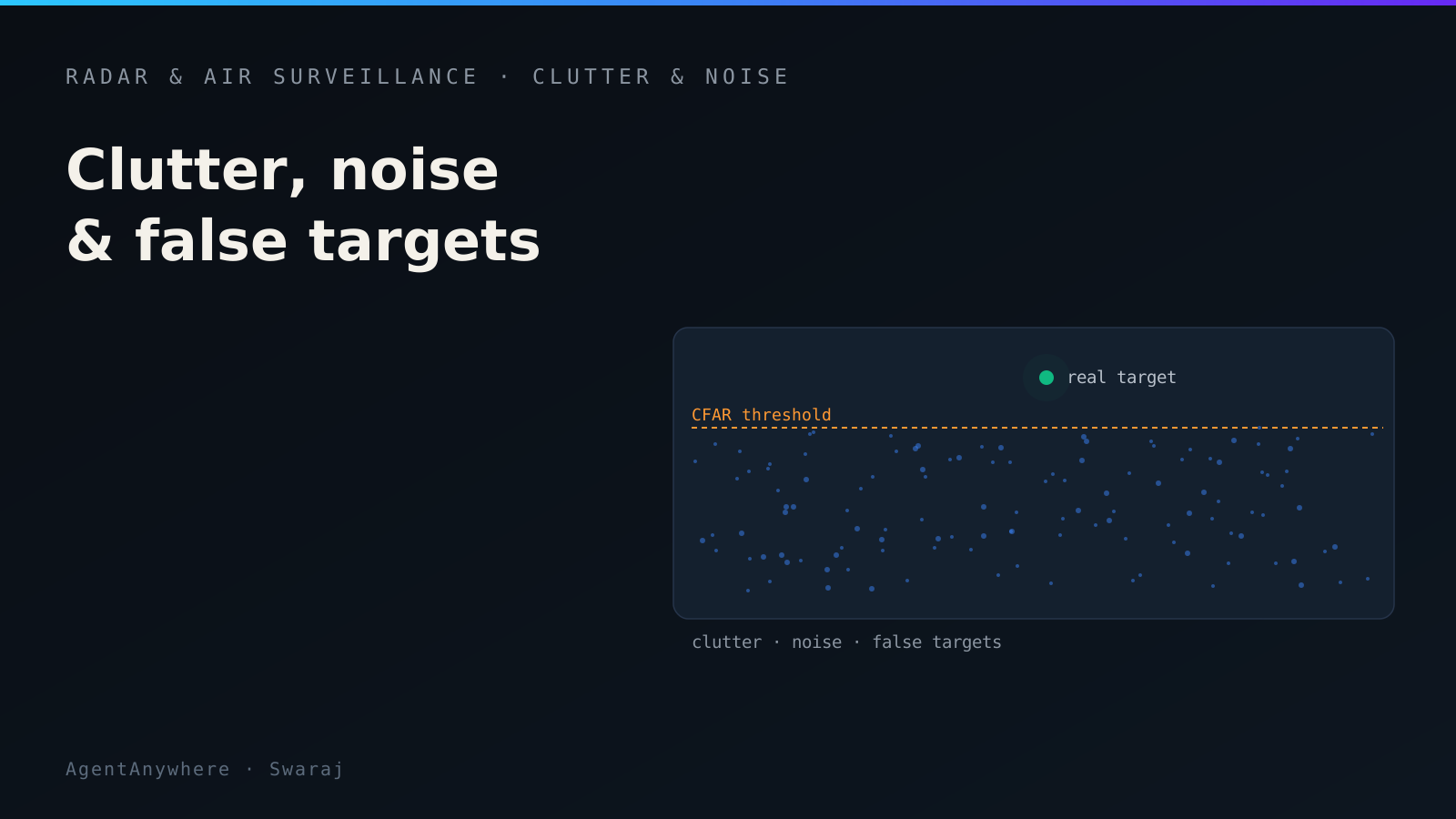
Detection is deciding that a return is a real object rather than noise. Classical radar sets a threshold — too low and the screen fills with false alarms, too high and it misses the faint, the small and the low. Machine-learning detectors instead learn the texture of real targets against real backgrounds, so they pull a weak drone return out of sea or ground clutter that a fixed threshold would either bury or drown. The practical gain is detecting the hard targets — small, slow, low — without being swamped by false positives.
Tracking is stitching detections across time into the path of one object, through gaps, crossings and manoeuvres. Traditional trackers lean on motion models that assume targets move predictably; they struggle when two tracks cross or a target jinks. Learned trackers hold identity through those moments and through short sensor dropouts, so a contact is not 'lost' and re-acquired as a brand-new unknown every time it manoeuvres.
Classification is the step that turns a track into a decision. From the micro-Doppler signature of rotor blades, the kinematics of the path, the presence or absence of a transponder reply and the agreement between sensors, the system proposes what the object is and how sure it is — and, crucially, why. A good classifier shows its reasons, because an air-defence controller cannot act on a verdict they cannot inspect.
Traditional radar vs AI-powered radar: key differences
The hardware can be identical. The difference is what happens to the signal after it returns — and how much interpretation the operator is left to do by hand.
| Dimension | Traditional radar | AI-powered radar |
|---|---|---|
| Dimension: What the operator sees | Raw blips — range, bearing, speed. Identity and intent are inferred by hand. | Labelled tracks — each classified friend / unknown / hostile with a confidence and stated reasons. |
| Dimension: False alarms & clutter | A fixed threshold trades missed targets against clutter; sea, terrain and weather drive false alarms. | Learned detectors separate real targets from clutter, cutting false alarms while still catching small, slow, low contacts. |
| Dimension: Multiple sensors | Fused manually or with rigid rules; disagreements land on the operator. | AI sensor fusion reconciles radar, IFF, EO/IR and more into one track with a confidence. |
| Dimension: Drones & low-slow targets | Easily lost in clutter or below threshold. | Micro-Doppler and kinematic learning pick out multirotors and distinguish them from birds. |
| Dimension: Operator load | Scales with traffic — more aircraft means more controllers. | Triage is automated; people spend attention on judgement and decisions, not on watching. |
| Dimension: Under jamming / spoofing | Degrades quietly; the operator may not know the picture is wrong. | Integrity scoring flags when a feed degrades, so the loss of trust is visible, not silent. |
AI-powered radar augments the operator; it does not remove them. Across every row, a human makes the consequential call.
How machine learning is changing military radar systems
Military radar lives in an adversarial world: targets that hide, signals that are jammed, and decoys designed to fool exactly the system watching for them. Machine learning is reshaping it on several fronts at once. Cognitive radar adapts its own waveform and beam in real time to the environment and the target, rather than transmitting a fixed pattern an adversary can learn. Electronic counter-countermeasures (ECCM) increasingly use learned models to recognise and reject jamming and spoofing instead of relying on hand-tuned filters. And automatic target recognition (ATR) uses the same classification advances to tell a genuine threat from a decoy or a civilian aircraft.
The newest and fastest-moving driver is counter-drone. Small, slow, low, cheap uncrewed aircraft are the targets classical air-defence radar was never built to see, and they now arrive in numbers. Learned detection and classification — separating a multirotor from a bird, a swarm from scattered clutter — is becoming the difference between seeing a drone incursion and missing it.
Two principles govern responsible use, and AgentAnywhere builds to both. First, a human stays in command: the AI detects, classifies and recommends; a controller or commander decides. Targeting and weapon release sit outside the model, behind human authority — the systems we build are for surveillance and decision support, observe-and-assist, never a fire-control trigger. Second, the model must be auditable: every recommendation should carry its reasons and a tamper-evident record, so a decision can be reconstructed and defended afterwards.
The future of AI-based airspace monitoring and surveillance
Three shifts are shaping where AI airspace monitoring goes next. The first is to the edge. A cloud-hosted classifier is useless the moment the backhaul is jammed or cut — which is precisely the moment it is needed — so the model moves onto the sensor site itself and keeps detecting and deciding when the link is gone. For defence, coastal and critical-infrastructure surveillance, that also answers the data-residency requirement: if the air picture never leaves the site or the country, there is nothing to intercept and nothing to export.
The second is integrated, multi-domain fusion: radar, passive RF, acoustic, EO/IR, ADS-B and space-based sensing folded into one picture, with AI holding the fusion together as the sensor mix changes. The third is explainable autonomy — systems trusted to do more of the watching precisely because every recommendation is inspectable and every consequential action still waits for a human.
The direction is consistent: not AI that replaces the air-defence controller, but AI that gives a small sovereign team the reach of a large one — resilient when contested, honest about its own confidence, and auditable after the fact.
Where AgentAnywhere fits: sovereign edge AI for air surveillance
AgentAnywhere builds Sanjaya, a sovereign edge-AI family for telemetry, anomaly detection and prediction — the kind of model that scores a live sensor feed for integrity and flags when it has been degraded. It is designed to run inside your perimeter on hardware you own, with the data staying local: the properties air surveillance actually needs when the network is the first thing an adversary attacks.
Around the model sits the AgentAnywhere trust layer, so every classification and recommendation carries a signed, inspectable record, and a commander or controller approves every consequential step. The posture is deliberate and unchanging — decision support and ISR, observe-and-assist, with no targeting and no weapon release in the loop.
If you are evaluating sovereign AI for air surveillance, airspace monitoring or critical-infrastructure protection, you can read the honest status of every model family on the sovereign model portfolio, and see the enterprise and public-safety scenarios on the use-cases page.
More in this series
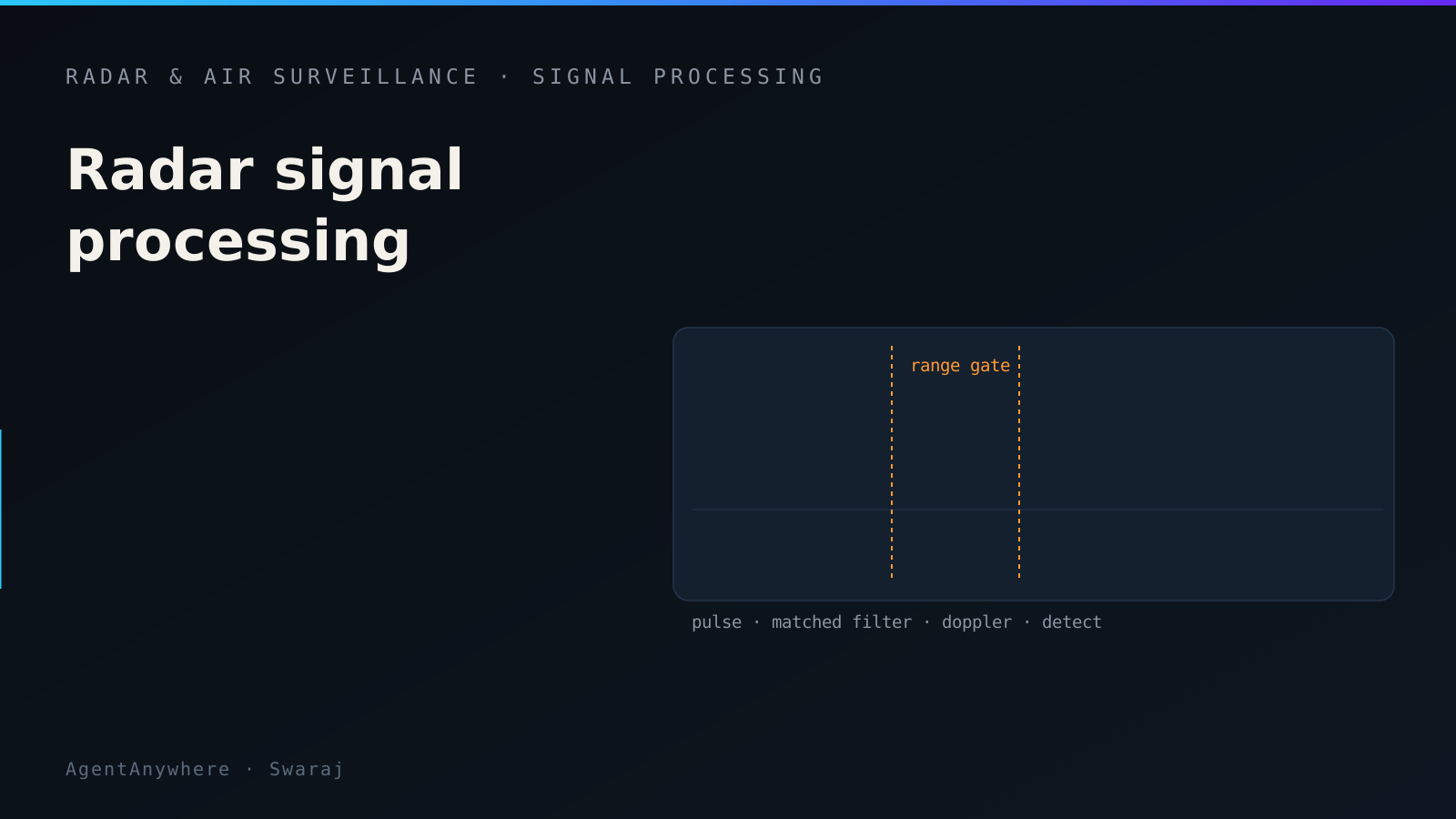
Radar signal processing — what happens to the echo — detection, Doppler, CFAR and tracking.
Clutter, noise & false targets — why radar sees things that aren't there, and how it is cleaned up.
Multi-sensor fusion — turning radar, IFF and EO/IR that disagree into one trusted track.
Radar + EO/IR fusion — how a radar cue and a camera confirmation work as one picture.
AI in signal processing — learned detection, recognition and ECCM beyond fixed thresholds.
Low-observable & low-flying targets — why small, slow, low drones are hard — and how AI pulls them out.
Frequently asked questions
What is AI in radar systems?
AI in radar systems is the use of machine learning to interpret radar returns rather than just measure them. A classical radar reports range, bearing and speed and leaves interpretation to the operator; an AI layer learns the patterns in the returns to detect real targets through clutter, track them through manoeuvres, classify each contact as friendly, unknown or hostile with a confidence, and rank which ones matter — turning raw blips into labelled, prioritised tracks.
How does AI improve radar target detection and tracking?
For detection, learned models separate real targets from sea, terrain and weather clutter, so they catch small, slow, low contacts such as drones without flooding the screen with false alarms that a fixed threshold would cause. For tracking, learned trackers hold a target's identity through crossings, manoeuvres and short sensor dropouts, instead of losing it and re-acquiring it as a new unknown. Classification then adds what the object probably is, how confident the system is, and why.
What is the difference between traditional radar and AI-powered radar?
The hardware can be identical; the difference is what happens to the signal after it returns. Traditional radar shows raw blips and leaves identity, intent and sensor-disagreement to the operator. AI-powered radar fuses multiple sensors into one track, classifies each contact with reasons and a confidence, cuts false alarms while still catching small low-slow targets, and flags when a feed has been jammed or spoofed. AI-powered radar augments the operator rather than replacing them; a human still makes the consequential decision.
How is AI used in military radar?
In military radar, machine learning drives cognitive radar that adapts its waveform to the environment and target in real time, electronic counter-countermeasures that recognise and reject jamming and spoofing, and automatic target recognition that distinguishes genuine threats from decoys and civilian aircraft. A fast-growing use is counter-drone detection of small, slow, low uncrewed aircraft. Responsible systems keep a human in command and keep targeting and weapon release outside the model, behind human authority.
Can AI radar surveillance keep working if the network or GPS is jammed?
That is the reason air-surveillance AI is moving to the edge. When the model runs on the sensor site itself rather than in the cloud, detection and decision support continue even when the backhaul is jammed or cut — which is exactly when they are needed most. Running locally also keeps the air picture in-country, so nothing is exposed to interception or export. Replay protection in contested environments can use message counters rather than GPS time so a GPS-denied setting does not break it.
Does AI replace human air-defence operators?
No. AI automates the triage — fusing sensors, detecting, tracking, classifying and ranking — so a small team can hold a large, busy, contested sky. But the consequential call stays with a person. In responsible air-defence and surveillance systems, including AgentAnywhere's, the AI detects, classifies and recommends with its reasons, and a controller or commander decides; targeting and weapon release are not automated.
What is a recognised air picture?
A recognised air picture is a single, trusted view of everything flying in a volume of airspace: where each aircraft is, whether it is friendly, hostile or unknown, and which tracks matter right now. Building it requires fusing sensors that each see only part of the problem — primary radar for position, IFF for cooperative identity, EO/IR for visual confirmation — into one coherent, prioritised view, which is the core task AI performs in air surveillance.
Is AI airspace monitoring secure and sovereign?
It can be, if it is built for it. Sovereign air surveillance runs the AI at the edge on hardware the operator owns, keeps all sensor data and the resulting air picture in-country with no external requests, and wraps every recommendation in an inspectable, tamper-evident record. AgentAnywhere's Sanjaya edge-AI family is designed around those properties — local inference, data residency, and a human in command of every consequential decision.
Written by
AgentAnywhere Research
The team that builds the platform and the models
AgentAnywhere Research writes about the platform, the model families and the trust layer we build and run in India. Where a figure is ours, it says what it covers; where something is a demonstration, it says so.