
From pulse to detection: the classic chain
A pulsed radar transmits a short burst of radio energy and listens for the reflection. The time delay gives range, the angle of the antenna gives bearing, and the frequency shift of the echo gives radial velocity via the Doppler effect. Everything that makes those measurements usable happens in signal processing.
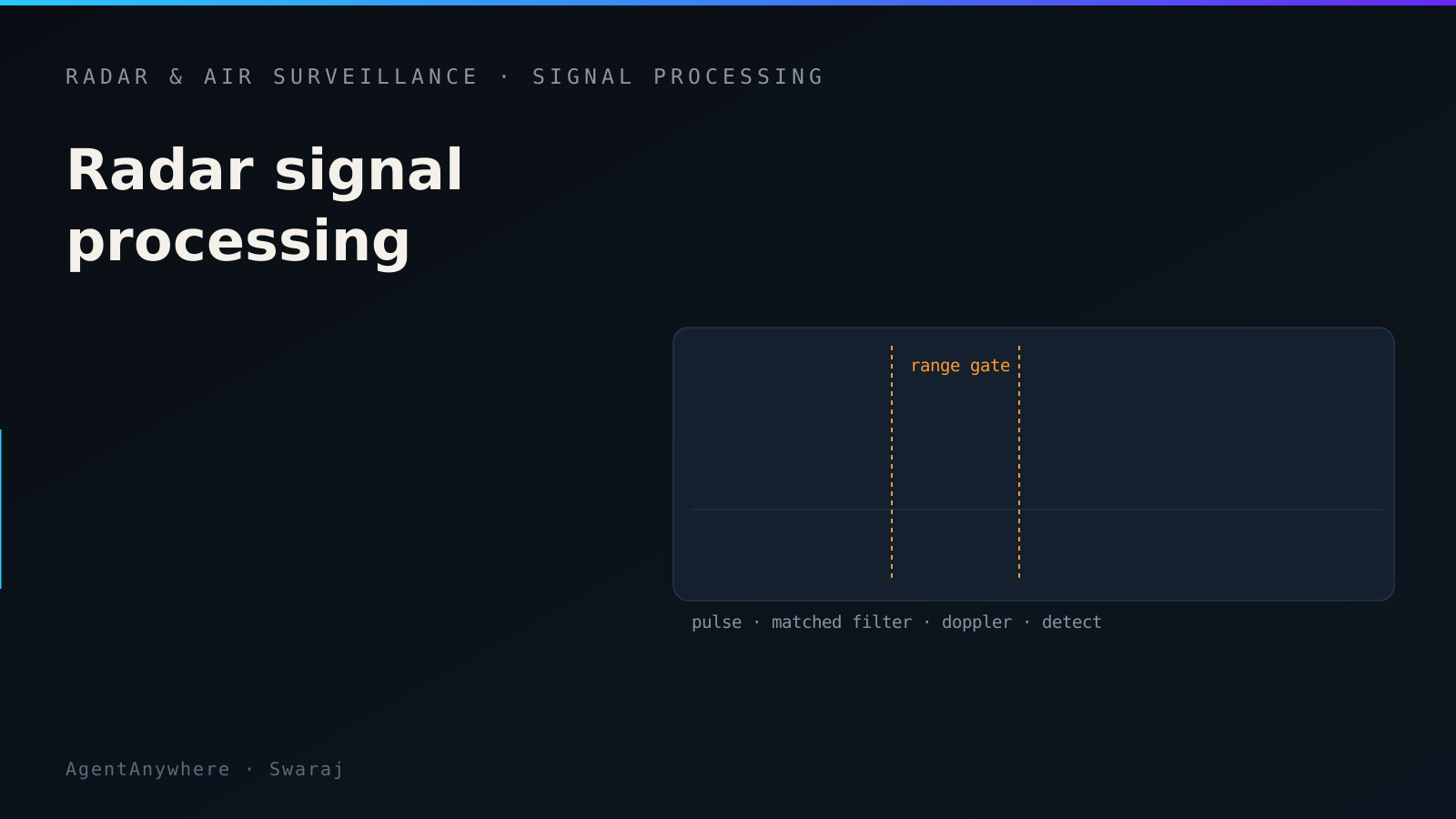
Matched filtering and pulse compression come first. A radar wants two things that fight each other: enough energy in the pulse to detect a distant target, and a short enough pulse to resolve two targets close in range. Transmitting a long coded pulse and compressing it on receive with a matched filter gives both — the energy of a long pulse with the range resolution of a short one, and a welcome boost in signal-to-noise ratio.
Doppler processing comes next. By looking at how the echo's phase changes across many pulses, the radar measures velocity and, crucially, separates moving targets from the static return of the ground, sea and buildings. This is the heart of MTI (moving-target indication) and pulse-Doppler radar: the background sits at zero Doppler, and the mover stands out from it.
The stages of radar signal processing
A typical air-surveillance chain, in order. Each stage has one job and hands a cleaner product to the next.
| Stage | What it does | Why it matters |
|---|---|---|
| Stage: Matched filter / pulse compression | Correlates the echo with the transmitted waveform. | Recovers weak returns and gives fine range resolution without a huge peak power. |
| Stage: Doppler processing | Measures velocity across a burst of pulses. | Separates moving targets from stationary clutter; enables MTI and pulse-Doppler. |
| Stage: CFAR detection | Sets an adaptive threshold from the local background. | Holds a constant false-alarm rate as noise and clutter vary across the scene. |
| Stage: Clutter & interference rejection | Suppresses ground, sea, weather and jamming returns. | Stops the real target from being buried under things that aren't targets. |
| Stage: Plot extraction & tracking | Groups detections and links them over time. | Turns scattered blips into the continuous path of one object. |
Detection: deciding a return is real (CFAR)
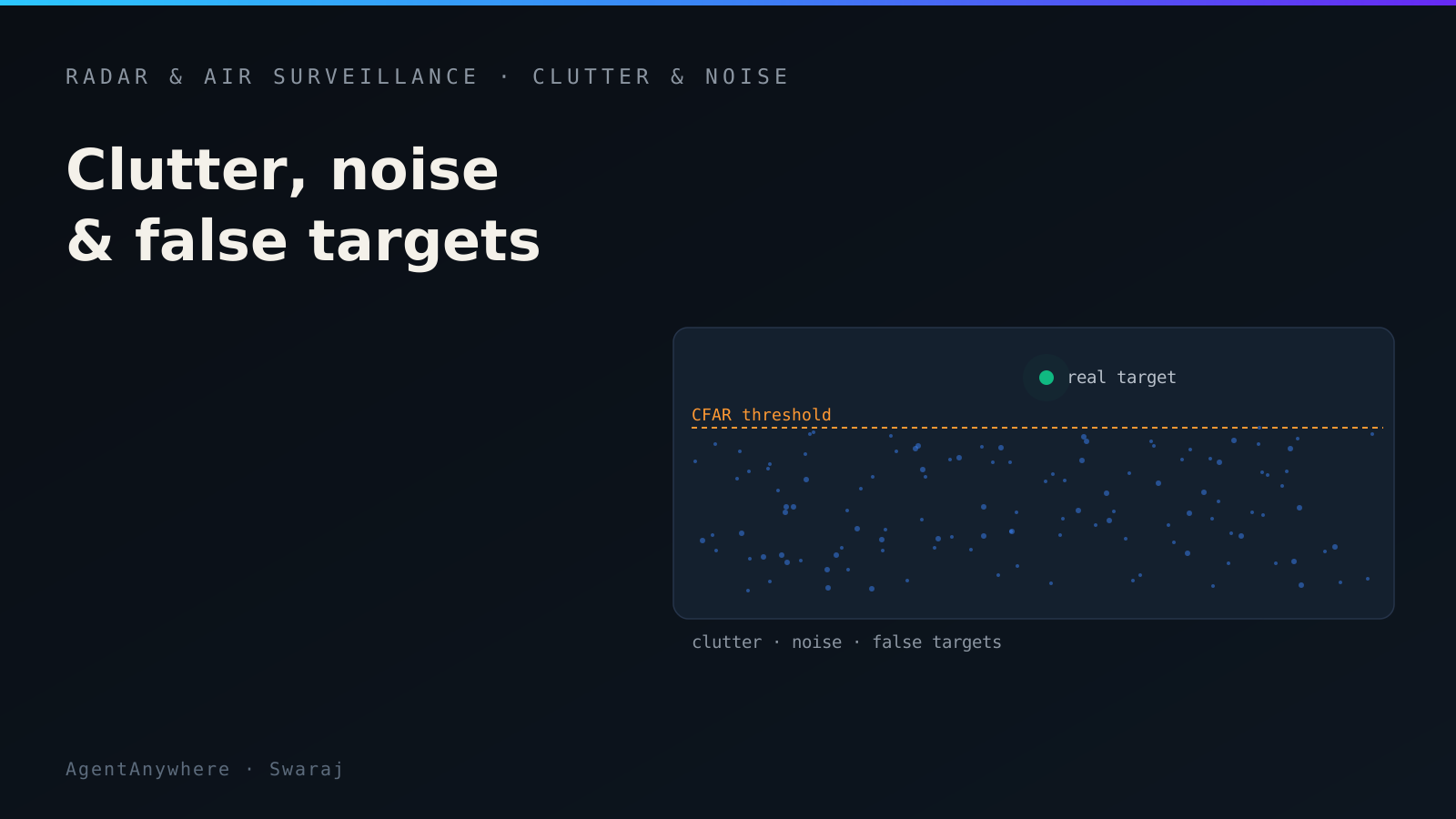
A detection is a decision: is this peak a target, or just a loud moment of noise and clutter? Set the threshold too low and the screen fills with false alarms; set it too high and you miss the faint, the small and the low.
The classical answer is CFAR — constant false-alarm rate detection. Instead of a fixed threshold, CFAR estimates the background level from the cells around the cell under test and sets the threshold relative to it, so the false-alarm rate stays constant even as noise and clutter change across the scene. It works well when the background is well-behaved — and struggles exactly where air surveillance is hardest: cluttered coastlines, urban edges, and targets close together.
That limitation is where learning helps: a detector trained on real target-and-background data separates the two by texture, not a single threshold, which is how modern systems pull a small drone return out of sea clutter a CFAR gate would bury or drown. We go deeper on this in how AI improves radar signal processing and understanding radar clutter and false targets.
Tracking: from blips to paths
A single detection tells you something is there now. Tracking turns a stream of detections into the path of one object — associating this scan's blip with the right track from last scan, smoothing the estimate, and predicting where the target will be next. Classical trackers (alpha-beta, Kalman filters, and multi-hypothesis methods for crowded skies) assume targets move according to a motion model.
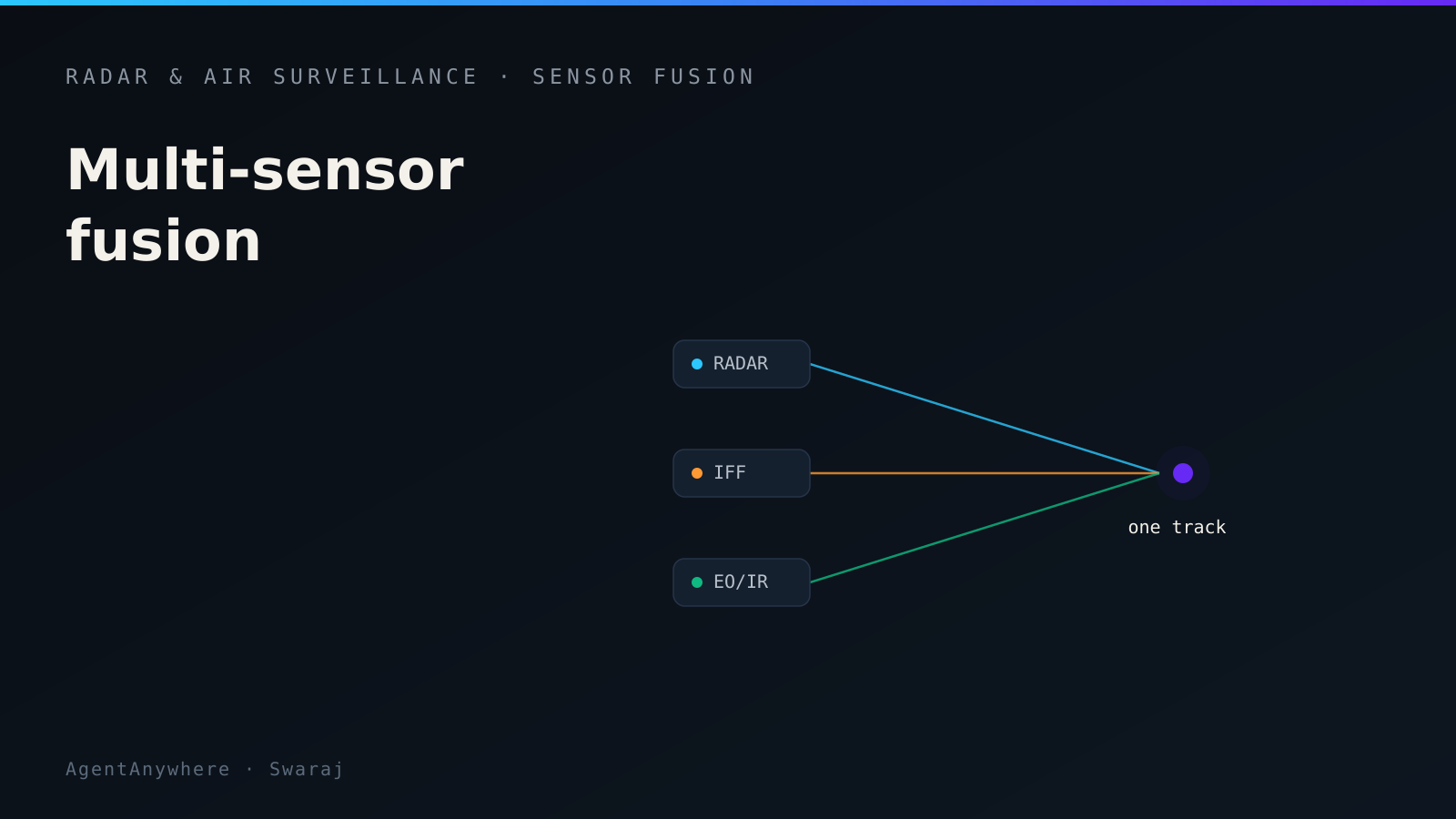
They struggle in the moments that matter: two tracks crossing, a target manoeuvring hard, or a contact dropping out for a few scans. Learned trackers hold identity through those moments and short dropouts, so a manoeuvring contact is not repeatedly 'lost' and re-acquired as a brand-new unknown. Robust tracking is also what makes multi-sensor fusion possible — you can only fuse a radar track with an IFF reply or a camera cue if each is a stable track in the first place. That is the subject of multi-sensor fusion in air surveillance.
More in this series
AI in radar & air surveillance — the pillar: how AI turns raw returns into a recognised air picture.
Clutter, noise & false targets — why radar sees things that aren't there, and how it is cleaned up.
Multi-sensor fusion — turning radar, IFF and EO/IR that disagree into one trusted track.
Radar + EO/IR fusion — how a radar cue and a camera confirmation work as one picture.
AI in signal processing — learned detection, recognition and ECCM beyond fixed thresholds.
Low-observable & low-flying targets — why small, slow, low drones are hard — and how AI pulls them out.
Frequently asked questions
What is radar signal processing in simple terms?
It is the chain of computational steps that turns the raw echo a radar receiver captures into a useful report of a target's range, bearing, velocity and track. It includes matched filtering to recover weak echoes and sharpen range, Doppler processing to measure velocity and separate movers from the static background, detection to decide which returns are real, clutter and interference rejection, and tracking to link detections over time into paths.
What is pulse compression and why is it used?
Pulse compression lets a radar transmit a long coded pulse and then compress it on receive with a matched filter. This gives the detection range of a long, high-energy pulse together with the fine range resolution of a short pulse, and improves the signal-to-noise ratio — resolving two closely spaced targets without needing enormous peak transmit power.
What is CFAR detection?
CFAR stands for constant false-alarm rate. Instead of using a fixed detection threshold, CFAR estimates the background noise and clutter level from the cells surrounding the one being tested and sets the threshold relative to it, so the false-alarm rate stays constant even as the background changes across the scene. It works well in uniform backgrounds and struggles in heavy, non-uniform clutter or where targets are close together.
How does Doppler processing separate targets from clutter?
By examining how an echo's phase changes across a burst of pulses, Doppler processing measures the target's radial velocity. Stationary clutter — ground, sea, buildings — returns at zero Doppler, while a moving target appears shifted away from it, so the mover can be separated from the static background. This is the basis of moving-target indication (MTI) and pulse-Doppler radar.
Where does AI fit into radar signal processing?
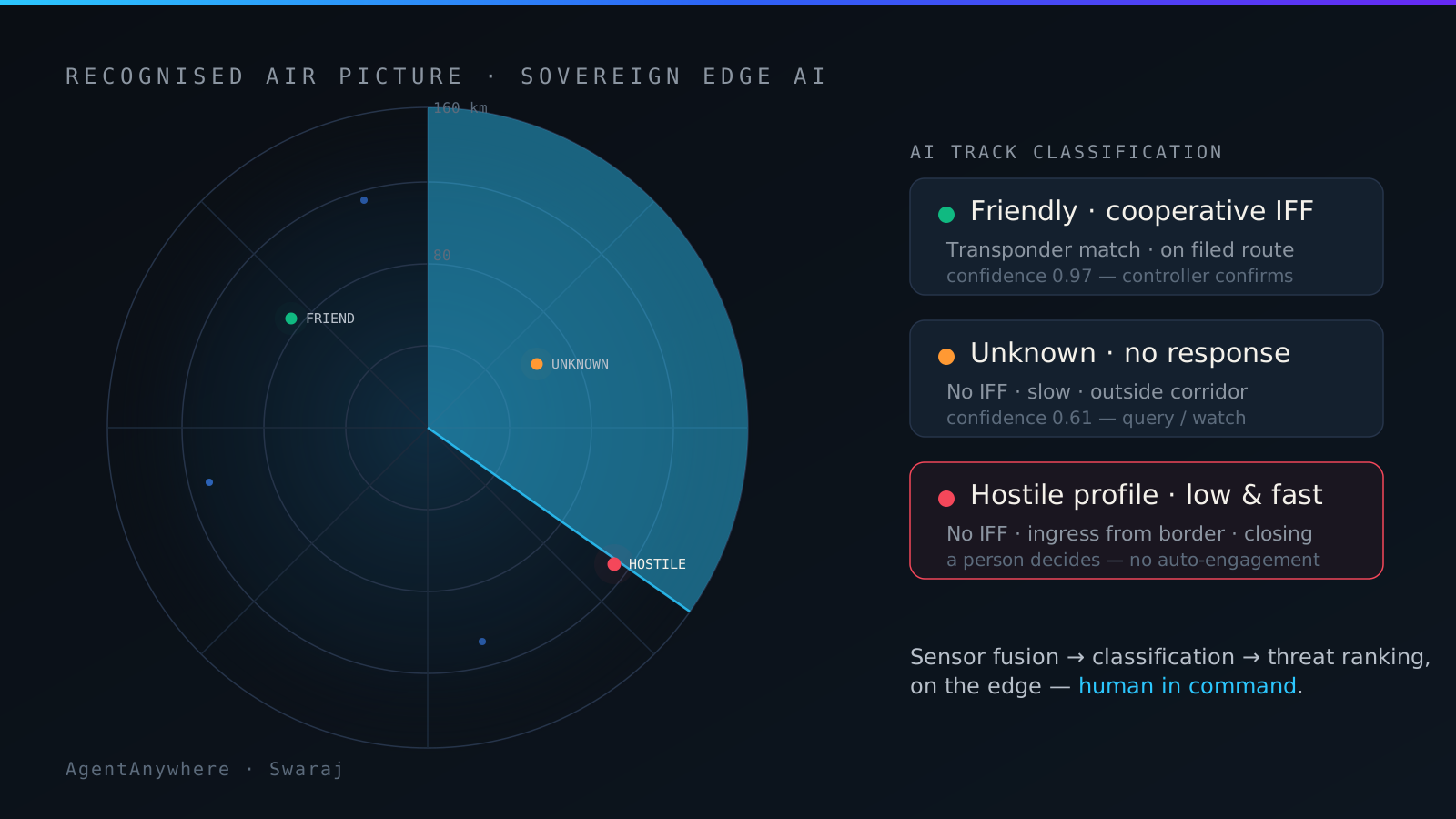
Each classical stage relies on fixed models and thresholds that trade sensitivity against false alarms. Machine learning adapts to the actual environment: learned detectors separate real targets from clutter by texture rather than a single threshold, and learned trackers hold identity through manoeuvres and dropouts. The result is better detection of small, slow, low targets and more reliable tracking, without flooding operators with false alarms.
Written by
AgentAnywhere Research
The team that builds the platform and the models
AgentAnywhere Research writes about the platform, the model families and the trust layer we build and run in India. Where a figure is ours, it says what it covers; where something is a demonstration, it says so.