
How does machine learning improve radar detection?
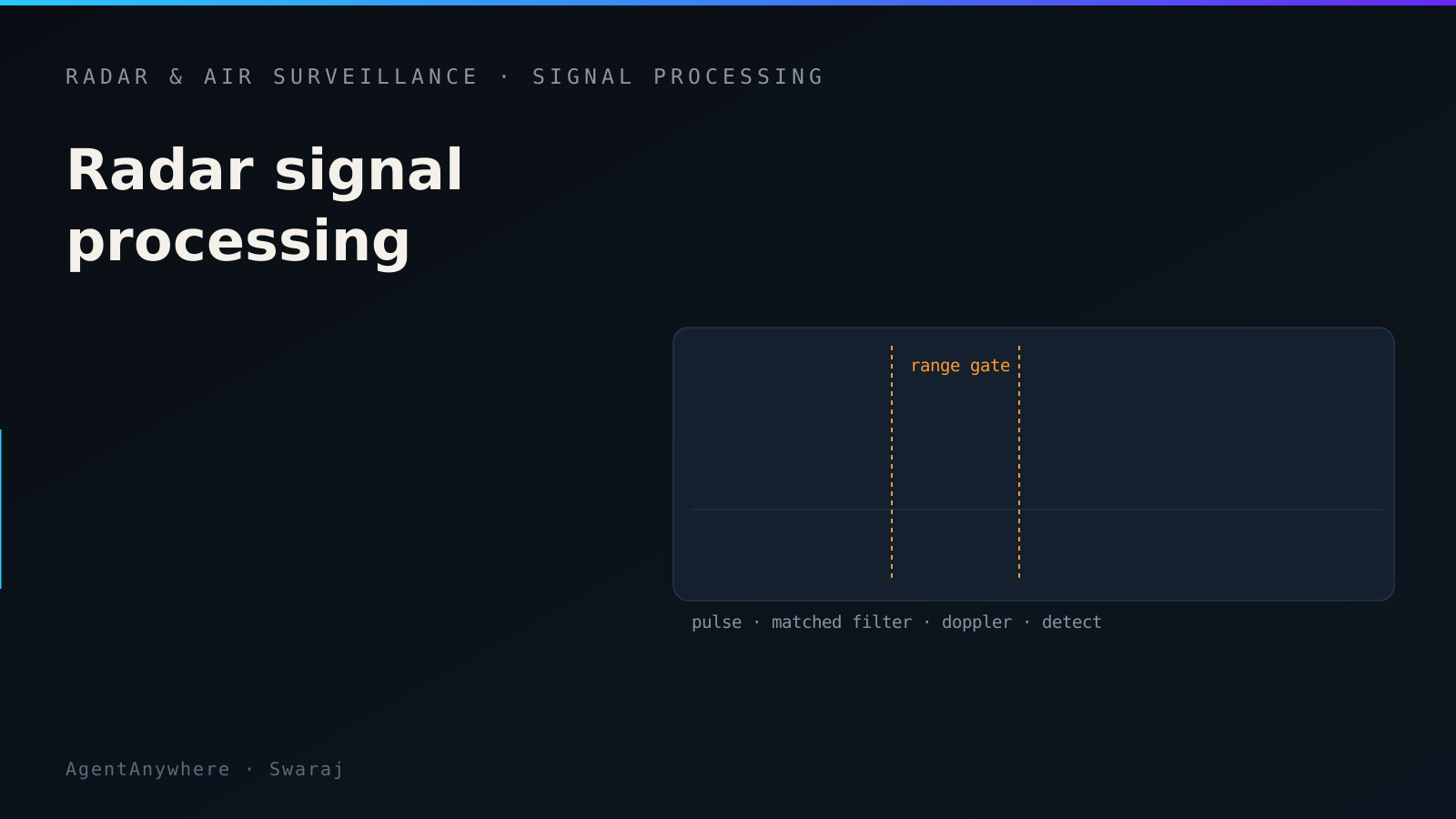
If you want the baseline first, what radar signal processing is walks the chain from matched filter to track. The short version: a detector must decide whether a peak is a target or a loud moment of noise and clutter, and the classical answer is CFAR, which sets an adaptive threshold from the cells around the one under test.
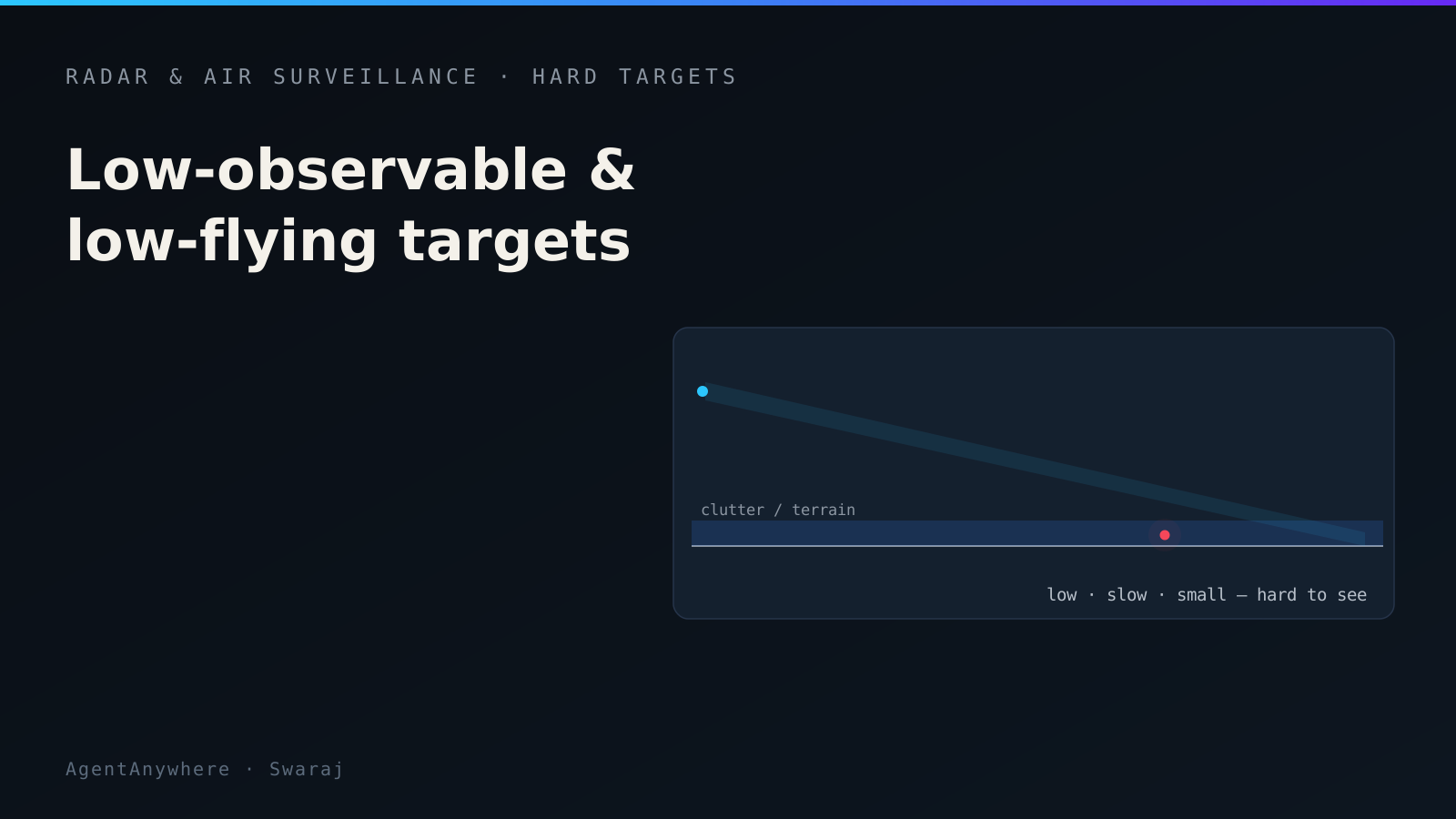
CFAR is elegant, but it assumes a reasonably well-behaved background. Near coastlines, urban edges, weather and terrain, the background is anything but, and a threshold has to be set high enough to avoid false alarms, which is exactly what hides the small, slow, low-flying contact you most want to find.
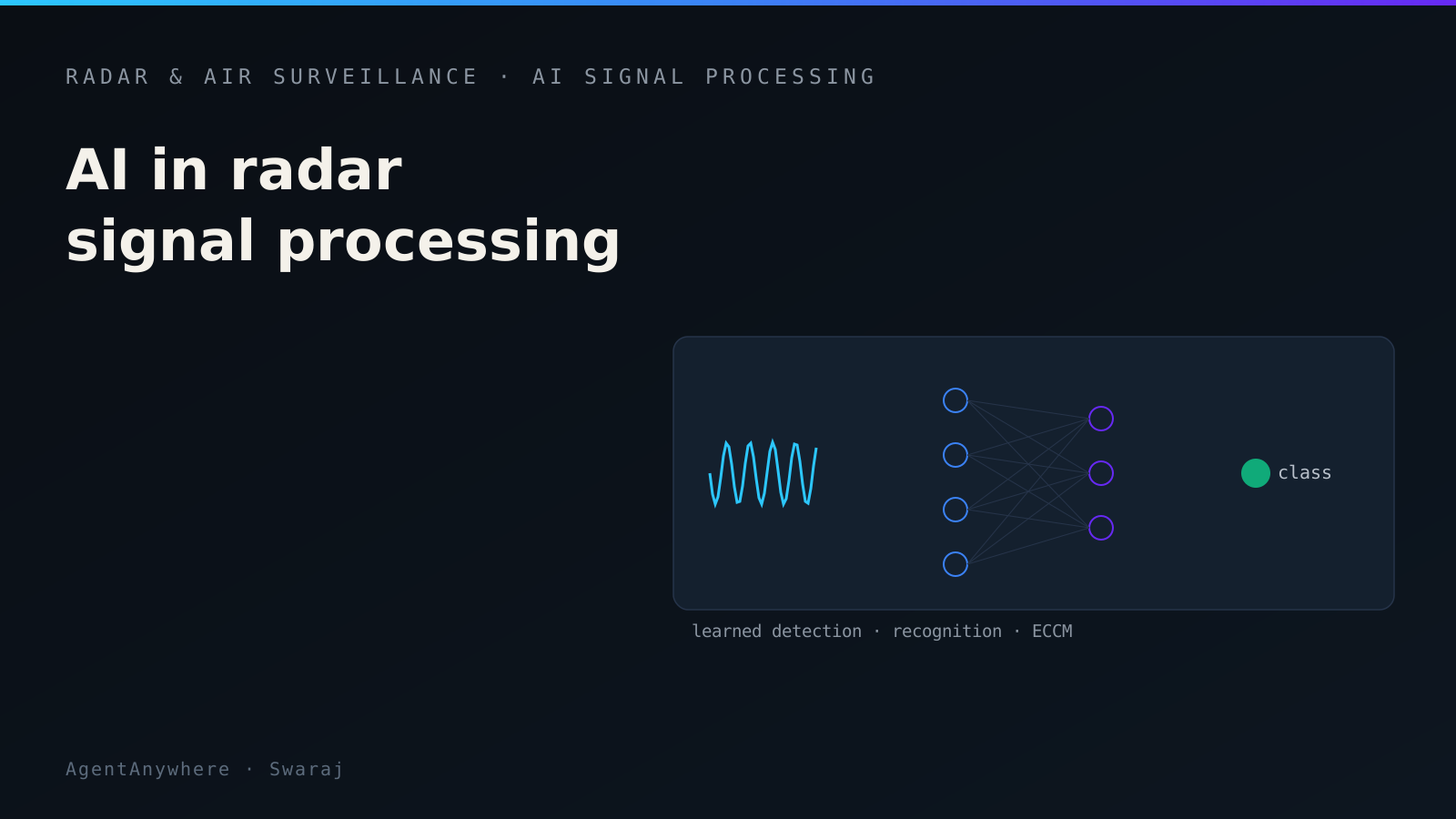
Learned detection treats the same data as a pattern-recognition problem. Trained on examples of targets and backgrounds, a model, typically a convolutional network working on range-Doppler maps or raw I/Q samples, learns the texture that separates a real return from clutter. It looks at structure across range, Doppler and time rather than one cell against its neighbours, so it can pull a faint return out of a background a fixed gate would bury or drown.
Learned clutter rejection follows the same logic. Sea, ground and weather clutter have characteristic statistics that vary with conditions; a model that has seen those conditions can suppress them adaptively, rather than relying on a clutter map or filter tuned for an average day. We unpack the sources of clutter and ghost contacts in radar clutter, noise and false targets.
Classical versus learned: task by task
Learning does not replace the radar chain; it upgrades individual decisions inside it. A side-by-side view of where the approaches differ.
| Task | Classical approach | Learned / AI approach |
|---|---|---|
| Task: Detection | CFAR sets an adaptive threshold from neighbouring cells. | A trained detector judges the pattern of a return against its background across range, Doppler and time. |
| Task: Clutter rejection | Clutter maps and Doppler filters tuned for typical conditions. | Models that adapt to sea state, terrain and weather they have been trained on. |
| Task: Target recognition | Hand-built features and rules on speed, altitude and radar cross-section. | Classifiers over micro-Doppler signatures and kinematics that separate classes of object. |
| Task: ECCM | Fixed waveform plans and pre-programmed responses to known jamming. | Adaptive waveform and parameter selection; learned recognition of jamming and spoofing patterns. |
| Task: Tracking | Kalman-style filters assuming a motion model. | Learned association and motion models that hold identity through manoeuvres and short dropouts. |
What is automatic target recognition (ATR) in radar?
Automatic target recognition (ATR) answers the question detection leaves open: not is something there, but what is it. A radar return carries more than position. The way a target moves, and the way its moving parts modulate the echo, leave a signature.
The best-known example is micro-Doppler. A rotating propeller, a flapping wing or a swinging limb adds a characteristic fine structure around the main Doppler shift of the body. A small multirotor drone and a bird can have similar size and speed, yet their micro-Doppler patterns differ, so a classifier trained on those patterns, often combined with kinematics such as how steadily the object holds course and altitude, can separate them where a simple speed-and-size rule cannot.
The same idea helps against decoys. A decoy can imitate a target's radar cross-section, but reproducing its full motion, modulation and behaviour over time is harder. A learned classifier that weighs many weak cues together is more resistant to a single faked feature than a rule that checks one.
Two cautions belong in any honest account. First, recognition is probabilistic: the useful output is a class with a confidence, and a good system says so when it is unsure rather than forcing a label. Second, models generalise only as far as their training data. A recogniser should be validated on the environments, sensors and target types it will actually meet, and that classification feeds a decision made by a person, not an automatic action. Recognition becomes far stronger when radar is combined with other sensors, which is covered in multi-sensor fusion in air surveillance.
What are cognitive radar and AI-driven ECCM?
A conventional radar transmits a fixed, pre-planned waveform and processes whatever comes back. Cognitive radar closes the loop: it senses its environment, learns from what it observes, and adapts what it transmits and how it processes on the next cycle. The radar becomes an agent that is continually choosing the waveform and parameters best suited to the scene in front of it.
That adaptivity is the foundation of modern ECCM, the techniques a radar uses to keep working under electronic attack. Jamming floods the receiver with noise or deceptive signals; spoofing injects false returns designed to look like targets. Fixed counter-measures work against the jamming they were designed for and little else.
Learning helps in two ways. First, recognition: a model trained on how jamming and spoofed returns differ statistically from genuine echoes can flag and reject them, including patterns that were not hand-coded in advance. Second, adaptation: the radar can shift waveform, frequency or processing to step around interference and re-test whether a contact survives the change, since a real target persists through such changes while many false returns do not.
The same caution applies, perhaps more strongly. Adaptive systems are harder to verify than fixed ones, and a model that has never seen a new jamming technique may handle it poorly. Responsible designs keep the adaptation bounded, log what the system changed and why, and keep a human able to see and override it.
Where should AI radar processing run?
Learned detection and recognition work on dense, fast sensor data, and the value of a recognised contact decays quickly. That argues for running inference at the edge, close to the sensor, rather than shipping raw returns to a distant data centre. It also keeps sensitive sensor data inside your own perimeter, which matters for any operator working under sovereignty or security constraints.
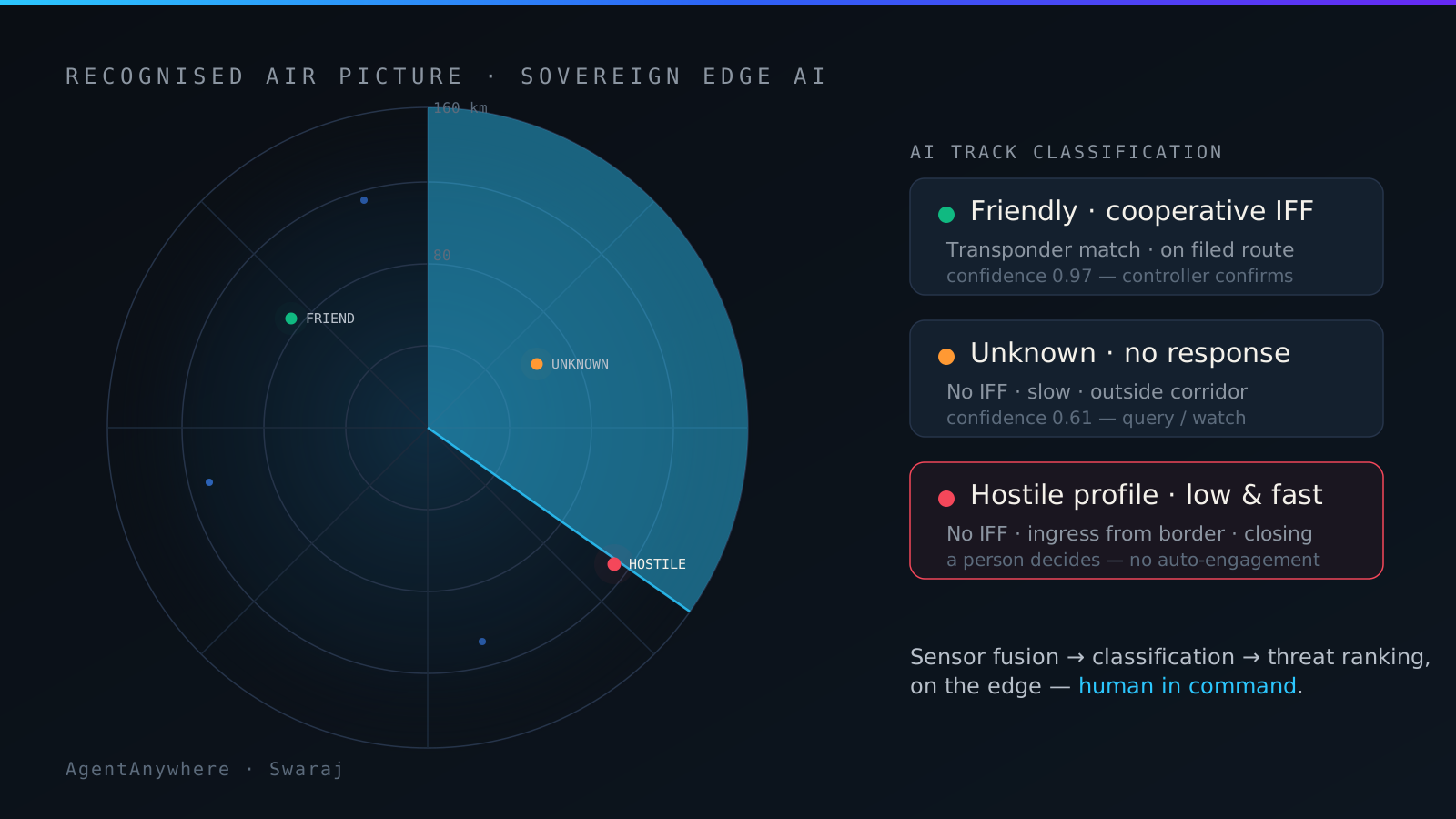
Just as important is that the output is auditable. A recognition that cannot be inspected is a poor basis for a serious decision. The posture AgentAnywhere builds to is decision support: the AI detects, classifies and recommends with its reasons, a human stays in command of every consequential call, and each recommendation carries an inspectable record. It is observe-and-assist, never a fire-control path.
Sanjaya is our sovereign edge-AI family for sensor telemetry, anomaly detection and prediction, designed to run inside the customer's perimeter. For how these pieces fit into a complete recognised air picture, including classification, threat ranking and why it increasingly runs at the edge, read the air-surveillance pillar, and see our sovereign models for the wider portfolio.
More in this series
AI in radar & air surveillance — the pillar: how AI turns raw returns into a recognised air picture.
Radar signal processing — what happens to the echo — detection, Doppler, CFAR and tracking.
Clutter, noise & false targets — why radar sees things that aren't there, and how it is cleaned up.
Multi-sensor fusion — turning radar, IFF and EO/IR that disagree into one trusted track.
Radar + EO/IR fusion — how a radar cue and a camera confirmation work as one picture.
Low-observable & low-flying targets — why small, slow, low drones are hard — and how AI pulls them out.
Frequently asked questions
How is AI used in radar signal processing?
AI is used to improve the decisions made inside the radar chain. Learned detectors judge a return against its background rather than a single threshold, learned clutter rejection adapts to sea, ground and weather conditions, classifiers recognise what a target is from micro-Doppler and kinematics, and learned association keeps tracks stable through manoeuvres. The underlying physics, such as matched filtering and Doppler processing, is retained.
What is automatic target recognition (ATR) in radar?
Automatic target recognition is the use of algorithms, increasingly machine learning, to classify what a radar detection is rather than only that something is present. It draws on signatures such as micro-Doppler from rotating blades or flapping wings, together with kinematics such as speed, altitude and course stability, to separate classes of object, for example a drone from a bird. The output is a class with a confidence, intended to support a human decision.
Can AI tell a drone from a bird on radar?
Often it can help. A drone's rotors and a bird's wings modulate the radar echo differently, producing distinct micro-Doppler patterns, and the two also tend to move differently over time. A classifier trained on those cues can separate them more reliably than a rule based on size and speed alone. Performance still depends on the radar, the environment and the quality of the training data, so it should be validated on the conditions it will face.
What is cognitive radar?
Cognitive radar is a radar that closes the loop between sensing and transmitting. It observes its environment, learns from what it sees, and adapts its waveform and processing on the next cycle to suit the scene, rather than transmitting a fixed pre-planned waveform. It underpins adaptive approaches to interference and electronic counter-countermeasures.
How does AI help radar resist jamming and spoofing?
In two main ways. Models trained on the statistical differences between genuine echoes and jamming or spoofed returns can recognise and reject them, including patterns not hand-coded in advance. And the radar can adapt its waveform, frequency or processing to step around interference and check whether a contact persists. Because adaptive systems are harder to verify than fixed ones, responsible designs bound the adaptation, log it, and keep a human able to inspect and override.
Written by
AgentAnywhere Research
The team that builds the platform and the models
AgentAnywhere Research writes about the platform, the model families and the trust layer we build and run in India. Where a figure is ours, it says what it covers; where something is a demonstration, it says so.