
What an EO/IR camera adds that radar cannot
An electro-optical / infrared (EO/IR) unit combines a daylight camera with a thermal imager, usually on a pan-tilt head with a zoom lens. It adds three things radar does not give you.
Visual and thermal identity. Radar sees a reflection; it has little to say about shape, markings, payload or whether a small contact is a bird, a drone or something else. An image does, and a thermal image shows heat signatures as well. This is the evidence a human operator trusts when deciding what a contact is.
Day and night. The thermal channel works in darkness, so day-night surveillance does not depend on ambient light. The daylight channel adds detail when light is good.
Passive confirmation. A camera does not transmit. It observes without emitting anything an adversary can detect or locate, which matters in sensitive environments and is one reason EO/IR is a favourite second sensor beside an emitting radar.
What radar adds that EO/IR cannot
A camera has a narrow field of view: it sees only where it points, so on its own it must search slowly. Radar covers the opposite ground. It scans a wide area continuously and keeps working in cloud, rain, haze and darkness, where optical and thermal performance can degrade.
Radar also measures — range, bearing and radial velocity of each contact — and keeps a track over time. A single passive camera gives a good bearing and angular size but struggles to give range on its own. So the radar supplies the where and the how fast; the camera supplies the what.
Who does what: radar versus EO/IR
Each sensor covers the other's blind spot, which is the whole case for pairing them.
| Capability | Radar | EO/IR |
|---|---|---|
| Capability: All-weather detection | Strong — works through cloud, rain and haze | Weather-limited — fog and heavy rain degrade the image |
| Capability: Range measurement | Direct measurement of range, bearing and velocity | Good bearing; range is hard to get from one camera |
| Capability: Identity confirmation | Weak — a reflection, not an identity | Strong — visual and thermal evidence of what it is |
| Capability: Day and night | Same by day and night | Thermal works in darkness; daylight channel needs light |
| Capability: Passive / covert | Emits energy that can be detected | Passive — observes without transmitting |
The cue-and-confirm workflow
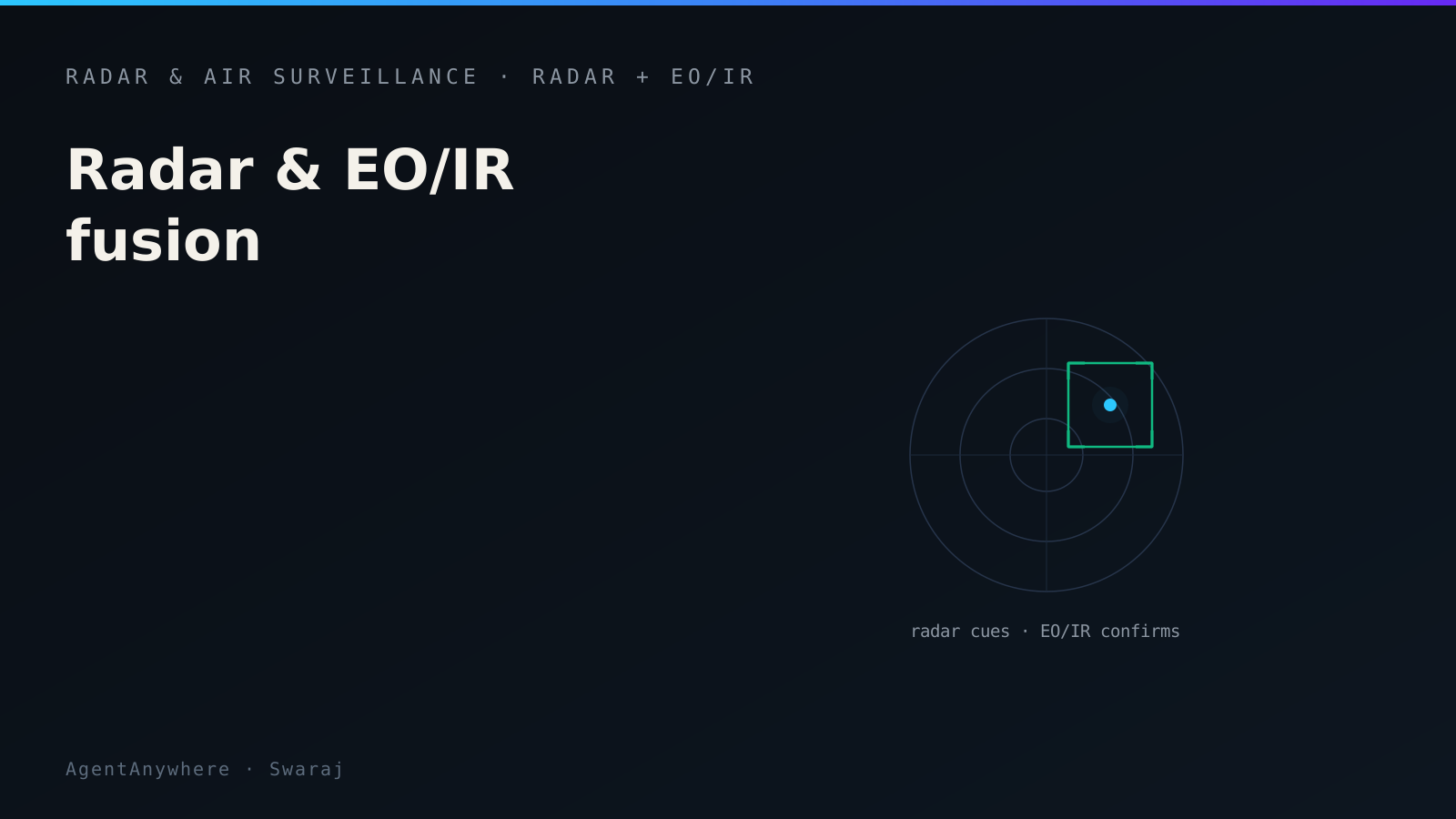
In practice the pairing runs as a short loop. 1. Detect: the radar picks up a contact and starts a track. 2. Cue: the track's position and motion are converted into pointing angles and sent to the EO/IR head, which slews to the contact — slew-to-cue — and sets zoom and focus to suit the estimated range. 3. Confirm: the camera acquires the contact and the image is checked, by an operator, by a classifier, or both, to establish what it is. 4. Fuse: the camera detection and the radar track are tied to one fused track carrying position, velocity and identity evidence.
Cueing is what makes the camera useful at area scale. Without it, an operator hunts across a wide sky with a narrow lens; with it, the camera arrives where the radar already knows to look, and the operator's attention goes to judging the image rather than finding the contact.
Aligning the sensors and resolving disagreement
Fusion only works if the two sensors agree about where and when. Space: the radar and the camera sit in different places with different reference frames, so their positions must be registered into a common frame, and the camera's pointing must be calibrated against the radar's measurements. Time: the radar updates at its scan rate, the camera at its frame rate, and a moving contact is somewhere different at each instant, so measurements are time-stamped and extrapolated to a common moment before they are compared.
Even then the sensors will sometimes disagree. The radar reports a contact the camera cannot see — it may be beyond the lens, behind cloud, or simply not visible. The camera shows an object the radar does not report, perhaps too small or slow to stand out from clutter. Or two contacts sit inside one camera frame. Good fusion does not pretend these away: it keeps the disagreement visible, attaches a confidence to each track, and flags contacts that remain unconfirmed rather than quietly promoting or discarding them. This is the association problem described in the multi-sensor fusion guide.
Where AI helps
Automatic cueing. Software can drive the camera from radar tracks without a person steering it, prioritising which contact to look at next when several compete for one lens.
Visual classification. A trained model can recognise the class of what the camera sees — for example separating a small drone from a bird or other airborne clutter — and report a confidence with its reasons, giving the operator a head start on the judgement.
Holding the fused track. Learned association keeps radar and camera detections attached to the same object as it manoeuvres, passes behind obstacles, or leaves the camera's view for a few seconds, instead of splitting one contact into two ghost tracks.
Sovereign, at the edge, with a human in command
Camera frames and radar tracks are sensitive. Running cueing, classification and fusion at the edge, inside the operator's own perimeter, avoids sending surveillance imagery to a third-party cloud, and keeps the picture available when links are degraded. Our wider view of why this matters is in the air-surveillance pillar.
AgentAnywhere's posture here is decision support: the AI cues, classifies and recommends with its reasons, a human makes every consequential call, and each recommendation carries an inspectable record. Sanjaya is our sovereign edge-AI family for sensor telemetry and anomaly detection; see the sovereign model portfolio.
More in this series
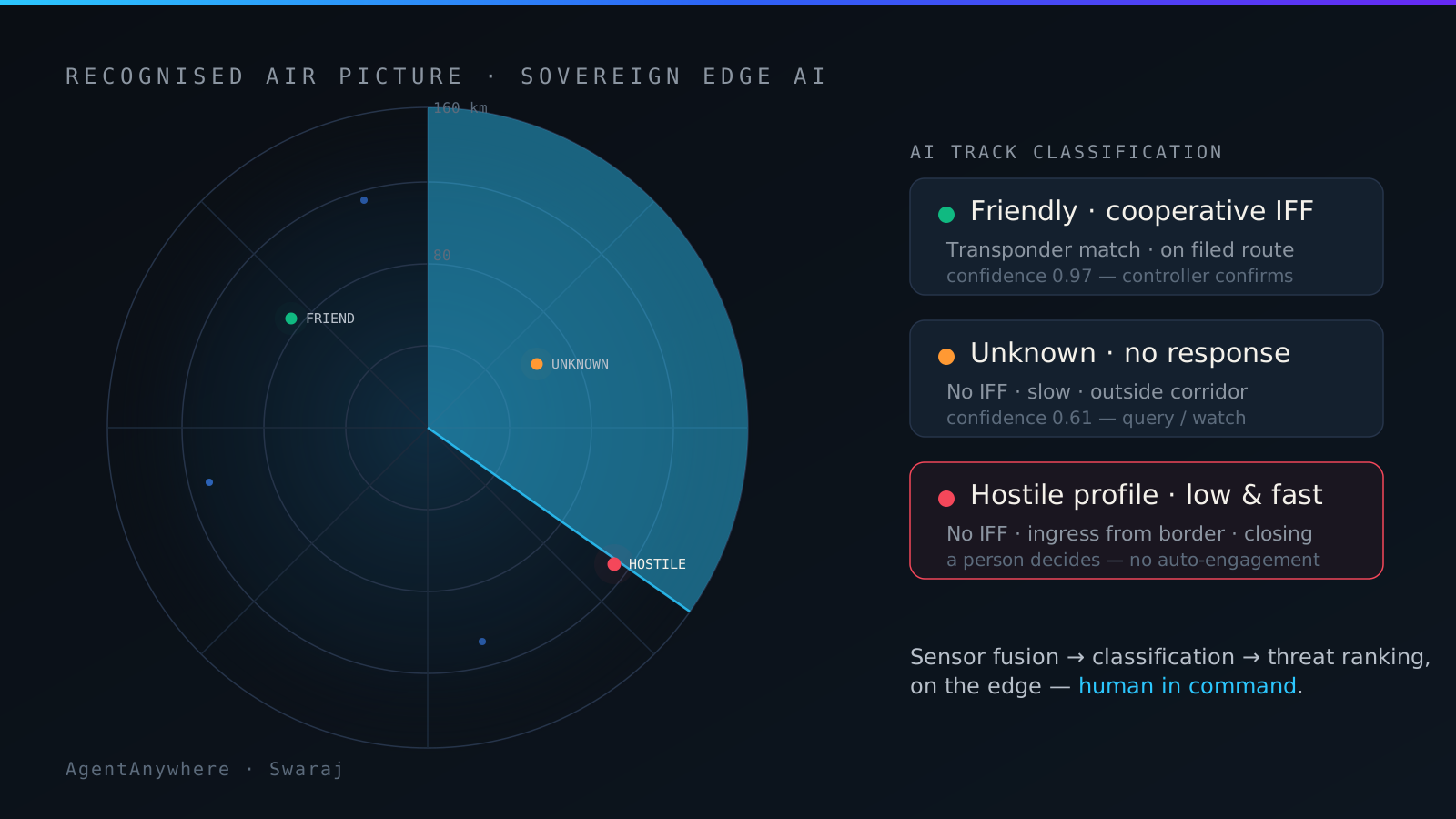
AI in radar & air surveillance — the pillar: how AI turns raw returns into a recognised air picture.
Radar signal processing — what happens to the echo — detection, Doppler, CFAR and tracking.
Clutter, noise & false targets — why radar sees things that aren't there, and how it is cleaned up.
Multi-sensor fusion — turning radar, IFF and EO/IR that disagree into one trusted track.
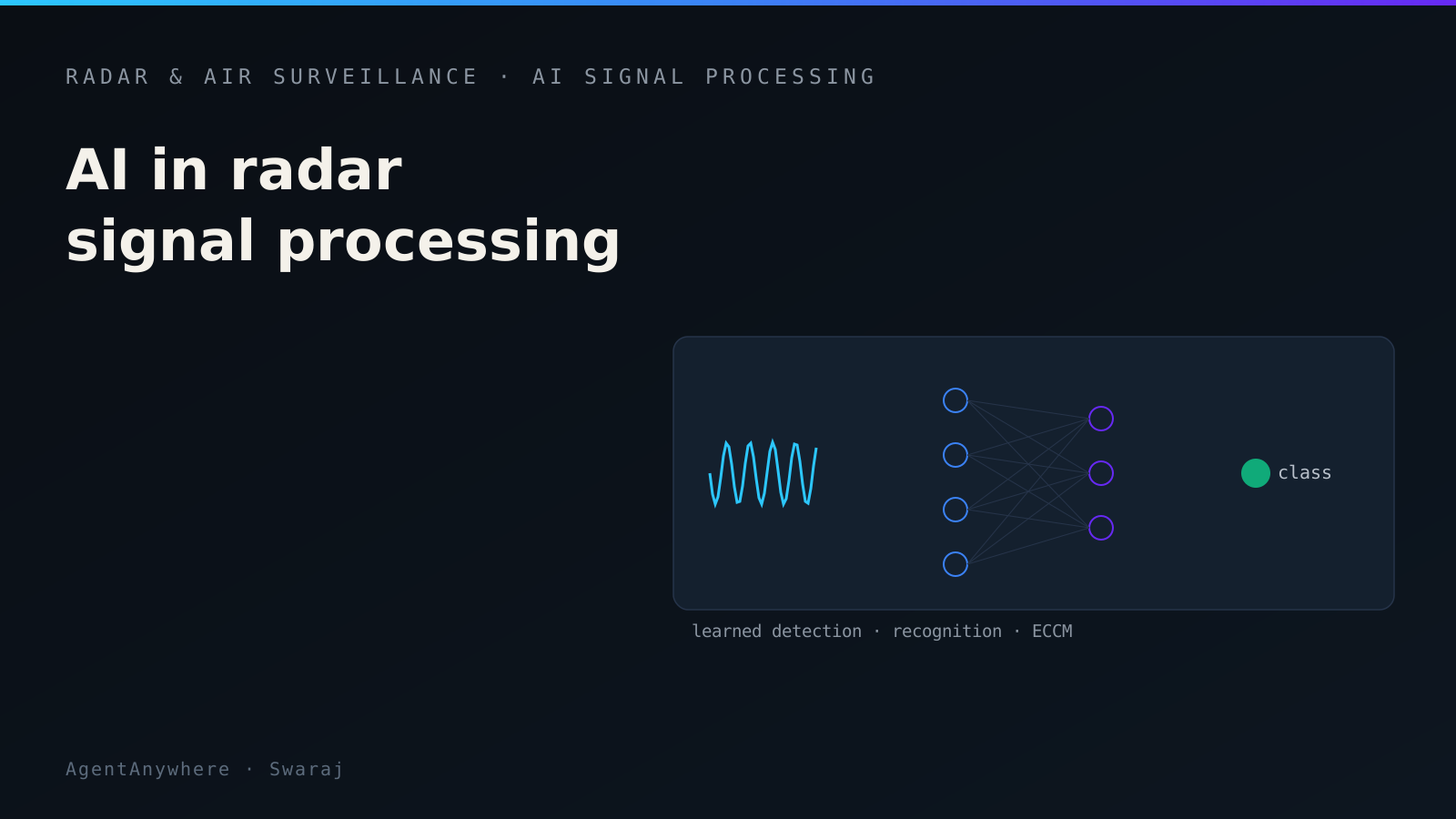
AI in signal processing — learned detection, recognition and ECCM beyond fixed thresholds.
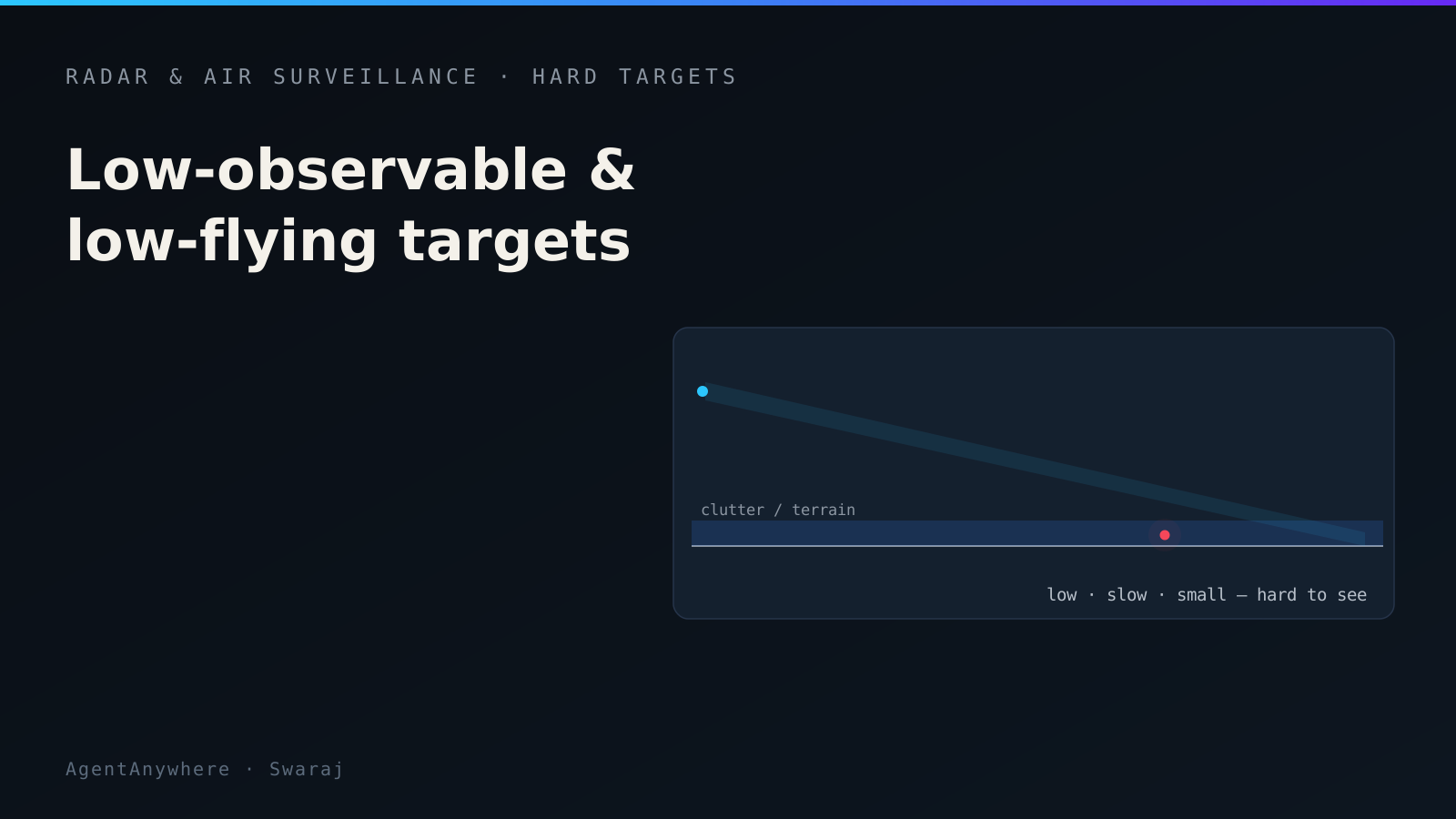
Low-observable & low-flying targets — why small, slow, low drones are hard — and how AI pulls them out.
Frequently asked questions
What is radar EO/IR fusion?
Radar EO/IR fusion combines a radar with an electro-optical / infrared camera into one surveillance picture. The radar provides wide-area, all-weather detection and measures range, bearing and velocity; the EO/IR camera provides a visual or thermal view that shows what a contact actually is. Their outputs are aligned in time and space and merged into a single fused track per object.
What does cue and confirm mean?
Cue and confirm is the workflow where one sensor tells another where to look, and the second sensor verifies what is there. The radar detects a contact and cues the camera with its position; the camera slews to it and its image confirms, or fails to confirm, the contact and what it is. The two are then merged into one track.
What is slew-to-cue?
Slew-to-cue is the automatic pointing of a pan-tilt camera at a position supplied by another sensor, usually a radar track. The radar's position and motion are converted into pointing angles for the camera, which turns and zooms toward the contact so that the narrow-field camera arrives where the radar already knows to look, instead of being steered by hand.
Why not use a camera alone, or radar alone?
Each has a blind spot the other covers. Radar sees wide areas in any weather and measures range and velocity, but gives little identity. A camera gives visual and thermal identity, works passively and handles day and night with its thermal channel, but sees only where it points and can be limited by fog or heavy rain. Together they give detection, measurement and confirmation.
How does AI improve radar and EO/IR fusion?
AI helps with automatic cueing so the camera follows radar tracks without manual steering, with visual classification of what the camera sees, and with association — holding one coherent fused track as a contact manoeuvres, is briefly hidden, or is seen by only one sensor. In responsible systems the AI recommends with its reasons and a human makes every consequential decision.
Written by
AgentAnywhere Research
The team that builds the platform and the models
AgentAnywhere Research writes about the platform, the model families and the trust layer we build and run in India. Where a figure is ours, it says what it covers; where something is a demonstration, it says so.