
Why low and small is hard: the physics
A radar sees a target by the energy that comes back. Radar cross-section (RCS) is the measure of how much a target reflects toward the radar, and it is not the same as physical size: shape, material and orientation all matter. A small object made largely of plastic and composites, or a shaped airframe designed to scatter energy away from the source, returns far less than a conventional aircraft. Lower RCS means a weaker echo, and a weak echo is easier to lose in receiver noise and clutter.
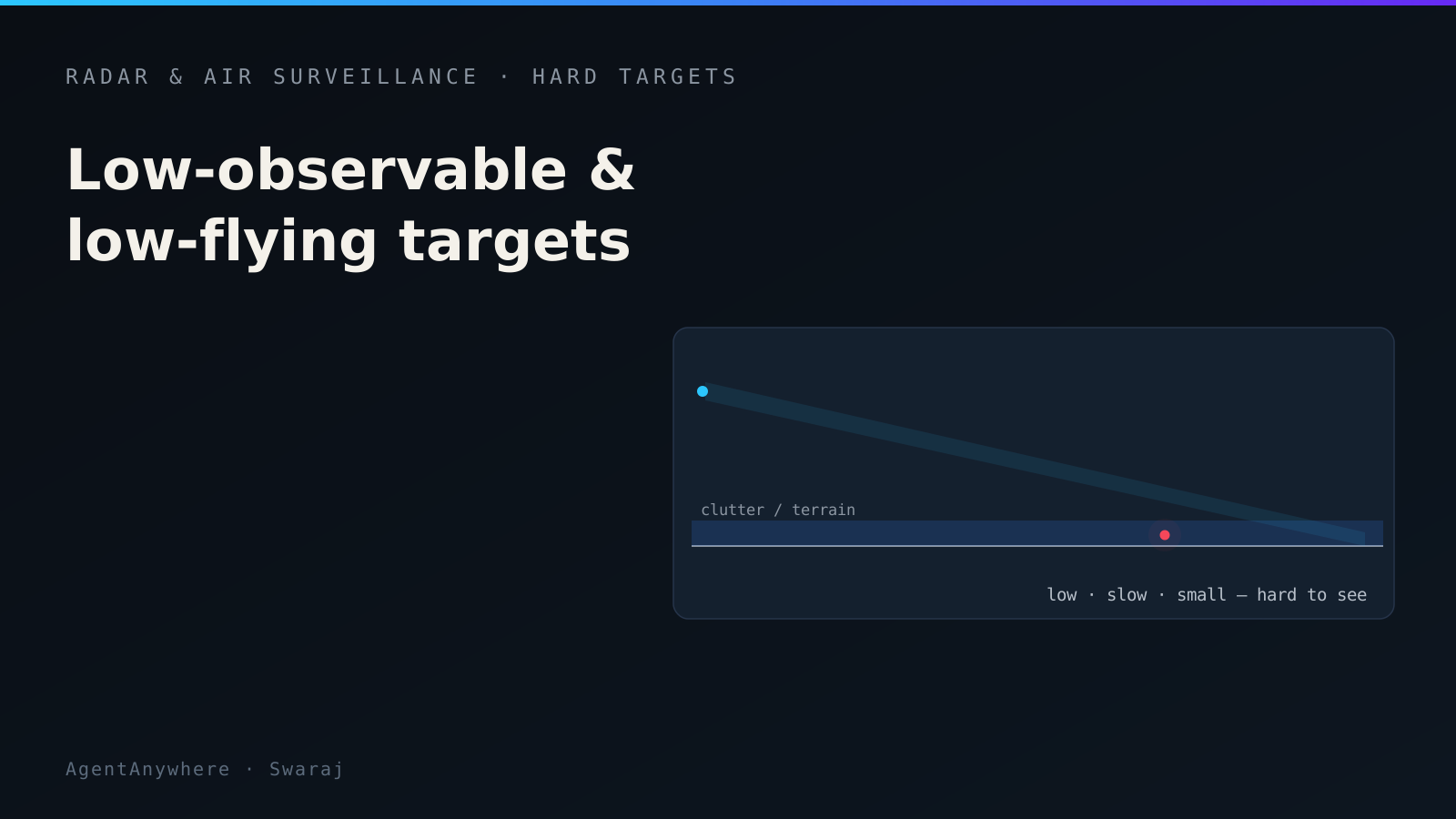
Geometry works against low flyers as well. Radar energy travels in roughly straight lines while the Earth curves away beneath it, so there is a radar horizon: below a certain height, a target at long range is simply not illuminated. Hills, buildings and tree lines add terrain masking, and over water, waves and multipath can hide or distort a low contact. Flying low is one of the oldest ways to shorten the time a radar has to see you — which is why low-flying aircraft detection depends so heavily on sensor placement and on combining sensors rather than on any one radar alone.
Slow speed is the third problem. Doppler processing separates movers from the static background, but a hovering or creeping target has a radial velocity close to that of the clutter itself, so the filter that removes the ground can remove the target with it. We cover that trade in detail in understanding radar clutter, noise and false targets.
Four reasons these targets slip through, and where AI helps
Each difficulty has a different physical cause, so each needs a different kind of help.
| Why it's hard | What's happening | How AI helps |
|---|---|---|
| Why it's hard: Low RCS | Small size, composite materials or shaping return a faint echo that sits close to the noise floor. | A learned detector judges the return against the pattern of real targets and real background, so a weak but consistent echo is kept instead of discarded by a single threshold. |
| Why it's hard: Radar horizon and terrain masking | Earth curvature, hills and waves leave low targets unilluminated or visible only in brief glimpses. | Track models hold identity through short dropouts, and fusion hands the contact to another sensor with a better view. |
| Why it's hard: Slow speed in the clutter notch | A hovering or creeping target has near-zero radial velocity, so clutter filtering removes it with the background. | Detection that uses texture, Doppler spread and behaviour over time rather than velocity alone keeps the slow return. |
| Why it's hard: Small drone versus bird | Both are small, slow and low, and both can look alike in a plain radar detection. | Micro-Doppler classification separates the periodic signature of rotors from the irregular signature of flapping wings. |
The small-drone problem: bird or multirotor?
Small drone detection is the sharpest form of the problem. A multirotor is physically small, often lightweight and plastic, can hover, and flies low. A flock of birds is also small, slow and low, and birds are far more numerous than drones. A system that raises an alert for every bird is quickly ignored; one that filters birds too aggressively can miss the one contact that matters.
The key is micro-Doppler. A target's body moves at one velocity, but its moving parts add their own small frequency shifts around it. Spinning rotor blades produce a rapid, regular, periodic signature; a bird's wings beat slowly and irregularly, and the body glides between beats. Seen as a time-frequency picture, those signatures look different, and that difference is exactly the kind of pattern a trained classifier is good at reading — more reliably than a hand-set rule on speed or amplitude.
The honest caveats matter. Micro-Doppler needs a sufficient dwell on the target and enough signal to resolve the moving parts, so it works best as one input among several, with a confidence the operator can see rather than a bare label. Because the goal here is counter-drone detection and identification, the output is an alert and a classification for a person to review.
How AI helps: three mechanisms
Learned detection. A fixed CFAR threshold looks at one cell against its neighbours. A learned detector is trained on real examples of targets and real examples of clutter, and judges texture, shape, Doppler spread and persistence together. That lets it retain a faint, slow return while rejecting a clutter spike of similar strength, improving detection of hard targets and reducing false alarms together rather than trading one for the other. The broader argument is in the air-surveillance pillar.
Micro-Doppler classification. Once a candidate return is detected, a classifier trained on rotor and wing signatures can label it as likely multirotor, likely bird, or unknown, and say how confident it is. This is the step that turns 'something small is out there' into a usable alert, while keeping genuine uncertainty visible instead of hiding it.
Multi-sensor cueing. No single sensor sees every low target. A radar with a poor view of a valley can hand a rough position to an optical or infrared camera, and an acoustic or radio-frequency sensor can add a bearing. A system that fuses these into one track is far harder to blind with terrain or clutter than any sensor alone. We explain how conflicting sensors become one trusted track in multi-sensor fusion in air surveillance.
Edge, sovereign and human in command
Low-flying and small-drone detection is also a latency and trust problem. Contacts can appear and vanish within seconds, the sensors are often at remote or exposed sites, and the data from them is sensitive. That argues for inference at the edge, close to the sensor, inside the operator's own perimeter, rather than a round trip to a distant cloud, and for models the operator can inspect and control. Our sovereign edge-AI family for sensor telemetry is Sanjaya; you can see the wider sovereign model portfolio.
The posture is decision support and observe-and-assist. A detection system should surface a contact, its classification and its confidence, flag when its inputs look degraded, and leave every consequential decision to a person who is in command. Detection and identification are the scope here; anything beyond that belongs to the operator and their chain of authority, not to the model.
More in this series
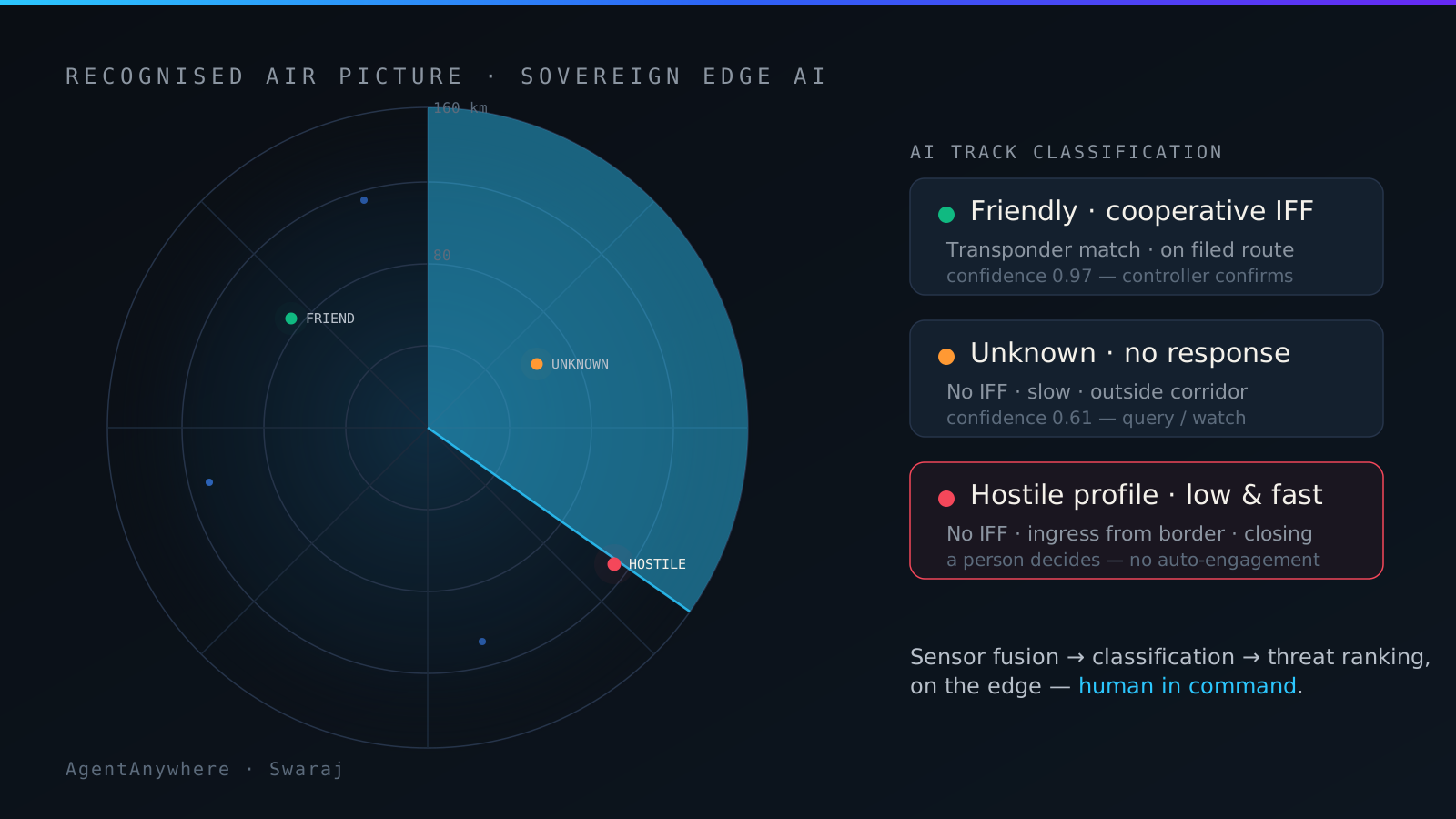
AI in radar & air surveillance — the pillar: how AI turns raw returns into a recognised air picture.
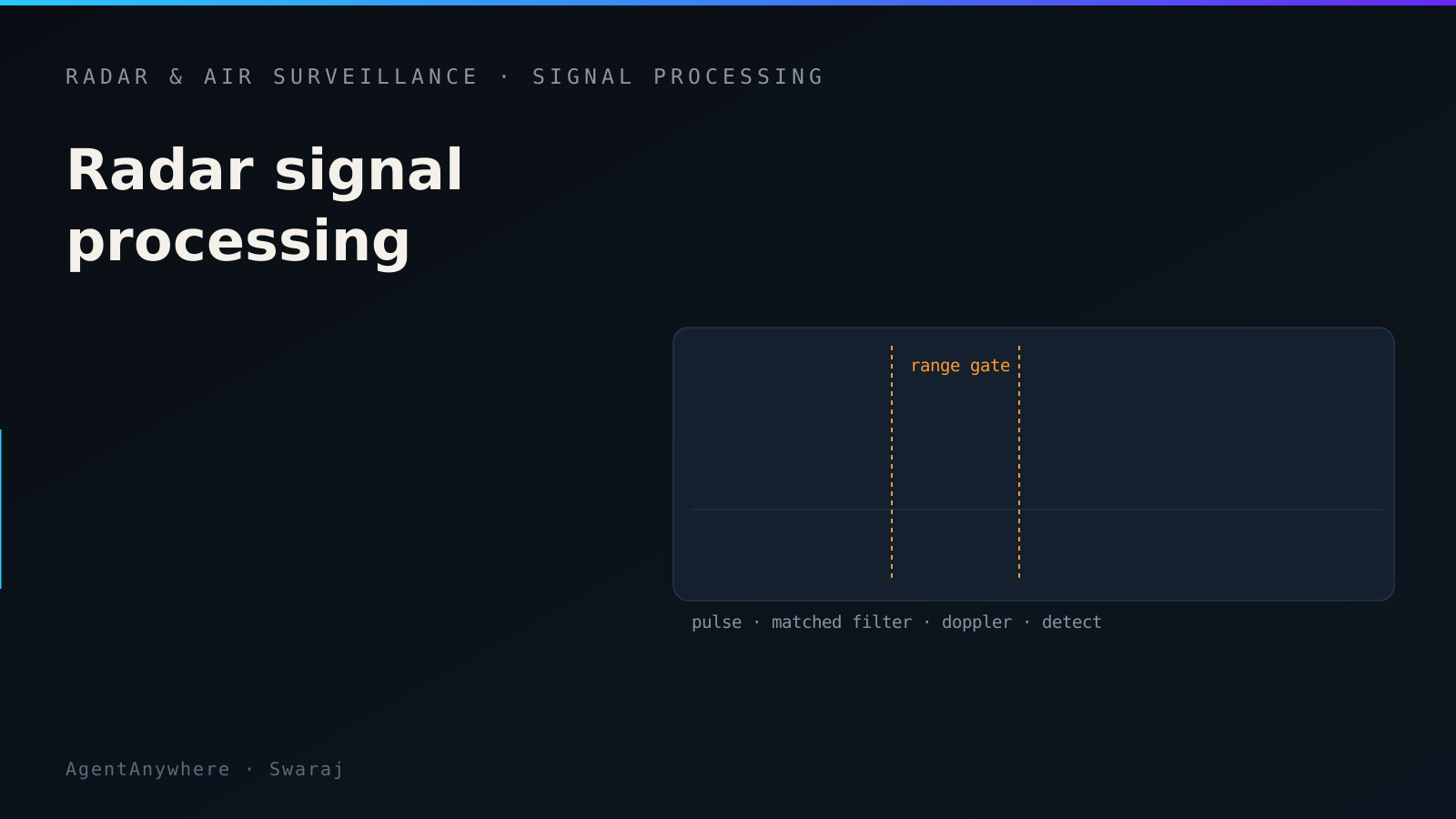
Radar signal processing — what happens to the echo — detection, Doppler, CFAR and tracking.
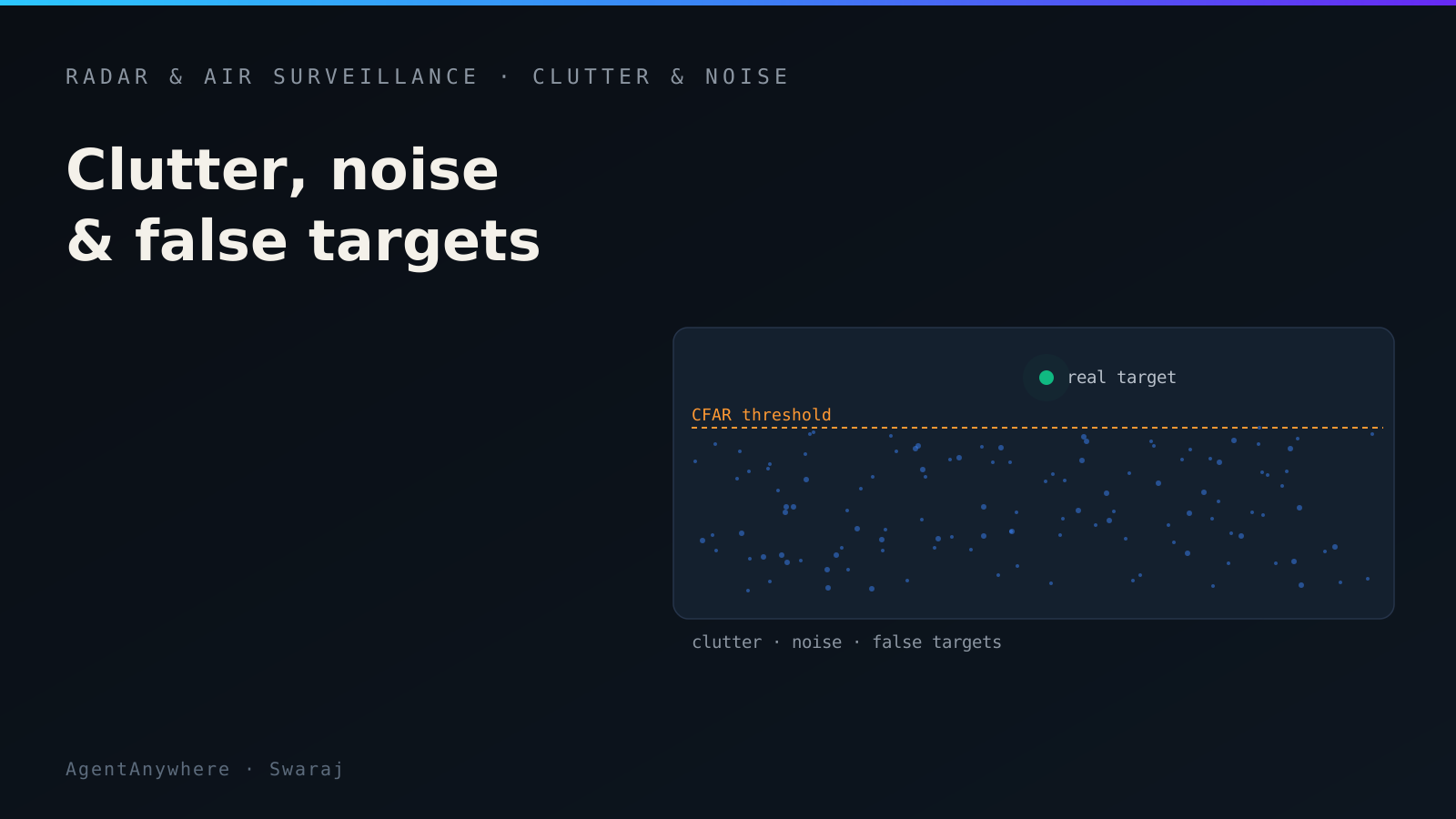
Clutter, noise & false targets — why radar sees things that aren't there, and how it is cleaned up.
Multi-sensor fusion — turning radar, IFF and EO/IR that disagree into one trusted track.
Radar + EO/IR fusion — how a radar cue and a camera confirmation work as one picture.
AI in signal processing — learned detection, recognition and ECCM beyond fixed thresholds.
Frequently asked questions
Why is low-flying aircraft detection so difficult for radar?
Several things stack up. The radar horizon means a low target at long range is below the beam. Terrain, buildings and waves mask or distort returns. Low flyers sit in the strongest ground and sea clutter. And if the target is also small or slow, its echo is weak and its velocity is close to that of the clutter, so standard clutter filtering can remove it. This is why low-flying detection usually relies on good sensor placement and on combining several sensors.
What is radar cross-section (RCS) and why does low RCS matter?
Radar cross-section measures how much energy a target reflects back toward a radar. It depends on size, shape, material and viewing angle, not on size alone. A target with low RCS returns a weaker echo, which sits closer to the receiver noise floor and is easier to lose in clutter. Low-observable targets are those whose design, materials or small size keep that return low.
How can radar tell a small drone from a bird?
A key method is micro-Doppler analysis. A drone's spinning rotors add a fast, regular, periodic frequency modulation around the body's velocity, while a bird's wing beats are slower and irregular. A classifier trained on these time-frequency patterns can separate the two more reliably than a rule based on speed or amplitude. It works best with enough dwell time and signal, and alongside other sensors such as cameras.
How does AI improve detection of low-observable and slow targets?
Learned detectors judge a return against the pattern of real targets versus real clutter, using texture, Doppler spread and behaviour over time instead of a single threshold or velocity cut. That lets them keep weak, slow returns while rejecting clutter spikes of similar strength. Learned trackers also hold a track through short dropouts caused by terrain masking, and classifiers add micro-Doppler identification.
Does counter-drone detection mean the system acts against the drone?
No. In this context counter-drone detection means detecting, tracking and identifying a small aerial contact and presenting it, with a confidence level, to an operator. It is decision support. Any response is a human decision made through the operator's own chain of authority, not something a detection model performs.
Written by
AgentAnywhere Research
The team that builds the platform and the models
AgentAnywhere Research writes about the platform, the model families and the trust layer we build and run in India. Where a figure is ours, it says what it covers; where something is a demonstration, it says so.