
TATVA · CARS & VEHICLES
Private previewAn in-car assistant that works in the tunnel, on the ghat road, and off the map.
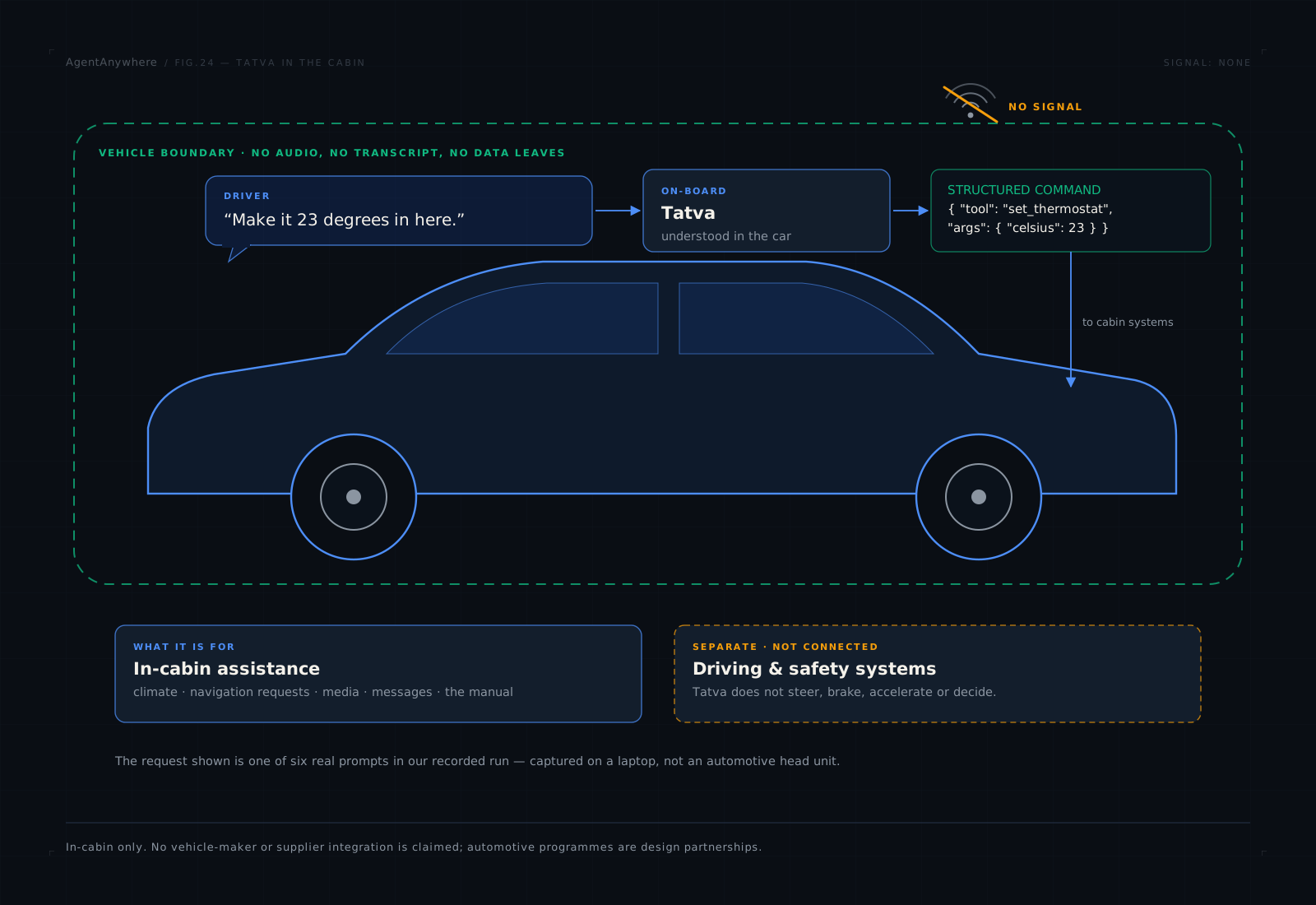
Tatva runs inside the vehicle, with no connection. “Make it 23 degrees in here” becomes a structured command in a fraction of a second, without a word leaving the cabin. For the in-cabin experience — not the driving. Built in India, in private preview.
In short
Tatva for vehicles is an on-device AI model from AgentAnywhere that runs inside the car with no internet connection. It turns a driver's or passenger's plain-language request — climate, navigation, media, messages — into a structured command locally, so it works without signal and nothing said in the cabin leaves the vehicle. It is built in India and is in private preview.
- Runs
- Inside the vehicle. No signal, no cloud, no round-trip.
- Does
- Spoken or typed request → structured command for cabin systems.
- Privacy
- What is said in the car stays in the car.
- Scope
- In-cabin assistance only. Never driving or safety functions.
Claims last reviewed · Tatva is in private preview.
A voice assistant that needs four bars is not a car feature.
Cloud voice assistants work beautifully in the showroom and the city centre. Then the road goes into a tunnel, up a ghat, across a border, or simply into the long stretches between towers — and the assistant says it is having trouble connecting, in exactly the moment a driver should not be looking at a screen.
A car is an edge device that moves through the worst connectivity it can find. The assistant has to live in the car. Tatva is small and efficient enough to do that, which means the experience is the same in a basement car park as it is on a motorway.
A real run, replayed at the speed it happened.
This is not an animation of a model — it is a recording of one. Six in-cabin style requests were run against Tatva and the token stream was captured with its real timings; what plays below is that capture, including its cold start. It was recorded on a laptop, not on an automotive head unit, and it needed no network — this page has none to offer it.
tell Priya I'll be late
{"tool": "send_message", "args": {"to": "Priya", "body": "I'm going to be late"}}- first token
- 0.42s
- complete
- 0.75s
- throughput
- 96.8 tok/s
Two things a connected assistant cannot give you.
It always answers
There is no network call in the path, so there is no network failure in the path. Climate, navigation, media and messaging requests are understood on-board, with the same response whether the car has full signal or none.
No round-trip also means the response does not wait on a server you do not control, in a region you did not choose.
It keeps the cabin private
A car hears everything: the phone call, the argument, the address you are driving to. With Tatva, the request is interpreted inside the vehicle and no audio or transcript is sent anywhere to be understood.
For a vehicle maker, that is also a simpler story to tell a regulator and a customer: the data was never collected, so it cannot leak, be subpoenaed from a third party, or be used to train someone else's model.
What it is for.
Comfort & climate
“Make it 23 degrees in here.” A sentence becomes a structured command with a named argument your cabin software already understands.
Navigation
“Navigate to the airport.” Understood on-board, then handed to your navigation system as an exact destination request.
Media & messages
“Put on some Rahman.” “Tell Priya I'll be late.” The everyday requests, without the everyday dependency on a signal.
The manual, spoken
A natural-language front door to your own vehicle's functions and documentation — scoped to what your vehicle can actually do.
Fleets & commercial vehicles
Trucks, buses and field vehicles that spend their working lives outside good coverage.
Vehicle makers & suppliers
A sovereign in-cabin model to ship under your brand, on your hardware, with no per-request dependency on anyone's cloud.
Built for the languages people actually speak in the car.
Tatva is trained from scratch in India, with Indian languages and English in the training mix by design rather than by accident. People switch languages mid-sentence in a car more than anywhere else; an assistant for Indian roads has to be built with that in mind from the first token.
The exact language coverage for a vehicle programme is scoped and measured with you, not asserted here.
It plans the action — or it declines.
Tatva maps language onto a defined set of commands with named arguments — the vocabulary your cabin software exposes — and onto nothing else. A request with no matching in-scope action returns no action, rather than a confident guess.
That narrowness is deliberate. A general-purpose chatbot in a moving vehicle is a liability; a small model that does a small set of things reliably, and refuses the rest, is a feature.
What Tatva for vehicles is not.
In a vehicle, an unstated boundary is a safety claim. So here is the boundary, stated.
- It is not a driving system. Tatva does not steer, brake, accelerate, or make any driving or safety decision, and it is not part of any driver-assistance function.
- It is not connected to safety-critical vehicle functions. It is for in-cabin comfort, navigation, media and information requests.
- It is not shown running on an automotive head unit. The replayed run on this page was recorded on a laptop; performance on your in-vehicle hardware is something we measure with you.
- It is not an automotive-specialised model yet, and no vehicle maker or supplier integration is claimed. That is design-partner work.
- It is not a general chatbot in your dashboard. It is deliberately narrow.
FAQ
Frequently asked questions.
- Can an in-car voice assistant work without an internet connection?
- Yes. Tatva runs inside the vehicle and interprets requests on-board, so it works in tunnels, remote areas and anywhere without signal. There is no cloud round-trip in the path, so connectivity does not affect whether the assistant responds.
- Does anything the driver says leave the car?
- No. With Tatva the request is understood on the vehicle's own compute. No audio and no transcript is sent to a cloud service to be interpreted, so what is said in the cabin stays in the cabin.
- Does Tatva drive the car or control safety systems?
- No. Tatva is for in-cabin assistance only — climate, navigation requests, media, messages and information. It does not steer, brake or accelerate, it is not part of any driver-assistance function, and it is not connected to safety-critical systems.
- How fast is it?
- The run on this page is a real recording replayed at its true speed, including its cold start, with the timings read from the capture file rather than written into the page. It was recorded on a laptop, not an automotive head unit; we measure performance on your target hardware with you instead of quoting a number that would not transfer.
- Does it understand Indian languages?
- Tatva is trained from scratch in India with Indian languages and English in the training mix by design. The specific languages and the level of coverage for a vehicle programme are scoped and measured with the manufacturer.
- Can a vehicle maker ship Tatva under its own brand?
- That is the intent. Tatva runs on your hardware with no per-request dependency on a third-party cloud. It is in private preview, and automotive programmes are taken on as design partnerships.
Build the assistant that still works when the signal doesn't.
Tatva is in private preview. We are working with vehicle makers, suppliers and fleet operators on in-cabin experiences that are private by construction. Bring your cabin's command set.