Listen to any Indian helpline for ten minutes
“Mera account se double debit ho gaya hai, please check karo.” “Order cancel karna hai, refund kab tak aayega?” “Ambulance chahiye, address note kar lo.” Nobody on those calls is making a mistake. They are speaking the language they think in.
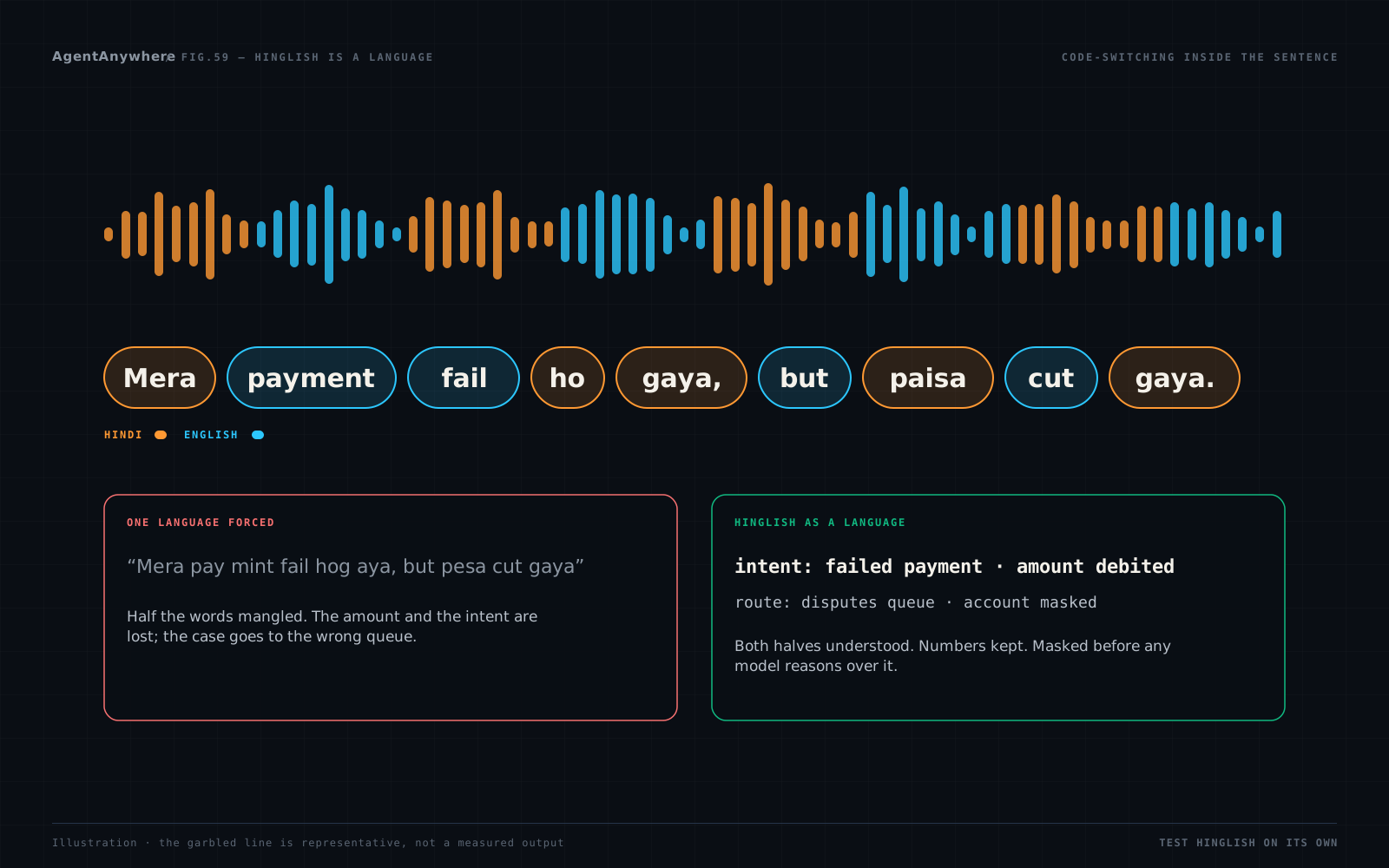
Bank terms, product names, numbers, dates and emotions arrive in whichever language comes first. The grammar holding the sentence together is usually Hindi; the words carrying the business meaning are often English. Take either half away and the request stops making sense.
Yet most voice systems deployed in India were built for a world of one language per sentence. They were built elsewhere, for someone else's customers, and then adapted.
Five ways voice AI breaks on Hinglish
It guesses one language
Language detection picks Hindi or English for the whole utterance, and the half it did not pick gets transcribed as nonsense.
It learned from clean speech
Read-aloud, single-language recordings do not sound like a worried customer on a mobile line in a busy street.
It trips on Roman script
“Kar do”, “kardo”, “krdo”: the same words spelled five ways in chats and transcripts, none of them in a dictionary.
It loses the numbers
Amounts, account digits and dates said in English inside a Hindi sentence are exactly the tokens that matter, and exactly the ones that get dropped.
It answers in the wrong register
A reply in formal Hindi or corporate English to a Hinglish question feels like talking to a form. People hang up.
What building for Hinglish properly looks like
Treat it as its own language in the data. Collect real code-mixed speech from the channels you serve, with consent, and label it as Hinglish, not as Hindi with noise.
Test on it separately. A single “Hindi accuracy” number hides Hinglish failure completely. Measure Hinglish on its own frozen test set, and publish nothing you have not measured.
Understand intent, not only words. In a contact centre, the goal is not a perfect transcript. It is knowing that this is a failed payment with money debited, and routing it correctly.
Protect what gets said. People say account numbers, card digits and addresses out loud. Mask them before any model reasons over the transcript, and keep nothing you do not need.
Answer in kind. Match the caller's mix and tone, within whatever your policy allows.
How to test a vendor on Hinglish in one afternoon
Bring your own calls
Take a few dozen real, consented recordings from your own channels (a mix of Hinglish, Hindi and English, noisy and clean) and hold them back as a private test set the vendor never sees in advance.
Ask for results broken out by language, with Hinglish as its own row. If the vendor cannot separate it, that is your answer.
Score what matters
Did it get the intent right? Did it capture the amount, the date, the account reference? Did it route to the right queue? Did it mask what should be masked?
Then ask where the audio went while it was being processed. For many Indian institutions, a recording sent to an overseas transcription service is a data export, whatever the contract calls it.
What we are building
AgentAnywhere Vaani is our Indic voice stack, built around exactly this. It starts with seven languages, English, Hinglish, Hindi, Urdu, Tamil, Telugu and Marathi, and treats Hinglish as a language in its own right: measured on its own, never inferred from Hindi. Calls are understood on Indian infrastructure, sensitive values are masked by Veil before any model reasons over them, and only an anonymised tally is kept.
We are honest about the parts: speech recognition and synthesis in AgentAnywhere Vaani currently use open-licensed components as an interim, running on Indian infrastructure; the masking, classification, routing, safety logic and evaluation are ours. It is in private preview, the first pilot is being built, and we will publish accuracy only when it is measured on a frozen test set. Our on-device command model, Tatva Edge, takes Hinglish instructions like “AC 22 pe kar do” for the same reason.
If your customers speak Hinglish, book a session with us and bring a few of your own calls.
Frequently asked questions
Is Hinglish a language?
Linguists describe Hinglish as code-mixing or code-switching between Hindi and English, usually with Hindi grammar and English vocabulary, often written in Roman script. For building voice AI, the practical answer is to treat it as a language in its own right: collect it, label it and test on it separately.
Why does speech recognition fail on Hinglish?
Most systems guess a single language per utterance, are trained on clean monolingual speech, struggle with Romanised spellings, and lose numbers, names and dates spoken in English inside Hindi sentences.
How should I evaluate a voice AI vendor for Hinglish?
Use a private test set of your own consented calls that the vendor has not seen, ask for results broken out with Hinglish as its own row, score intent, key values and routing rather than transcript perfection alone, and ask where the audio is processed.
What is AgentAnywhere Vaani?
AgentAnywhere Vaani is AgentAnywhere's Indic voice stack, in private preview. It starts with English, Hinglish, Hindi, Urdu, Tamil, Telugu and Marathi, processes calls on Indian infrastructure, masks sensitive values before any model reasons over them, and keeps only an anonymised tally.
Written by
Siddhartha Chandurkar
Founder, ShepHertz Technologies
Siddhartha Chandurkar writes for AgentAnywhere, the sovereign AI platform built by ShepHertz Technologies, which has put AI into production since 2012.