
A transformation hiding in plain sight
The automotive industry has spent the last decade changing how vehicles are powered, connected and operated. Electric mobility is reinventing propulsion. Connected-car technology has reshaped the driving experience. Advanced driver-assistance systems keep raising the bar on safety. Each of these is a genuine revolution — and together they have quietly turned the car into one of the most sophisticated computers most people will ever own.
But another transformation is now taking shape, and it is the one that will define the decade. The next generation of vehicles will need to do more than collect data, reach the cloud and execute predefined instructions. They will need to understand context, interpret information, and provide intelligent assistance — to reason about the world, not merely sense it.
The next automotive revolution may not be defined by what powers a vehicle, but by the intelligence operating inside it. And that shift opens a significant, time-bound opportunity for India.
Electric was only the beginning
Electrification changed automotive engineering, but it is only one dimension of what is happening. Underneath it, the car is becoming a software-defined platform — its functions, diagnostics, infotainment, driver assistance, connectivity and fleet operations increasingly defined by software and compute rather than fixed hardware.
The scale of that shift is easy to underestimate. A premium vehicle today already runs on the order of 100 million lines of code — more than a modern airliner's flight systems — and some engineering estimates see that tripling toward 300 million by 2030. The dozens of scattered electronic control units that used to run a car are being consolidated into a handful of high-performance central computers; the newest automotive compute platforms are rated in the thousands of trillions of operations per second, the kind of silicon once reserved for data centres, now riding under the dashboard.
The money is following the intelligence. Analysts project the software-defined vehicle market will exceed $1.2 trillion by 2030, and McKinsey estimates that software will grow from roughly 10% of a vehicle's value today to about 30% by 2030. In other words, within this product cycle, close to a third of what a car is worth will be software and the intelligence it carries. The question for every manufacturer is no longer whether the car becomes a computer. It is what that computer will be able to think.
From connected cars to AI-native vehicles
A connected vehicle exchanges information with apps, cloud platforms and services. An AI-native vehicle is a broader idea: intelligence woven through the vehicle at every layer. Crucially, this does not require one giant model controlling every function — it is a coordinated set of specialized capabilities, each within clear safety boundaries and human oversight.
Perception
Understanding what cameras and sensors are actually seeing — not just detecting objects, but reading a scene.
Contextual intelligence
Interpreting information in relation to the vehicle's current situation, history and operating conditions.
Reasoning
Evaluating the available evidence, connecting it, and identifying the pattern that matters now.
Predictive intelligence
Spotting the early signatures of an anomaly or a developing fault before it becomes a failure.
Intelligent assistance
Natural, context-aware interaction and recommendations for the driver, in the languages they speak.
Fleet intelligence
Helping operators see patterns across many vehicles, without routing every decision through a server.
Why this intelligence can't live entirely in the cloud
The cloud made modern AI possible: large models, centralized management, continuous updates. But a vehicle imposes requirements a data centre never has to meet. It travels through places with no reliable connectivity. Much of what it senses is private. Many of its decisions need predictable, millisecond timing. Continuous conversation with remote infrastructure simply isn't always available — and the moments it fails are often the moments that matter most.
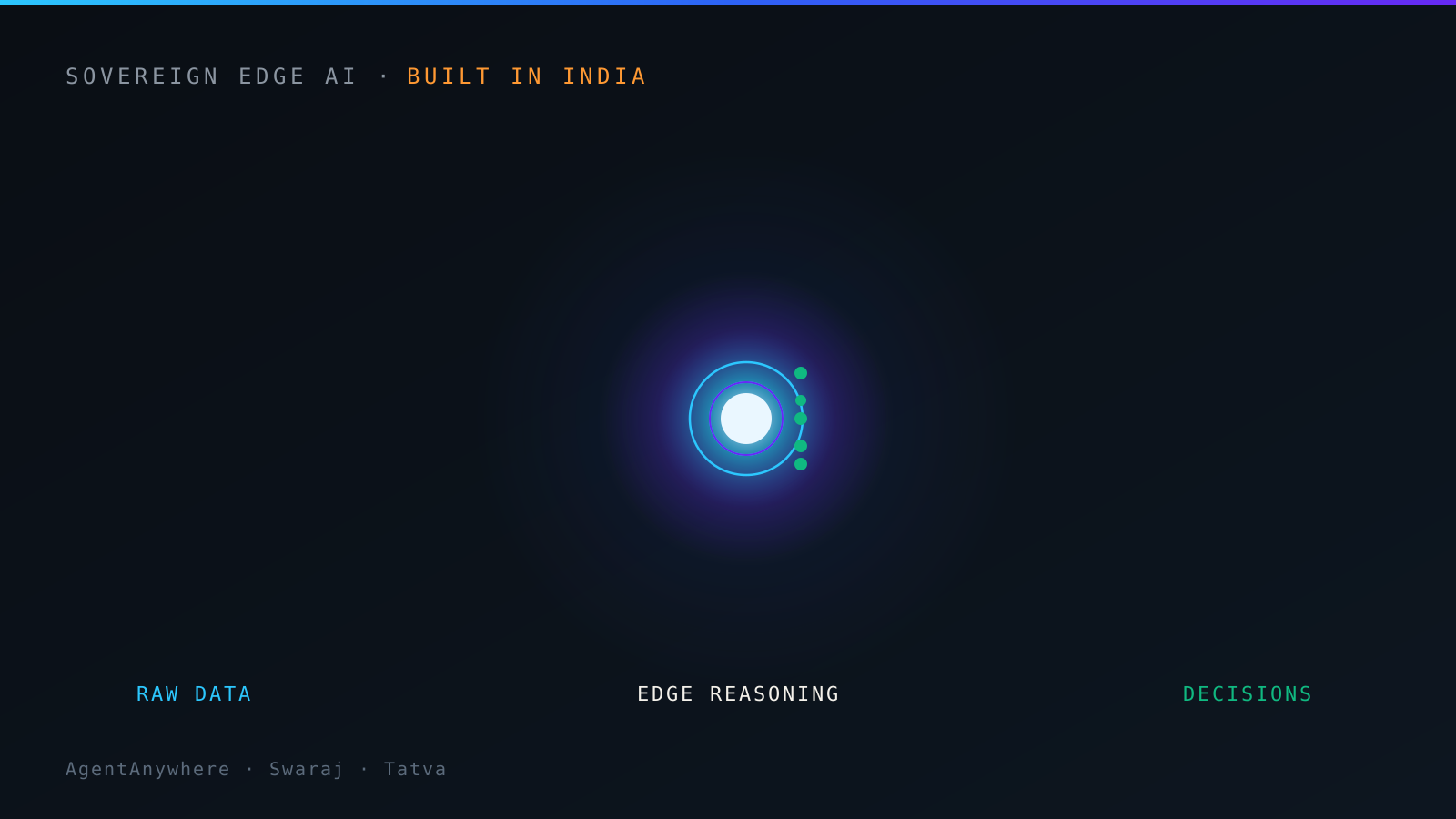
That is why edge AI — processing information close to where it originates, inside the vehicle's own compute — is becoming central rather than optional. A connected car can generate on the order of 25 gigabytes of data an hour; shipping all of it to the cloud to be understood is neither affordable at fleet scale nor fast enough to act on. Running the reasoning locally lowers dependency on connectivity, keeps sensitive data on the vehicle, avoids network round-trips, and stays resilient when the link drops.
The future is not purely cloud or purely edge. It is a deliberate split — heavy training and fleet-wide analysis in the cloud, real-time understanding and decision support on the vehicle. The right intelligence, in the right place.
The missing layer: reasoning inside the vehicle
Most of today's automotive AI conversation is about perception and prediction. A vision system identifies an object. A diagnostic model flags an unusual parameter. A predictive model estimates the odds a component fails. All valuable — and all incomplete. Identifying something and understanding what it means are different problems.
Take a simple case. A diagnostic system notices an unusual temperature reading. A conventional monitor fires an alert the moment it crosses a threshold. A reasoning layer does something else: it reads that temperature alongside the history, the operating conditions and recent diagnostic events, and either explains what is likely happening or recommends the vehicle be checked — in language a driver or a technician can act on. The goal is never to replace validated control systems. It is to add an interpretive layer that supports decisions within clearly defined limits.
That opens a wide, grounded set of applications: contextual interpretation of diagnostics, intelligent maintenance recommendations, natural-language interaction with vehicle information, summarized health reports, fleet-level anomaly analysis, and assistance for service technicians. Each needs real validation — especially where it touches anything safety-related — but each turns raw data into something a person can use.

The principle that has to hold
An intelligent vehicle is not one monolithic brain. It is a set of specialized capabilities working together, with reasoning as the layer that turns perception and prediction into something a person can act on. Exactly how those pieces are built is where the real engineering — and the real differentiation — lives, and every serious player will answer it differently.
What should not differ is the discipline. The non-negotiable principle underneath any credible automotive AI is simple: AI reasoning complements validated vehicle control and safety systems; it never bypasses them. A human stays in command of consequential decisions. An intelligence you can trust in a vehicle is one that knows exactly what it is not allowed to touch.
India's opening: building more than vehicles
India has already built one of the world's great automotive ecosystems. It is the third-largest car market and among the largest producers in the world, turning out on the order of 30 million vehicles a year, and it is the world's largest manufacturer of electric two- and three-wheelers — the exact high-volume, cost-sensitive, connectivity-variable vehicles where efficient on-device intelligence matters most. It also has the deepest software and engineering talent pool of any emerging automotive power.
The next opportunity is to strengthen the software and intelligence capabilities that will increasingly define the vehicle — to look past assembly, batteries and connected-car apps toward indigenous capability in automotive AI models, edge inference, vehicle perception, embedded compute, AI-assisted diagnostics, intelligent fleet management, automotive cybersecurity and software-defined vehicle platforms.
The ambition should not be to import intelligence built elsewhere and wire it into Indian vehicles. It should be to develop foundational intelligence that serves Indian manufacturers and the global mobility ecosystem — the way India built global IT services and a world-leading digital public infrastructure, now applied to the mind of the machine. Whoever supplies that intelligence layer shapes the margins, the data and the roadmap of the vehicles it runs in. That is a position worth holding at home.
Tatva: exploring the reasoning layer
At AgentAnywhere, we are exploring this direction through Tatva, our indigenous AI-reasoning initiative — reasoning built to run efficiently close to where information is generated, rather than only in a distant cloud. Our telemetry work, Sanjaya, sits alongside it, built to read a machine's own signals and anticipate trouble early.
We will be precise about what this is. Tatva is an exploration of this intelligence layer — not a claim of automotive certification or production deployment. We are deliberately saying more here about where the industry is going than about how we intend to get there. The aim is sovereign, efficient AI reasoning that can be deployed across many computing environments — the vehicle among them.
What this could mean for manufacturers
The opportunity is bigger than adding one more AI feature. A reasoning layer can create value across the whole vehicle lifecycle — from testing to ownership, servicing and fleet operations.
| Area | Where a reasoning layer helps |
|---|---|
| Area: Vehicle health | Context-aware interpretation of diagnostics, not just threshold alerts. |
| Area: Predictive maintenance | Recognising the early patterns that precede a developing fault. |
| Area: Driver experience | Natural-language, context-aware assistance that works on-device. |
| Area: Fleet operations | Reading health and operating patterns across many vehicles at once. |
| Area: Service ecosystem | Helping technicians make sense of diagnostic information faster. |
Automotive AI must be evaluated for reliability, security, privacy, robustness and predictable behaviour; safety-related functionality stays within validated automotive systems. The objective is useful intelligence, not uncontrolled autonomy.
Who will build the intelligence layer for tomorrow's vehicles?
The industry has already lived through several transitions — mechanical to electronic, combustion to electric, standalone to connected, hardware-defined to software-defined. The next one is toward AI-native vehicles, and it will take a coalition: manufacturers, semiconductor companies, AI developers, embedded-systems engineers, platform providers and research institutions. No single company builds every layer. But the ones that contribute real intelligence to this ecosystem will help shape the next generation of mobility.
For India, this is an opening to seize now, while the architecture of the AI-native vehicle is still being drawn. The future of mobility will not be defined by electrification alone. It will be defined by how intelligently a vehicle can understand, interpret and respond to the world around it — and the next great automotive breakthrough may well come from the intelligence inside the machine, built here.
Frequently asked questions
What is a software-defined vehicle?
A software-defined vehicle is a car whose functions, features and behaviour are determined mainly by software and central computing rather than fixed hardware, and which can be updated over its life. Modern vehicles already run on the order of 100 million lines of code and are consolidating dozens of electronic control units into a few high-performance computers, so software is becoming the dominant part of a vehicle's value and differentiation.
What is an AI-native vehicle?
An AI-native vehicle goes beyond being connected: it weaves AI through the vehicle at multiple layers — perception, contextual intelligence, reasoning, prediction, assistance and fleet intelligence. Rather than one large model controlling everything, it coordinates specialized models within clear safety boundaries and human oversight, so the vehicle can understand and interpret situations, not just sense and transmit data.
Why does automotive AI need to run at the edge instead of the cloud?
Vehicles travel through areas with unreliable connectivity, handle sensitive data, and need predictable, real-time responses. A connected car can also generate roughly 25 gigabytes of data an hour, which is impractical to stream to the cloud in full. Running AI at the edge — inside the vehicle's own compute — lowers dependence on connectivity, keeps sensitive data local, avoids network delays and stays resilient when the link drops. The future is a deliberate split of cloud and edge, with the right intelligence in the right place.
What is the reasoning layer in an AI-native vehicle?
The reasoning layer interprets information in context. Where perception identifies an object and a diagnostic model flags an unusual reading, the reasoning layer evaluates those outputs alongside history and operating conditions to explain what is happening or recommend an action. It is the layer the industry has largely been missing, and it must operate with defined permissions and human oversight, supporting rather than replacing validated vehicle control systems.
Does an AI reasoning layer control the car or make safety decisions?
No. The architectural principle is that AI reasoning complements validated vehicle control and safety systems and never bypasses them. Safety-critical functionality stays within appropriately validated automotive systems and processes, and a human remains in command of consequential decisions. The objective is useful intelligence and assistance, not uncontrolled autonomy.
What is Tatva, and is it deployed in vehicles today?
Tatva is AgentAnywhere's indigenous AI-reasoning initiative, exploring compact reasoning models that run efficiently close to where information is generated. For automotive, it explores context-aware diagnostics, edge-first deployment and coordination of perception, analytics and reasoning. Tatva is an exploration of this intelligence layer, not a claim of automotive certification or production deployment.
Written by
AgentAnywhere Research
The team that builds the platform and the models
AgentAnywhere Research writes about the platform, the model families and the trust layer we build and run in India. Where a figure is ours, it says what it covers; where something is a demonstration, it says so.