
What does the client's contract ask of AI in BPO?
A retailer and an insurer outsource their email backlog to the same firm. The retailer allows a model on its own account. The insurer allows nothing outside its own environment and wants to know who touched its queue. The same team works both queues.
How does AI in BPO keep clients apart?
1. Orchestration: the same workflow in two workspaces
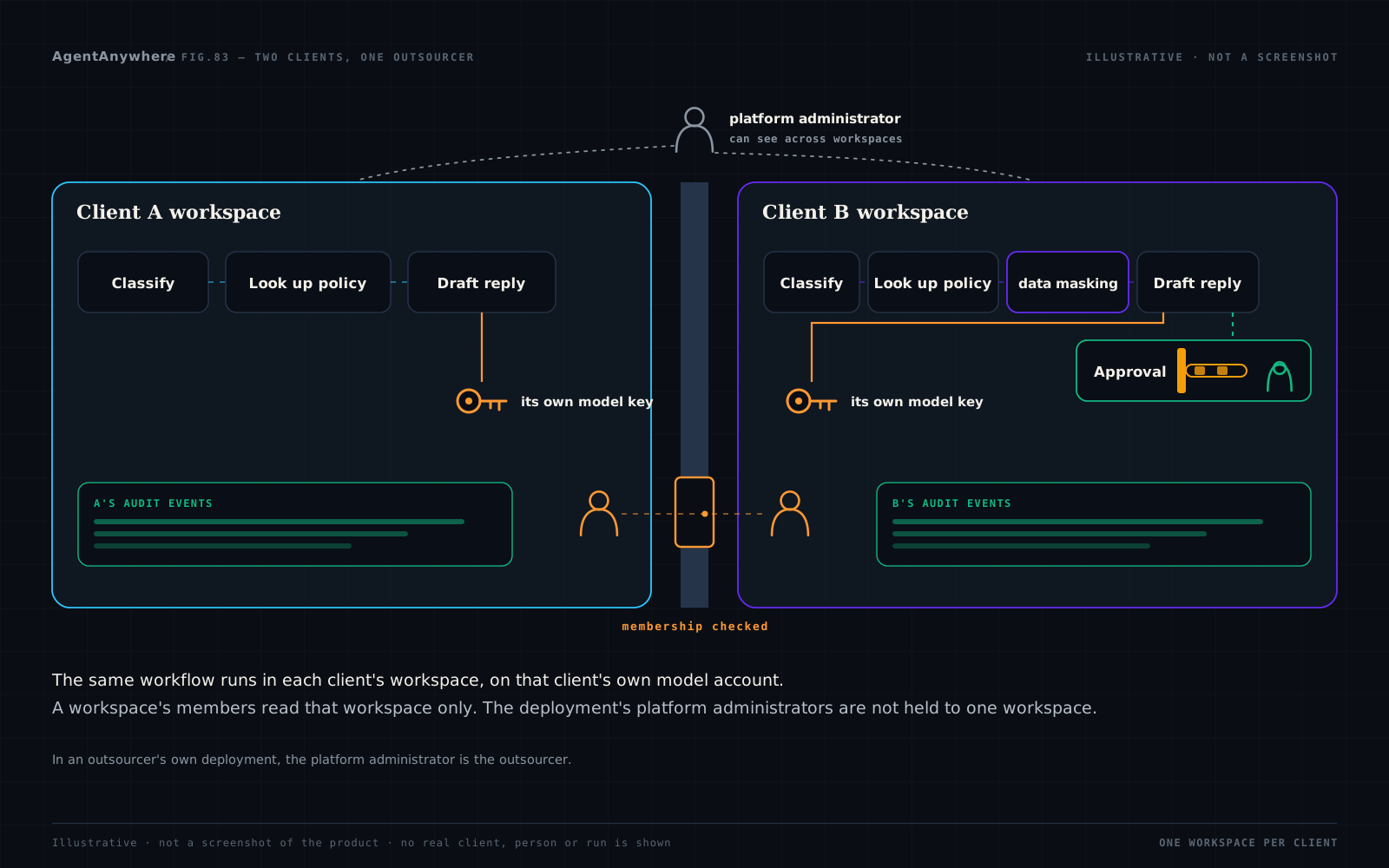
Classify, look up the policy, draft a reply. Each client's copy belongs to that client's workspace.
2. Guardrail: membership is checked every time
A person who works on both clients switches workspace, and is checked against that workspace's membership on every request.
3. Model choice: per client
Each workspace stores its own model key, encrypted, and its workflows run on that account: its own account with the provider it has approved, or Manthan served inside its perimeter. The platform holds no key of its own for these providers, so one client's work does not run on another's account, and each client's model use is on its own bill from its provider.
4. Guardrail: a person approves what leaves
In the insurer's workflow a masking step runs before the model step, and every reply stops at an approval step. An Admin of that workspace approves or rejects.
5. Observability: the queue as a system
For each workspace: its runs, how long each step takes, calls and errors for each agent, and what is waiting on a person.
What can a client be handed?
For the client
Its workspace's audit events, filtered by person, action, target and dates and downloaded as CSV a page at a time: sign-ins, roles given and removed, agents, tools and servers added or removed, approvals.
Kept 90 days unless the deployment sets another period. A run's step-by-step record is separate and kept 30 days by default.
Separation by workspace
A workspace's members read that workspace only.
The deployment's platform administrators are not held to one workspace; in an outsourcer's own deployment, that is the outsourcer. See the audit trail post.
What does it not do?
It does not decide which client's data may go to which model; the client's contract does, and the workspace's connection carries out what was agreed. A model step on an outside provider does not pass through Kavach. Voice, live assist and call scoring are a different piece of work, in the contact-centre post. The week described is illustrative.
For how steps and approvals fit together in a workflow, see Orchestrating AI agents; for what each run shows, the observability post; for what a guardrail can and cannot promise, the guardrail post.
Frequently asked questions
How does AI in BPO keep one client's data apart from another's?
Each client is its own workspace on AgentAnywhere. A workspace's agents, runs, stored keys and audit events are read by that workspace's members and by the deployment's platform administrators.
Can each BPO client use a different model?
Yes. Each workspace runs on the model that client has chosen: its own account with the provider it has approved, or Manthan served inside its perimeter.
Can staff work on more than one client?
Yes. A person can belong to several workspaces and switches between them; membership is checked on every request.
Can a client be given an audit trail of its own account?
Yes. Audit events are kept per workspace and can be filtered and downloaded as CSV for that workspace.
Are replies sent without review?
Only if the workflow says so. A step marked for approval waits for an Admin of the workspace, and the steps after it do not run until then.
Where are a client's model keys kept?
Encrypted in that client's workspace, listed by field name only and never shown again; replacing or deleting one takes effect at the next run.
Written by
AgentAnywhere Research
The team that builds the platform and the models
AgentAnywhere Research writes about the platform, the model families and the trust layer we build and run in India. Where a figure is ours, it says what it covers; where something is a demonstration, it says so.