
What does an audit trail for AI agents have to answer?
An auditor does not ask how the model works. They ask who registered this agent, who gave it access to that system, who approved the step that moved money, and whether anyone changed anything in between. An audit trail is the record that answers those questions without anyone reconstructing them from memory.
What does AgentAnywhere record in its audit trail?
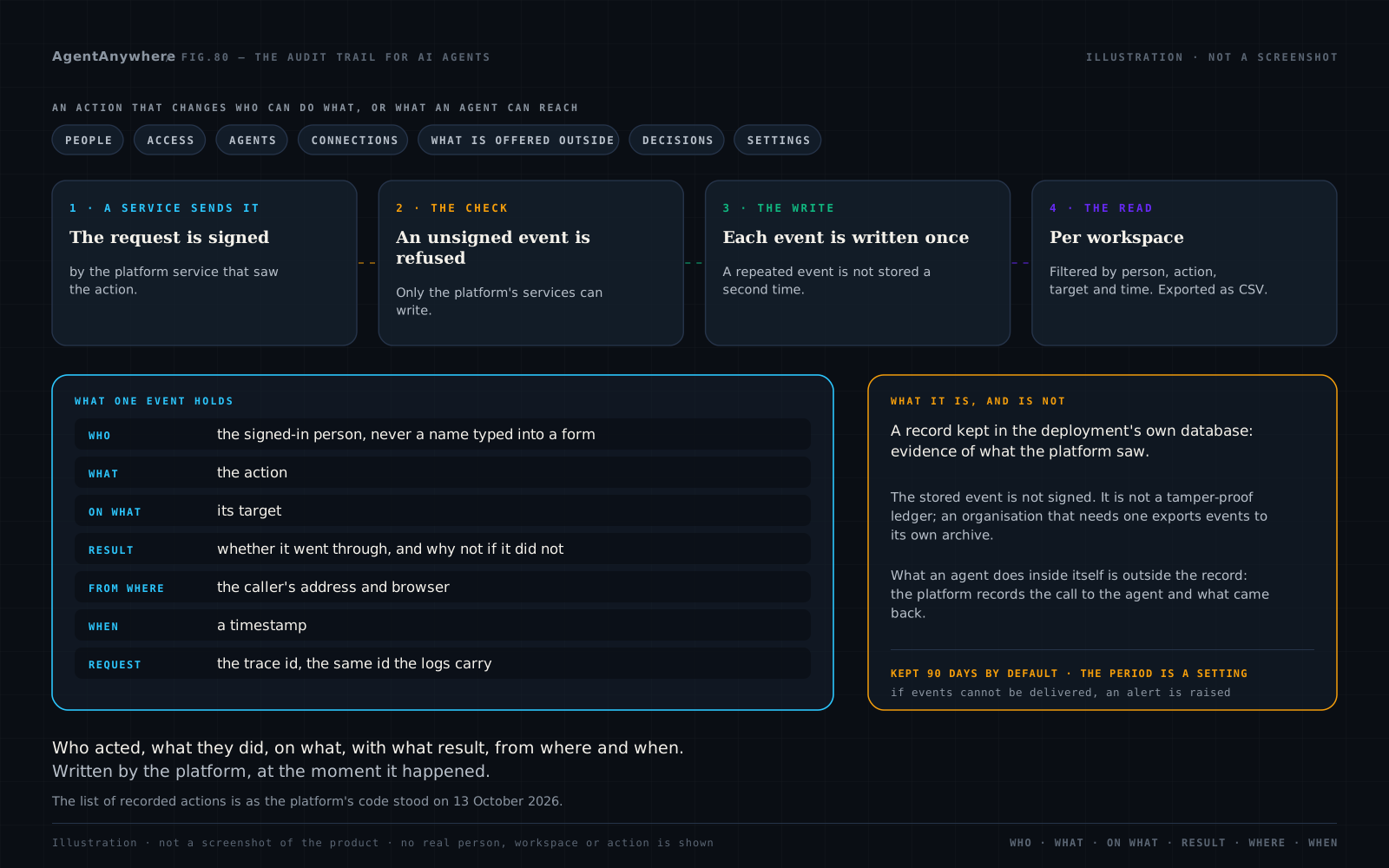
The list is as the platform's code stood on 13 October 2026. It will grow.
| Area | Events |
|---|---|
| Area: People | Sign-in, failed sign-in, sign-out, email confirmed, workspace switched |
| Area: Access | Role assigned, role removed, user enabled, user disabled |
| Area: Agents | Registered, updated, deleted, call headers replaced |
| Area: Connections | Product tools added or removed; MCP server connected, changed or removed; a tool's approval rule set; signing in to and out of an MCP server |
| Area: What is offered outside | A usecase or agent offered, changed or withdrawn; its key replaced |
| Area: Decisions | A held run approved and completed, or approved and failed; an agent's question answered by a person |
| Area: Settings | Platform settings changed |
Not every deployment will see every event: some appear only for accounts made on the platform itself, or only for servers that ask for a sign-in.
What does each audit event hold?
Who
The signed-in person, never a name typed into a form.
What and on what
The action and its target.
Result and reason
Whether it went through, and why not if it did not.
From where
The caller's address and browser.
When, and which request
A timestamp and the request's trace id, which is the same id the logs carry, so an event leads to what the services did.
How is the audit trail kept?
For audit
Only the platform's services can write. An event must arrive signed by the service that sends it; one that is not is refused. The signing secret is set by whoever runs the deployment.
Each event is written once. A repeated event is not stored a second time.
Lost events are not silent. If events cannot be delivered, an alert is raised inside the deployment; sending it to a chat channel or an on-call tool is set up per deployment.
For operations
Retention is a setting. Events are kept for 90 days unless the deployment sets another period, or sets it to keep everything.
Runs have their own record. Each run's steps, approvals and outcomes are kept with the run, for a period of their own, and read from Observability.
What we don't claim
The audit trail is a record kept in the deployment's own database. It is evidence of what the platform saw; it is not a tamper-proof ledger, and an organisation that needs one should export events to its own archive. What an agent does inside itself is outside the record: the platform records the call to the agent and what came back.
This post cites no regulation and makes no compliance claim. ShepHertz's own compliance position is on the Trust Center, in that page's words.
Frequently asked questions
What is an audit trail for AI agents?
A dated record of every action that changes what AI agents are, what they can reach and who approved their work, with the person, the action, the target, the result and the time.
What does AgentAnywhere record in its audit log?
Sign-ins and failed sign-ins, role and user changes, agents registered, changed or deleted, tools and servers connected or removed, usecases offered outside, approvals of held runs, questions answered by a person and platform settings changes.
Can I export AgentAnywhere audit events?
Yes. Events can be filtered by person, action, target and time, and downloaded as CSV.
How long does AgentAnywhere keep audit events?
For 90 days by default. The period is a setting of the deployment and can be set to keep everything. A run's step-by-step record is kept separately, for its own period.
Can one workspace see another workspace's audit events?
No. A workspace's people read only their own workspace's events. A platform administrator can read across workspaces.
Written by
AgentAnywhere Research
The team that builds the platform and the models
AgentAnywhere Research writes about the platform, the model families and the trust layer we build and run in India. Where a figure is ours, it says what it covers; where something is a demonstration, it says so.