
Across the lifecycle
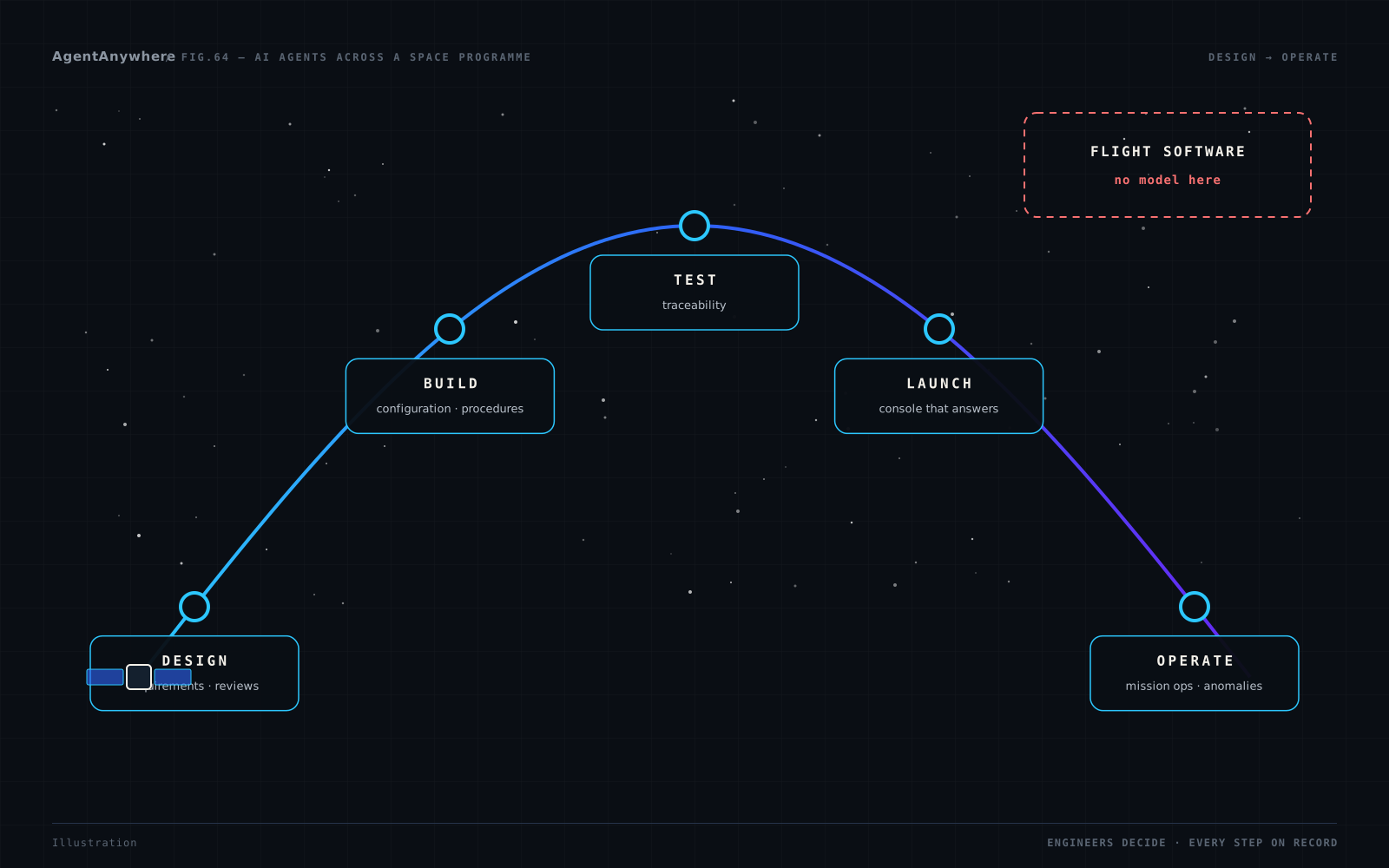
Design · Requirements and reviews
Agents check requirement sets for gaps, conflicts and untraced items, and prepare review packs that list open questions for the review board.
Build · Configuration and procedures
Every procedure and configuration item versioned with an owner and approvals, and agents that flag when a change in one document affects another.
Test · Campaign traceability
Test reports read and linked back to the requirements they verify, with gaps and failed verifications surfaced for the test lead.
Launch · A console that answers
Plain-language telemetry plots and procedure navigation for launch control and test stands. Read the launch post.
Operate · Mission operations
Operators type or say what they want; the exact telecommand is proposed, checked against flight rules and queued for approval. Read the satellites post.
Operate · Anomaly reports
Long anomaly and non-conformance reports summarised, cross-referenced with similar past events, and contractor and personnel details redacted before any model reads them.
And around the programme
Ground software engineering
Coding, testing and review assistance for ground-segment teams, with every change reviewed by an engineer. Our own engineering is AI-accelerated on the same agentic platform we deliver.
Earth-observation data products
Tasking requests prepared from plain-language asks, and imagery triaged for analysts. Detection on imagery is the work of our Astra line, with design partners.
Proposals and compliance matrices
Requirement-by-requirement compliance statements drafted from your own past responses and technical documents, for the bid team to finalise.
Supplier documentation
Supplier data packs checked against programme requirements, with missing certificates and deviations listed for quality assurance.
What makes it safe to use on a programme
Where it runs, what it sees
The platform runs in the programme's own cloud, on-premises or air-gapped with Swaraj. Programme documents and telemetry do not leave.
Veil masks or redacts contractor, personnel and other sensitive details before any model reads a document, and every model in use is registered with its provenance in Model Hub.
Who decides, and the record
Agents prepare; engineers, review boards, flight directors and test leads decide. Consequential steps wait for the named role.
Every step writes a signed Trust Receipt, and the Registry keeps agents, prompts and policies under the same configuration discipline as the rest of the programme.
Where to begin
Most programmes start with one document-heavy task a review board already cares about: requirement-to-test traceability, anomaly report summaries, or procedure navigation on an operations console. The value shows up in weeks, and the approval habits carry over to everything that follows.
Tell us the phase you are in and we will run a pilot on one task in your environment. Critical telemetry reasoning is the work of our Sanjaya line, engaged through partner-scoped design partnerships.
What we don't claim
No model runs in flight software, guidance, fault protection or flight termination, and nothing is sent to a spacecraft without a person approving it through the programme's own systems. On-board AI on a specific spacecraft is design-partner work. Our mission-operations console demonstration replays real model output against simulated telemetry, and says so on screen.
Frequently asked questions
How is AI used in space programmes?
Mostly on the ground: checking requirements and preparing design reviews, managing procedures and configuration, tracing test results to requirements, summarising anomaly reports, assisting ground-software engineering, and giving mission-operations consoles a plain-language front end with commands approved by operators.
Can AI agents run on a satellite?
Compact models such as Tatva Edge are candidates for on-board use, but on-board deployment on a specific spacecraft is design-partner work. Today the demonstrated use is on the ground console, where commands are proposed, checked against flight rules and approved by a person.
Is it safe to use AI with space programme documents?
It can be, if the platform runs inside the programme's own environment, sensitive details are masked or redacted before any model reads them, every model is registered with its provenance, and a signed record is kept of each step.
Does AI touch flight software in these use cases?
No. Flight software, guidance, fault protection and flight termination are outside the scope of every use case here.
Written by
AgentAnywhere Research
The team that builds the platform and the models
AgentAnywhere Research writes about the platform, the model families and the trust layer we build and run in India. Where a figure is ours, it says what it covers; where something is a demonstration or in preview, it says so.