
What is an AI agent gateway?
An AI agent gateway is infrastructure that sits between AI agents and everything they call, such as tools, other agents and internal APIs, and applies the same checks to every call before passing it on. It is the agent-era version of a familiar idea: one front door, so that security and limits live in one place instead of being copied into every service.
Agents make the front door matter more. An agent decides at run time which tool to call next, often in a loop. The Model Context Protocol gives agents a standard way to call tools, and the Agent2Agent protocol gives them a standard way to call each other 12. Standard ways to call are good news. They also mean an agent can reach a great deal, quickly. The gateway is where a team decides how much of that reach to allow.
A model router picks who answers. An agent gateway decides whether the question may be asked.
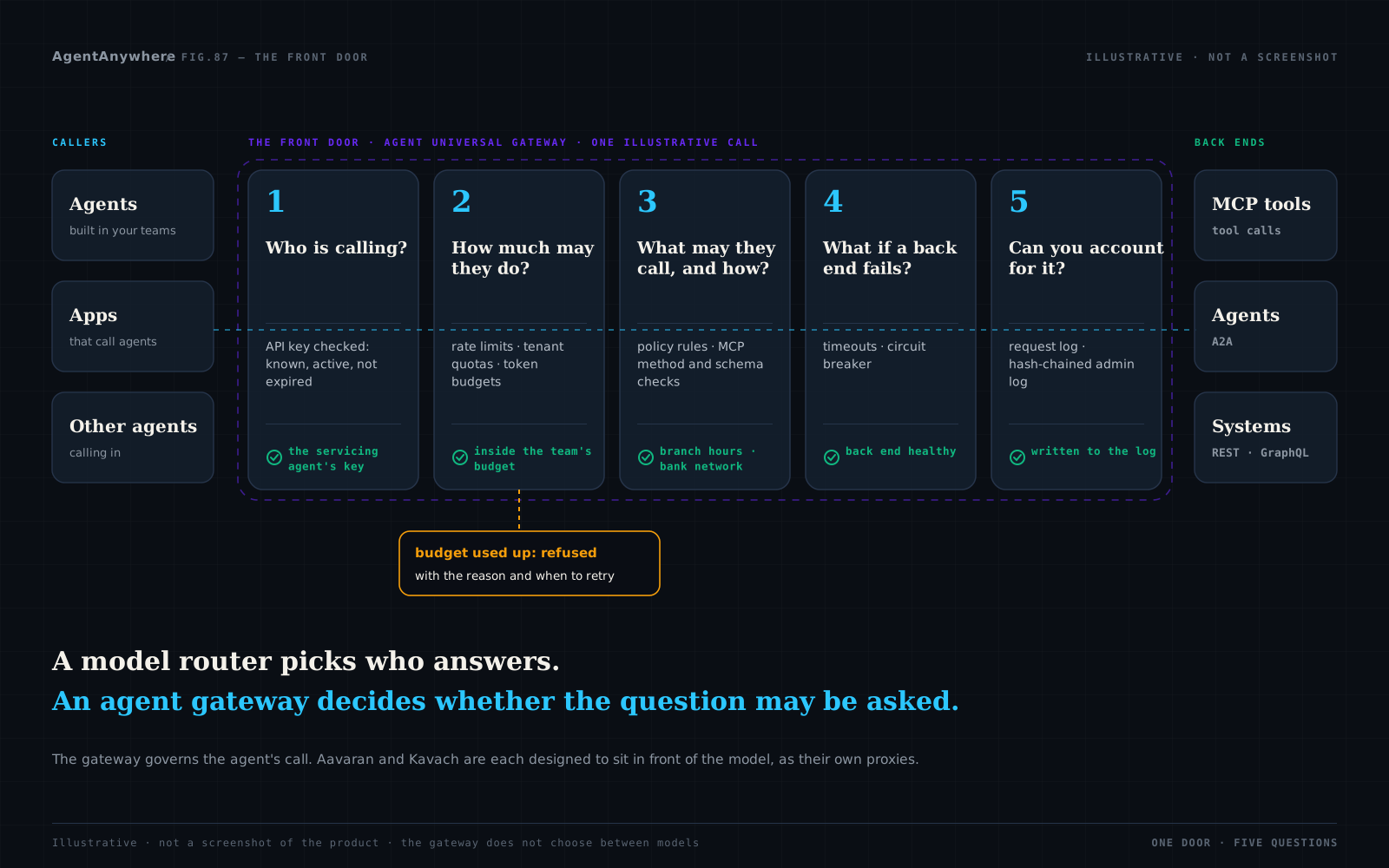
What happens to one request at the front door?
An illustration. No bank, customer or system is depicted.
A bank's servicing agent is helping a branch officer answer a customer. It needs the customer's account summary, so it calls an MCP tool the bank has published behind the gateway.
First, who is calling. The agent presents its API key, and the gateway checks that the key is known, active and not expired.
Then, how much. The key's rate limit, the branch team's quota for the minute and the hour, and the token budget for this use case are checked. The budget has a hard cap: had this month's tokens been used up, the call would stop here, with the reason and the time to try again.
Then, what. A policy rule allows this tool only from the bank's own network and only in branch hours. Because the call is MCP, the gateway also checks that the method is allowed, that the tool call matches the tool's published schema, and runs a pattern check on the arguments for known prompt-injection phrases.
Then, safely. The call goes on to the tool's back end with a timeout. If that back end had been failing, a circuit breaker would stop sending it traffic for a while, rather than let every agent wait on it.
Finally, on record. The request is logged as metadata, with who called, which path, the result and how long it took, but not the body. Later that day an administrator tightens the policy rule, and that change goes into a separate audit log in which each entry carries the hash of the one before.
Five questions to ask of any AI gateway
Ask them of any gateway you are considering, including ours. Each answer below is how the Agent Universal Gateway handles it.
1. Who is calling?
Every call should carry an identity the gateway can check. On the Agent Universal Gateway that is an API key, looked up by its hash and checked for expiry and status. Administrators sign in to the console with single sign-on.
2. How much may they do?
Limits should be set per caller and per team, not hoped for. The gateway applies per-key rate limits by the minute and the hour, quotas per tenant, and token and cost budgets per tenant, key, agent or use case, which can be set to stop calls once they are spent.
3. What may they call, and how?
Policy belongs outside the agent. The gateway's rules allow or deny a call by path, method, network address, time window, tenant or header, and addresses can be allowed or blocked for one key, one tenant or everyone. For MCP it adds a method allow-list, a schema check on each tool call and a pattern check for known prompt-injection phrases.
4. What happens when a back end fails?
A slow tool should not become a slow fleet. Every call has a timeout, and a circuit breaker stops sending traffic to a back end that keeps failing, then tries it again later.
5. Can you account for it afterwards?
Each request is logged as metadata, with its caller, path, result and timing but not its body, and metrics are exposed for Prometheus. Administrators' changes to keys, policies, network rules, budgets and registered agents go into a separate audit log in which each entry carries the hash of the one before. The entries are not signed; the chain can be checked from the admin API.
AI agent gateway, model router or API proxy: what is the difference?
Three jobs that are often confused. Many products combine them; the columns describe the jobs, not any vendor.
| AI agent gateway | Model router (LLM gateway) | API proxy | |
|---|---|---|---|
| : Decides | Whether a call between agents, tools and systems may happen | Which model answers a prompt | Where a request is forwarded |
| : Reads agent protocols such as MCP and A2A | Yes | Not its job: it speaks model APIs | Passes them through |
| : Limits | Rate limits, quotas and token budgets per caller, team or use case | Usually token budgets per model or key | Rate limits, if set |
| : Policy | What may be called, from where and when | Which models may be used | Rarely |
| : When a back end fails | Timeouts and a circuit breaker | Falls back to another model | Timeouts |
| : Record | A metadata-only request log, and an unsigned hash-chained log of admin changes | Prompt and token logs | Access logs |
The Agent Universal Gateway does the first job. It does not choose between language models.
Which protocols does the Agent Universal Gateway speak?
The gateway is built for the protocols agents use to reach tools, each other and people. MCP carries tool calls. A2A carries agent-to-agent calls, and the gateway publishes an Agent Card at the standard address, `/.well-known/agent-card.json` 2. AG-UI and ACP stream an agent's events over server-sent events 3. HTTP/REST and GraphQL reach the systems an enterprise already runs.
It is not a model router. Choosing between language models is a different job, and a team that needs it runs it behind the gateway like any other back end.
Where does the gateway sit in AgentAnywhere?
Each control does one job. The gateway governs the agent's call, and Aavaran and Kavach are each designed to sit in front of the model as their own proxy. Aavaran is designed to sit in front of the model, as an OpenAI-compatible proxy or as a mask-before-inference call that a gateway or agent runtime makes, so that raw data does not reach a model unmasked. Kavach is designed to sit in front of the model as a proxy and screen each request for prompt injection and unsafe output; see Kavach.
Teams build agents in Flow Studio and Agent Lab and run them on the AgentAnywhere platform, and the platform's audit trail and observability record what they did.
How do teams run the gateway?
The gateway runs in the team's own environment. It ships with a Docker Compose stack, with the gateway, Redis, Postgres, Prometheus and the admin console, and with a Helm chart for running the gateway on Kubernetes.
The admin console covers a dashboard, registered agents, monitoring and analytics, API keys, routes, a protocol tester, logs and settings. Logs can also be sent to Elasticsearch, Splunk, Amazon S3, Amazon CloudWatch or Datadog.
A checklist for your AI gateway
Copy it into your design review.
1. Every call carries an identity the gateway checks: a key that can expire and be switched off.
2. Limits are set per caller, per team and per use case, including token budgets that can stop calls.
3. What an agent may call is a written rule outside the agent: path, method, network, time.
4. Tool calls are checked against the tool's own schema before they are passed on.
5. Tool arguments get a pattern check for known prompt-injection phrases at the door.
6. Every call has a timeout, and a failing back end is taken out of the path until it recovers.
7. Each request is logged as metadata, and administrators' changes are kept in a log whose entries are hash-chained.
8. Masking personal data and screening model prompts are handled by controls built for those jobs.
9. The gateway runs in your own environment.
10. You can see it working: metrics, logs and a console your operators use.
What we don't claim
The Agent Universal Gateway is not a model router, and it does not mask personal data or screen model prompts: those are Aavaran's and Kavach's jobs, each designed to sit in front of the model. Its admin audit log is a hash chain kept in the deployment's own database; it is not a signed record, and it covers administrators' changes, not every call. This post gives no performance figures.
Frequently asked questions
What is an AI gateway?
An AI gateway is the single front door that calls between AI agents, tools and back-end systems pass through, so that identity, limits and policy are checked in one place instead of in every service.
What is the difference between an AI gateway and an LLM gateway?
An LLM gateway, or model router, decides which language model answers a prompt. An AI agent gateway decides whether a call between agents, tools and systems may happen at all. The AgentAnywhere Agent Universal Gateway does the second job; it does not choose between models.
What is an MCP gateway?
An MCP gateway sits in front of Model Context Protocol tool servers and checks each tool call before passing it on. The Agent Universal Gateway checks the caller's key, allows or blocks MCP methods, checks each tool call against the tool's schema and runs a pattern check on the arguments for known prompt-injection phrases.
Does an AI agent gateway replace an API gateway?
It does the same kind of job for agent traffic. The Agent Universal Gateway also handles HTTP/REST and GraphQL, so a team can put agent calls and the system calls they lead to behind one front door.
How does an AI gateway enforce token budgets?
The Agent Universal Gateway reads token usage from upstream responses and keeps totals per tenant, key, agent or use case. A budget with a hard cap refuses further calls once it is spent, with the reason and the time to try again.
Does the gateway mask personal data?
No. Masking is Aavaran's job. Aavaran is designed to sit in front of the model, as an OpenAI-compatible proxy or as a mask-before-inference call that a gateway or agent runtime makes, so that raw data does not reach a model unmasked.
Does the gateway check for prompt injection?
It runs a pattern check on MCP tool-call arguments for known prompt-injection phrases and can block a call that matches. Screening the prompts that reach a model is Kavach's job: Kavach is designed to sit in front of the model as a proxy and screen each request for prompt injection and unsafe output.
Can we run the gateway in our own environment?
Yes. The Agent Universal Gateway ships with a Docker Compose stack and a Helm chart for Kubernetes, and runs in the team's own environment.
Sources
The texts as they stood on 17 October 2026.
- 1Model Context Protocol: Specification, version 2025-06-18.
- 2Agent2Agent (A2A) Protocol: Specification, version 1.0.0, section 8.2 on the Agent Card's well-known address.
- 3AG-UI: Introduction.
Written by
AgentAnywhere Research
The team that builds the platform and the models
AgentAnywhere Research writes about the platform, the model families and the trust layer we build and run in India. Where a figure is ours, it says what it covers; where something is a demonstration, it says so.