
PLATFORM · UNIVERSAL GATEWAY
AgentAnywhere Universal Gateway.
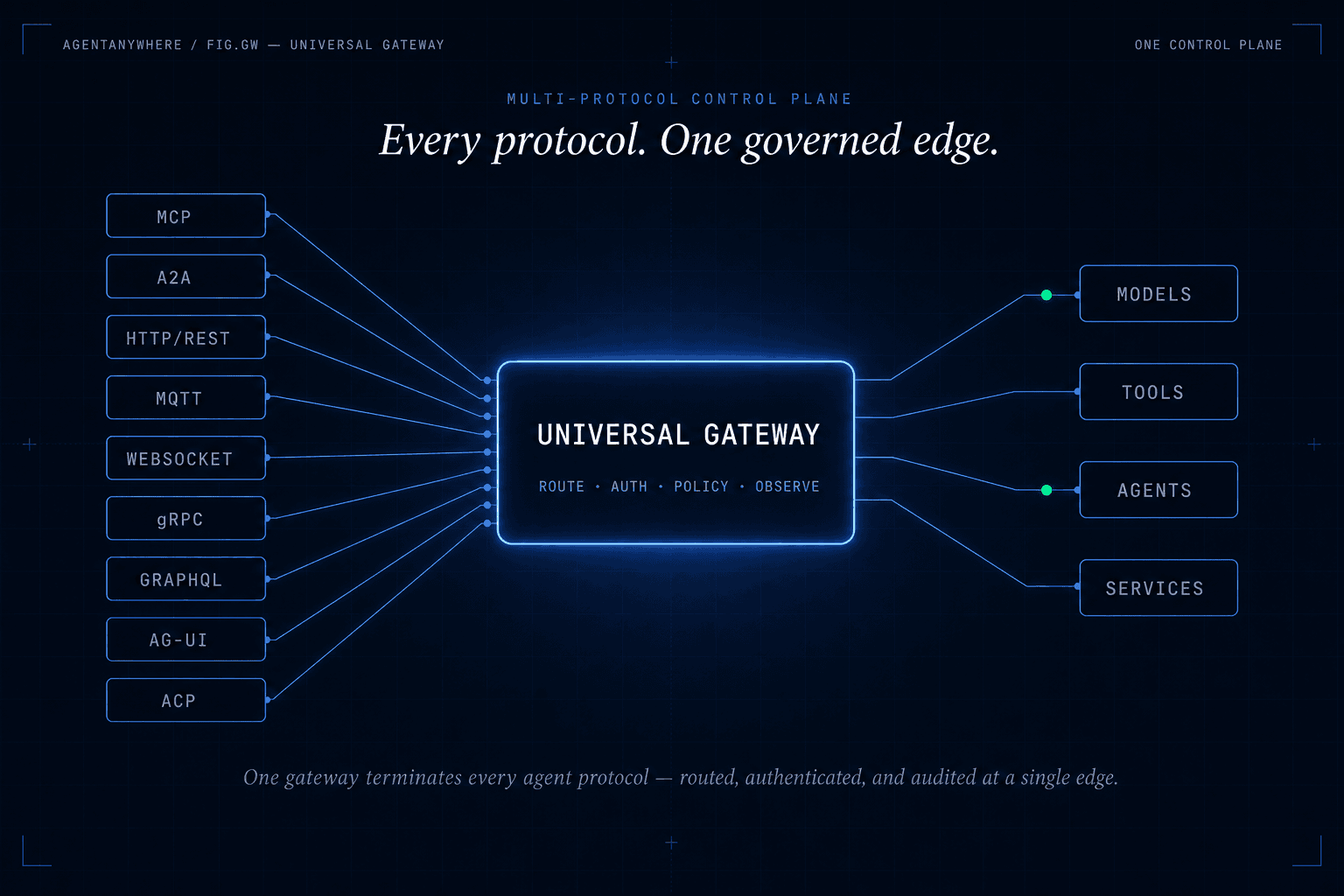
One gateway for every agent protocol — route, secure, observe, and govern multi-protocol traffic from a single control plane. MCP, A2A, HTTP/REST, MQTT, WebSocket, gRPC, GraphQL, AG-UI, and ACP, on your infrastructure.
Three jobs, one chokepoint.
Universal routing
One gateway across protocols. Connect any agent, model, or tool — MCP, A2A, and more — without bespoke integrations, and swap any of them without rewiring the others. Circuit breakers keep a failing upstream from cascading.
Policy enforcement
Guardrails applied at the point of call, not bolted on after. Every request is authenticated, scoped, and checked against your policies before it reaches a model or tool.
Full observability
Every call is logged, attributable to a human accountability chain, and audit-ready — with RED metrics, SLOs, and OTLP tracing out of the box. Nothing the agents do is invisible.
Speaks every protocol your agents use.
Agent ecosystems are fragmenting across protocols. The Universal Gateway terminates all of them at one edge, so a policy you write once applies everywhere.
MCP
Model Context Protocol — tool and context calls from AI assistants and agent frameworks.
A2A
Agent-to-Agent — coordination and delegation between autonomous agents.
HTTP / REST
The universal default — any service, SDK, or webhook that speaks HTTP.
MQTT
Lightweight pub/sub for IoT fleets, sensors, and edge devices.
WebSocket
Full-duplex streaming for live agent sessions and real-time UIs.
gRPC
High-throughput, low-latency RPC for service-to-service backends.
GraphQL
Typed, client-shaped queries for data-rich agent front-ends.
AG-UI
Agent-UI protocol for rendering interactive agent surfaces.
ACP
Agent Communication Protocol for interoperable agent messaging.
Why a gateway, not a library.
Most agent stacks scatter routing, policy, and logging across application code. That works in a demo and fails an audit — there is no single place a regulator or CISO can inspect to know what every agent is allowed to do.
The Universal Gateway is that single place. It sits between your agents and everything they touch, so control and evidence live at one layer instead of a hundred.
Get started in minutes.
Install from PyPI or run the full stack — gateway, admin console, and health checks — with Docker Compose.
pip install agentanywhere-gateway
cp env.example .env
docker compose up -d
# Health:   http://localhost:8000/health
# Admin UI: http://localhost:3001
CLI: agentanywhere-gateway · see the docs for env vars and deployment.
Part of one platform.
The Universal Gateway is how AgentAnywhere stays one system. Teams build agents in Flow Studio and Agent Lab; internally, the Orchestrator runs them and the Registry governs their lifecycle; and the Universal Gateway controls every call they make. Orchestrator and Registry are integral platform services — not separately sold or open-sourced — that hold this together as one governed system.
Compliance from the control plane.
Aligned with all twenty-six recommendations of RBI FREE-AI. Continuously verified against OWASP Top 10 and SANS Top 25. SOC 2 · ISO 27001 · HIPAA · GDPR.
FAQ
Frequently asked questions.
- What is the AgentAnywhere Universal Gateway?
- The AgentAnywhere Universal Gateway is a multi-protocol API gateway for AI agents. It routes, secures, observes, and governs traffic across MCP, A2A, HTTP/REST, MQTT, WebSocket, gRPC, GraphQL, AG-UI, and ACP from a single control plane, so every agent, model, and tool interoperates under one policy layer.
- Which protocols does the Universal Gateway support?
- It supports MCP (Model Context Protocol), A2A (Agent-to-Agent), HTTP/REST, MQTT, WebSocket, gRPC, GraphQL, AG-UI, and ACP. All of them are terminated at one edge so a single authentication, rate-limiting, and policy definition applies across every protocol.
- How do I install and run the Universal Gateway?
- Install from PyPI with 'pip install agentanywhere-gateway', or run the full stack — gateway, admin console, and health checks — with Docker Compose. The CLI command is 'agentanywhere-gateway'. The gateway exposes a health endpoint on port 8000 and the admin console on port 3001.
- How is a gateway different from a routing library?
- A gateway centralizes routing, authentication, policy enforcement, and logging at one inspectable layer instead of scattering them across application code. That single chokepoint is what a regulator or CISO can audit to know exactly what every agent is allowed to do.
- Is the Universal Gateway secure and compliant?
- Yes. API keys, OAuth2, role-based access control, multi-tenant isolation, IP allow/deny rules, and a tamper-evident audit chain are enforced at the edge. It is aligned with all twenty-six recommendations of RBI FREE-AI, continuously verified against OWASP Top 10 and SANS Top 25, and maps to SOC 2, ISO 27001, HIPAA, and GDPR.
- Can I deploy the Universal Gateway on my own infrastructure?
- Yes. It runs as a container inside your environment — a single instance or scaled horizontally behind your load balancer — so request traffic, encryption keys, and audit evidence never leave your perimeter. Configuration is environment-driven and promotes cleanly from local to production.
Put every agent call under one control point.
Pilots start with an audit of your current agent communication surface — who calls what, with what policy, and where the evidence lives today. We replace scattered ad-hoc wiring with a single governed Universal Gateway. Six to ten weeks, sovereign environment.