
When the link degrades, the bar lies
Five years ago, a lost link was usually a tower too far away or a battery on its last legs. Today it is just as likely to be interference. Cheap jammers, crowded spectrum, and GPS denial have moved from the battlefield to the ordinary map: ports, borders, stadiums, protests, critical infrastructure, and any airspace someone wants to keep quiet. For a drone, the radio link is the thread the whole mission hangs from, and it is the part most operators instrument the least.
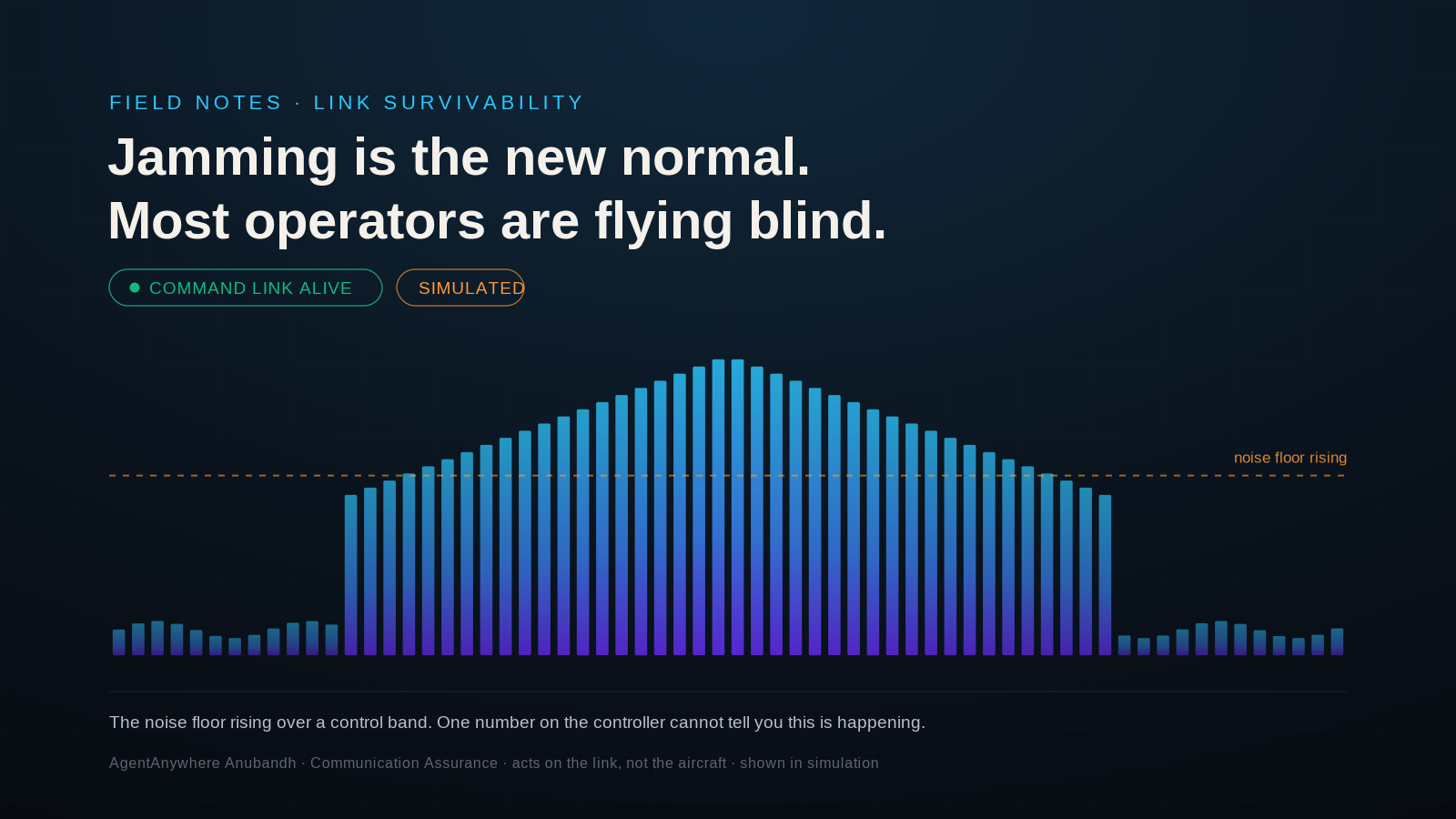
The reason is simple. Most radios hand up a single link-quality number, a bar that slides from green to red. It feels like information. It is actually an average of several very different problems, and by the time it turns red it has already thrown away the one thing you needed: why.
One bar, five very different stories
A link can fare badly for reasons that call for opposite responses. Climb for altitude when the real problem is a jammer and you make it worse; shed bandwidth when you have simply flown out of range and you give up margin you did not need to. The metrics that separate these causes are there in most radios, if you read them instead of averaging them away. This is a field reference, not a product specification.
| What is happening | Noise floor | Your own signal | The tell |
|---|---|---|---|
| What is happening: Jamming or interference | rises hard | still strong | loud noise while your own transmitter is fine |
| What is happening: Out of range | about flat | fades away | your signal falls off while the band stays quiet |
| What is happening: A busy channel | about flat | strong | the channel is occupied, not noisy |
| What is happening: A hardware fault | flat | collapses | the radio reports or drops with no noise rise |
| What is happening: GPS spoofing | not the signal to watch | normal | the clock jumps and position disagrees with inertial |
None of this needs a secret. It is the honest reading of metrics a decent radio already exposes — per-packet signal-to-noise, received strength, retransmits, channel occupancy, and where you can get it, a spectrum snapshot.
Read the link, not the bar
The value is in reading those metrics together, over time, and resisting the urge to collapse them into one word too early. Each of the stories above has a different fingerprint even when the single bar looks the same, and each wants a different move. A system that reads the fingerprint can act; a system that only watches the bar can only panic.
Which sets up the real problem. The dangerous system is not the one that fails. It is the one that fails and reports a confident, wrong cause — because an operator, or an autopilot, will act on it. That is the failure the three principles below are built to prevent.
Principle one: let the system say "I don't know"
Coarse metrics cannot always settle it. Broadband jamming and ordinary narrowband interference can look alike without a spectrum snapshot. A nearby radar, a faulty amplifier, and a deliberate jammer can share a fingerprint for a few seconds. The temptation is to pick the most likely label and move on. We think that is exactly backwards.
We treat unknown as a first-class answer. When two causes fit the evidence, or none does cleanly, the system says so and names what extra evidence would settle it, instead of inventing certainty an operator might act on. In a contested environment, an honest "not sure yet" is worth more than a fast answer that sends the aircraft the wrong way. Trust is built on the moments a system admits its limits, not the moments it guesses well.
Principle two: survive by protecting command, not comfort
When the link is squeezed, the instinct is to fight for every kilobit. The discipline is to decide, before the mission, what gets protected and what gets dropped. Video is comfort. Command and telemetry are the mission. A link under pressure should shed the video to keep command alive, and fail over across whatever paths it carries — line-of-sight, satcom, mesh, cellular — before it drops entirely.
The hard rule underneath this is where we draw our line. We act on the link, never on the aircraft and never on anyone else's radio. The job is to keep your own channel healthy and your command path open, inside bounds a commander signs before the flight. That restraint is not a limitation. It is what makes the system safe to deploy and safe to trust.
Principle three: make the flight prove itself
Contested flights end in questions. Was the aircraft jammed or mishandled? Did the operator follow the plan? Who authorised the order that was carried out? "Trust us" does not survive an inquiry, an insurer, or a regulator. The record has to.
So every meaningful decision — the cause that was read, the traffic that was shed, the failover that fired, the order that was confirmed — should be signed and chained so that any tampering shows, and should verify on its own with no server to call. Evidence that only lives in a vendor's cloud is evidence you cannot fully defend. Evidence that verifies offline is a fact you own. Build the compliance in while you are at it: Remote ID, airspace adherence, and protection against replayed commands belong in the same record.
Take this with you
Five things to carry out of this, whether or not you ever use our software.
Stop trusting the bar
Ask your radio for raw per-packet metrics, not a summarised quality score. The summary is where the diagnosis goes to die.
Diagnose before you react
Noise up with your own signal strong is interference. Your signal fading with a quiet band is range. They need opposite moves.
Decide the shed order on the ground
Name what gets dropped to protect command, and the failover sequence, before the mission — not during the emergency.
Log for the inquiry you hope never comes
Record the decisions, sign them, and make sure they verify without your servers in the room.
Prize the honest unknown
A tool that admits uncertainty earns the trust to act when it is certain.
Proven in simulation. Ready for the airframe with you.
Everything above is how AgentAnywhere Anubandh already behaves, today, against a simulated channel, with the evidence verifiable offline. The classification, the graceful shedding that protects command, and the signed record are all shown in simulation — the models are offline stand-ins, and nothing has been flown on real radio hardware.
The remaining step is the hardware phase: the radio integrations and the live link action, and that is the part we want to do with partners who build the radios. Anubandh is a software layer, not a new radio — it reads the link metrics your radio already exposes and returns governed link actions through a clean adapter. If you fly drones in contested spectrum, or you make the datalinks that carry them, the honest conversation starts now. Radio and datalink makers can write to partners@agentanywhere.ai.
Frequently asked questions
Why is a single link-quality bar not enough for a drone?
A single link-quality bar averages several very different problems into one number: jamming, flying out of range, a busy channel, a hardware fault and GPS spoofing. Those causes call for opposite responses, so by the time the bar turns red it has already discarded the one thing you needed — why the link is failing. Reading the underlying per-packet metrics, rather than the summary, is what lets you tell the causes apart.
How do you tell jamming apart from flying out of range?
Watch the noise floor and your own signal together. Jamming or interference shows as the noise floor rising hard while your own transmitter is still strong — loud noise over a healthy signal. Flying out of range shows the opposite: your own signal fades away while the band stays quiet. They need opposite moves, which is why collapsing both into one quality bar is dangerous.
What should a drone link do when it is being jammed?
Protect command, not comfort. Decide before the mission what gets dropped and what gets kept: video is comfort, while command and telemetry are the mission. Under pressure the link should shed video to keep command alive and fail over across whatever paths it carries — line-of-sight, satcom, mesh, cellular — before it drops entirely. All of it inside bounds a commander signs before the flight, acting on the link and never on the aircraft.
What is AgentAnywhere Anubandh?
AgentAnywhere Anubandh is communication assurance for drones: own-band link survivability and accountability. It keeps the command link alive through interference on your own control band, shows the crew one honest picture of the link, and records every decision to a signed, hash-chained log that verifies offline. It is shown in simulation today, runs on the radio you already fly, and acts on the link, never on the aircraft.
Written by
AgentAnywhere Research
The team that builds the platform and the models
AgentAnywhere Research writes about the platform, the model families and the trust layer we build and run in India. Where a figure is ours, it says what it covers; where something is a demonstration, it says so.