

What is the DPDP Act, and when does it apply?
The Digital Personal Data Protection Act, 2023 (DPDP Act) is India's law on digital personal data. It applies to the processing of digital personal data within India. It also applies to processing outside India "if such processing is in connection with any activity related to offering of goods or services to Data Principals within the territory of India" (Section 3(b)) 1.
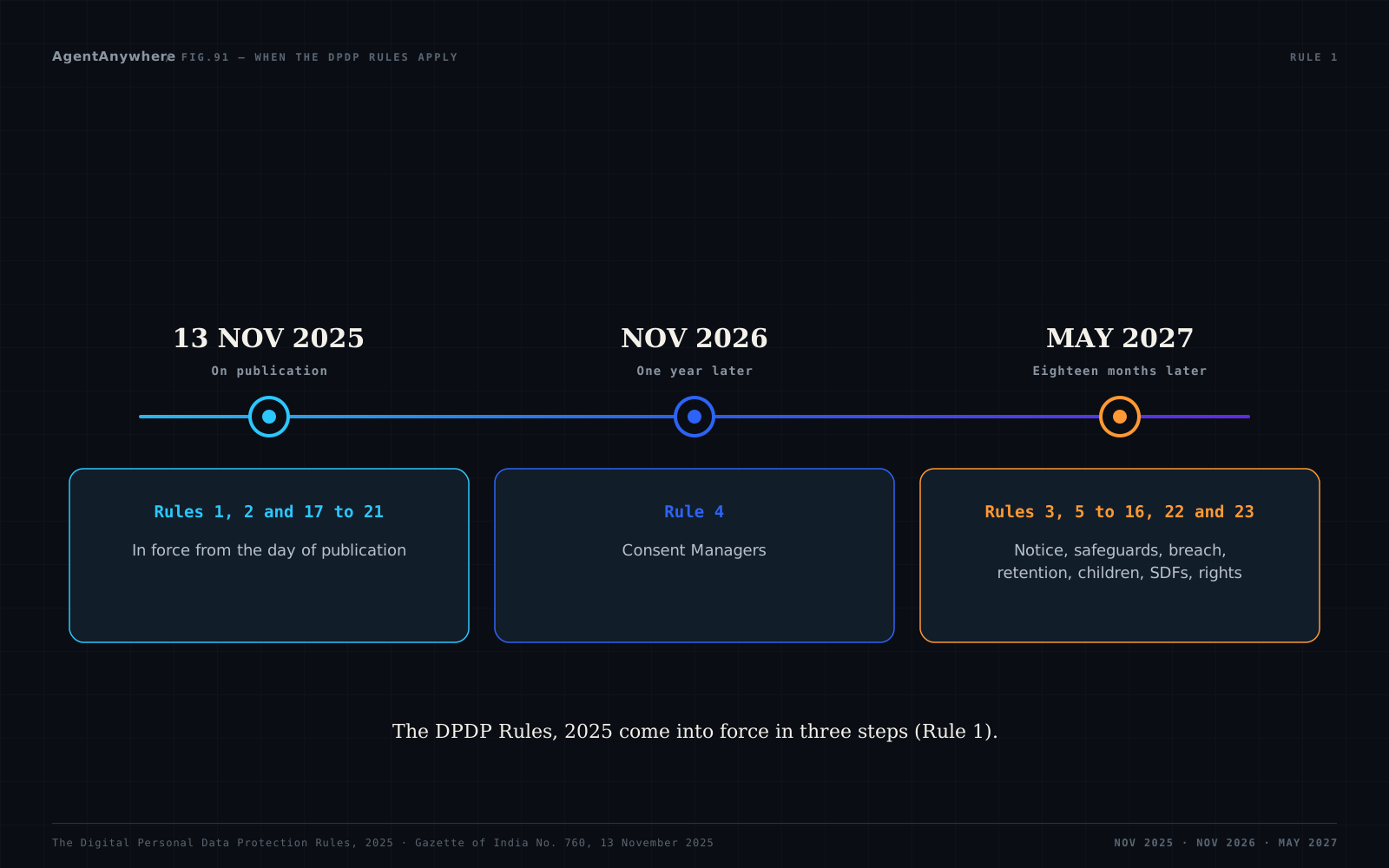
The Digital Personal Data Protection Rules, 2025 (DPDP Rules) were published in the Gazette on 13 November 2025, and they come into force in three steps (Rule 1) 2:
Rules 1, 2 and 17 to 21 on publication;
Rule 4, on Consent Managers, one year later, in November 2026;
Rules 3, 5 to 16, 22 and 23 eighteen months after publication, in May 2027. Those include notice, security safeguards, breach intimation, retention and erasure, children's data, Significant Data Fiduciaries and the rights of Data Principals.
Who is who under the DPDP Act?
Data Principal
The individual the personal data relates to. For a child, this includes the parents or lawful guardian. For a person with a disability who has a lawful guardian, it includes that guardian.
Data Fiduciary
A Data Fiduciary is whoever decides the purpose and means of processing. A bank, insurer or lender running AI agents on its customers' data is the data fiduciary.
Data Processor
Whoever processes personal data on the fiduciary's behalf. A model provider that processes a prompt for you, or the platform your agents run on, acts as one. A processor may be engaged "only under a valid contract" (Section 8(2)).
Consent Manager
A Consent Manager is a person registered with the Data Protection Board who lets a Data Principal "give, manage, review or withdraw her consent" through them (Section 6(7)).
Significant Data Fiduciary (SDF)
A Significant Data Fiduciary is a fiduciary the Central Government notifies on factors including "the volume and sensitivity of personal data processed" and "risk to the rights of Data Principal" (Section 10(1)). It has added duties.
Data Protection Board of India
The body that receives breach intimations, hears complaints and imposes penalties.
On what basis may personal data be processed?
There are two bases: consent (Section 6) and certain legitimate uses (Section 7).
Consent must be "free, specific, informed, unconditional and unambiguous with a clear affirmative action", limited "to such personal data as is necessary for such specified purpose" (Section 6(1)). The legitimate uses are listed in Section 7. They include data the principal "has voluntarily provided" for a specified purpose without objecting, compliance with law or a court order, medical emergencies, disasters and employment.
Neither basis is a general "legitimate interests" ground. That is one of the plainest differences from Europe's GDPR.
What must a DPDP notice contain?
Every request for consent comes with, or after, a notice (Section 5). The Rules say the notice must "be presented and be understandable independently of any other information" (Rule 3(a)). In "clear and plain language", it must give at the minimum (Rule 3(b), (c)):
"an itemised description of such personal data";
the specified purpose and "specific description of the goods or services to be provided or uses to be enabled";
how the Data Principal may withdraw consent, "with the ease of doing so being comparable to that with which such consent was given";
how to exercise her rights; and
how to "make a complaint to the Board".
The notice must also be available "in English or any language specified in the Eighth Schedule to the Constitution" (Section 5(3)), which lists 22 languages. Every consent request has to name the contact details of a Data Protection Officer, where there is one, or of another authorised person (Section 6(3)).
For data collected before the Act, a fiduciary must give a notice "as soon as it is reasonably practicable" (Section 5(2)).
What AgentAnywhere does: notices are versioned per purpose and can be written in English or any of the 22 languages; the notice headings ship in English and Hindi. Each consent record names the exact notice version the person saw.
How does consent work, and how is it withdrawn?
Withdrawal: a Data Principal may withdraw consent "at any time" (Section 6(4)). The fiduciary must then, "within a reasonable time, cease and cause its Data Processors to cease processing" (Section 6(6)), unless the law requires otherwise.
The burden of proof: if consent is ever in question, "the Data Fiduciary shall be obliged to prove that a notice was given … and consent was given" (Section 6(10)).
Consent Managers: these registered intermediaries come into force with Rule 4, in November 2026.
What AgentAnywhere does: a consent ledger per workspace. Each entry records the person, kept as a keyed hash rather than the identifier itself, the purpose, the notice version, given or withdrawn, when, and through which channel. Withdrawing is one call, the same as giving. A "Check consent" step stops an agent workflow, or sends it another way, when there is no consent for its purpose.
Integrating with a registered Consent Manager is a separate interface. It is not built.
What are a data fiduciary's general duties under Section 8?
Section 8 makes the fiduciary responsible for all processing, including "on its behalf by a Data Processor" (Section 8(1)). The duties that matter most for AI agents:
1. Processors only under contract (Section 8(2)).
2. Accuracy where data drives a decision: where personal data "is likely to be used to make a decision that affects the Data Principal", ensure "its completeness, accuracy and consistency" (Section 8(3)).
3. Reasonable security safeguards to prevent a personal data breach (Section 8(5); Rule 6).
4. Breach intimation to the Board and each affected person (Section 8(6); Rule 7).
5. Erasure when consent is withdrawn or the purpose is no longer served, including by processors (Section 8(7); Rule 8).
6. A published contact for questions (Section 8(9); Rule 9).
7. An effective grievance mechanism (Section 8(10)).
The sections below take them in turn.
What security safeguards do the DPDP Rules require?
Rule 6(1) lists the minimum. Here it is, with what AgentAnywhere records when your agents process personal data.
| Rule 6(1) | What it asks | What AgentAnywhere does |
|---|---|---|
| Rule 6(1): (a) | "encryption, obfuscation, masking or the use of virtual tokens" | A data masking step (Aavaran) can run before a model step; the steps after it receive the masked value, not the original, unless a step is wired to read the original input. A field read from documents can be set to show only its last four digits. Workspace keys are stored encrypted. |
| Rule 6(1): (b) | "control access to the computer resources" | Roles are enforced by the server, not only the screen. Expired or disabled members are stopped, including in sessions already open. Each workspace's runs, keys, knowledge, memory and audit trail are kept to that workspace; the deployment's own administrators can see across workspaces. |
| Rule 6(1): (c) | "appropriate logs, monitoring and review" | An audit event for each change of who can do what, and for each decision and erasure, with who, from where (IP address) and browser. A step-by-step record of every run. |
| Rule 6(1): (d) | "continued processing … such as by way of data-backups" | Yours: the backup of your own deployment. |
| Rule 6(1): (e) | "retain such logs and personal data for a period of one year" | The audit trail and run records are kept for as long as the deployment sets. The defaults are shorter than a year (see below). |
| Rule 6(1): (f) | contract provisions with processors | Yours. The platform records which model provider and model each step used. |
| Rule 6(1): (g) | "technical and organisational measures" | Shared: the platform's controls above; your policies and training. |
Is the audit trail tamper-evident?
Yes. Each audit event is signed with HMAC-SHA256 and linked into a per-workspace hash chain, so a changed or removed entry shows when the trail is verified. "Verify the trail" on the Audit page reports either that every entry is signed and chained, or the first entry that was changed or is missing.
That makes a change detectable. It does not make one impossible: the signing secret is held by the deployment's own services, so whoever holds it could rewrite the trail, and removing the newest entries leaves no gap for the check to find.
How long must logs be kept under the DPDP Rules?
At least one year. Rule 6(1)(e) asks for logs "for a period of one year", for detecting and investigating unauthorised access. Rule 8(3) asks a fiduciary to keep "personal data, associated traffic data and other logs of the processing for a minimum period of one year from the date of such processing", and then to erase them unless another law needs them kept longer. The Rules' own illustration applies the year to a fiduciary's processor too, such as its cloud service provider.
| What | AgentAnywhere default | To keep a year |
|---|---|---|
| What: Audit trail (who did what) | 90 days | Set RETENTION_DAYS to 365 or more (0 keeps everything). |
| What: Each run's step-by-step record | 30 days | Set OBS_RETENTION_DAYS to 365 or more. |
| What: Service logs | 30 days | Change the log store's retention in the deployment's configuration. |
| What: Agent session memory | 24 hours | A separate setting per workspace; long-term memory has its own. |
The System and Privacy pages warn when audit or run-record retention is under a year, and one deployment setting raises both to a year.
What does a DPDP breach notification have to say, and when?
"On becoming aware of any personal data breach", the fiduciary must tell two audiences.
Each affected Data Principal must be told "without delay", "in a concise, clear and plain manner", through her user account or registered contact (Rule 7(1)):
a description of the breach (nature, extent, timing);
the consequences likely for her;
the measures taken to mitigate risk;
the safety measures she may take; and
a contact who can answer her questions.
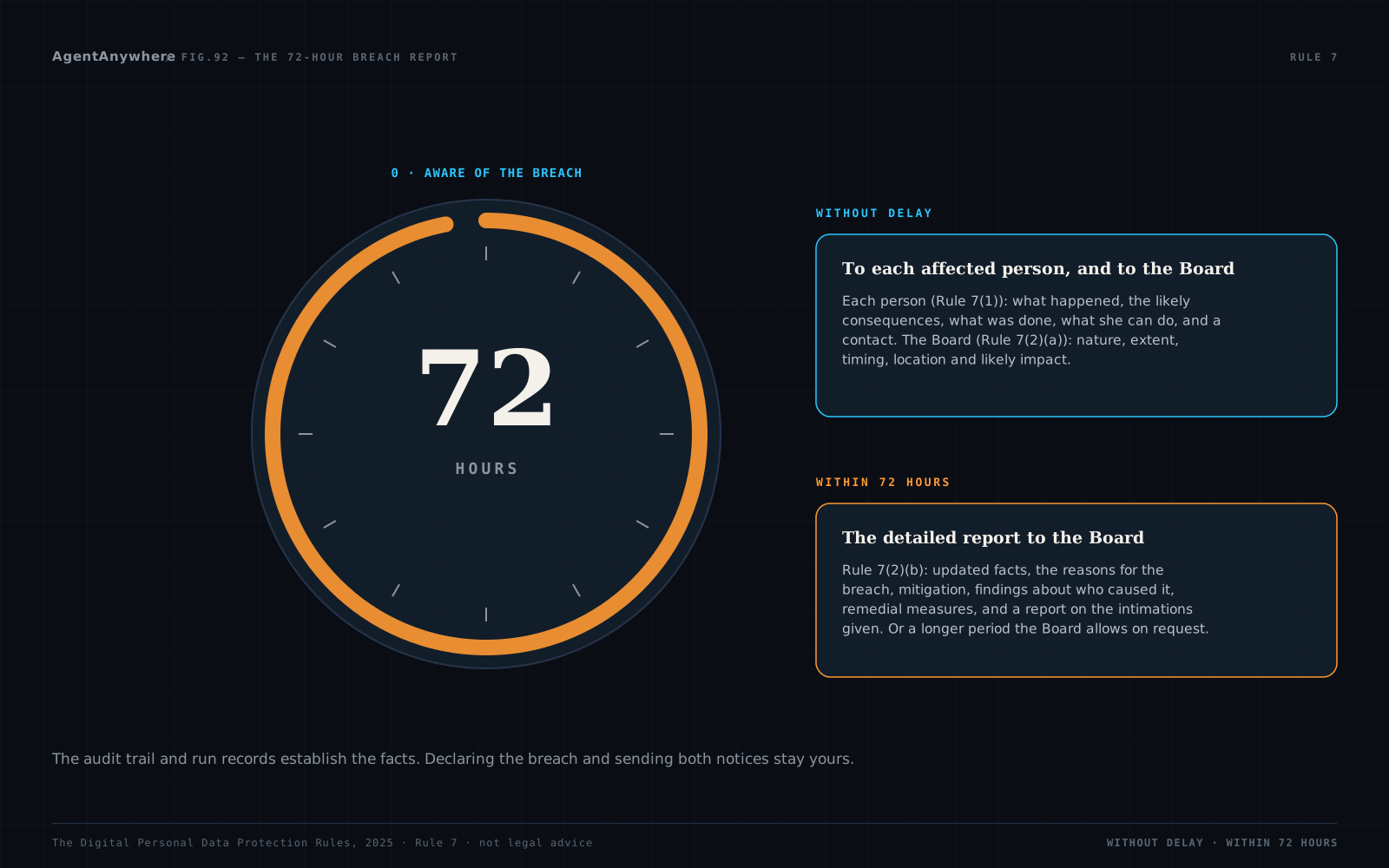
The Board must be told (Rule 7(2)): "without delay", a description including nature, extent, timing, location and likely impact; and "within seventy-two hours of becoming aware of the breach", or a longer period the Board allows on written request, the updated details, "the broad facts related to the events, circumstances and reasons leading to the breach", the mitigation, any findings about who caused it, remedial measures, and "a report regarding the intimations given to affected Data Principals".
What AgentAnywhere does: the audit trail and run records establish what happened, when, by whom and to which runs. They are searchable by date and exportable, and an evidence pack is available for each run.
A breach-incident record starts the 72-hour clock and drafts both the plain-language intimation to each person and the detailed report to the Board.
Deciding that something is a breach, and sending both notices, stay yours.
When must personal data be erased?
Section 8(7): erase "upon the Data Principal withdrawing her consent or as soon as it is reasonable to assume that the specified purpose is no longer being served, whichever is earlier", and "cause its Data Processor to erase" too, unless another law requires the data to be kept. The Act's own illustration is a bank that keeps a closed account's identity records for ten years because banking law requires it.
Rule 8(1) and the Third Schedule: set periods after which purposes are deemed no longer served, for certain classes of fiduciary.
Rule 8(2): "at least forty-eight hours before" erasure on that ground, the fiduciary must tell the person that the data will be erased unless she logs in or makes contact.
What AgentAnywhere does today:
Agent memory: an erasure by person removes every entry tagged with them, and its search-index entry. It also catches entries that mention their email address. The person is stored as a keyed hash, not as their email. Each erasure is an audit event, reports how many rows and index entries it removed, and contains no memory text.
Knowledge: one document, or a whole collection, can be deleted, removing its passages and their embeddings.
Document-field fingerprints: a subject's fingerprints can be erased.
Expiry: session memory, long-term memory past its retention, audit events and run records are deleted when their periods end.
One erasure request fans out to memory, knowledge, document fingerprints and run records. It returns a receipt: what was removed in each system, what was kept and why, and what no request can reach, with when it ages out (service logs, backups). The notice due at least 48 hours before erasure under Rule 8(2) is drafted and recorded.
Each audit event is written once and chained. An erasure is recorded in the audit trail as an event of its own; it does not delete past audit entries.
What rights does a Data Principal have under the DPDP Act?
Access (Section 11)
"A summary of personal data which is being processed" and "the identities of all other Data Fiduciaries and Data Processors with whom the personal data has been shared".
Correction and erasure (Section 12)
Correction, completion, updating and erasure. Erasure applies "unless retention of the same is necessary for the specified purpose or for compliance with any law".
Grievance redressal (Section 13)
The fiduciary must publish a response period "not exceeding ninety days" (Rule 14(3)). The person must use this first, before approaching the Board (Section 13(3)).
Nomination (Section 14)
Someone to exercise her rights "in the event of death or incapacity".
What does AgentAnywhere record for rights requests?
An access report per person, giving counts and locations in each system; correction notes; and a grievance record with its clock.
The model provider and model are named on every model step's answer, so you can list which processor saw which run. That is part of what an access request asks for.
What does the DPDP Act require for children's data?
A child is anyone under 18.
Before processing a child's personal data, the fiduciary must "obtain verifiable consent of the parent" or lawful guardian (Section 9(1)). The same applies to a person with a disability who has a lawful guardian.
It must not "undertake tracking or behavioural monitoring of children or targeted advertising directed at children" (Section 9(3)).
Rule 10 sets out how to check that the person giving consent is an identifiable adult: by "reliable details of identity and age" already held, or by details or "a virtual token" provided voluntarily. That includes tokens issued by an authorised entity or a Digital Locker Service Provider.
What AgentAnywhere does: a principal can be flagged as a child or as a person with a lawful guardian. Their consent then records how the parent or guardian was verified, not the documents themselves. A purpose can be marked as not allowed for children, so the consent check refuses it.
What extra duties does a Significant Data Fiduciary have?
A Significant Data Fiduciary must (Section 10(2); Rule 13): appoint a Data Protection Officer "based in India"; appoint an independent data auditor; and carry out a Data Protection Impact Assessment and an audit "once in every period of twelve months", sending the Board a report of the significant observations.
For a Significant Data Fiduciary, Rule 13(3) asks for due diligence that technical measures, "including algorithmic software", are not likely to risk Data Principals' rights. In our reading, AI agents an SDF deploys fall within that.
Rule 13(4) lets the Government specify personal data that an SDF may not transfer outside India, together with its traffic data.
What AgentAnywhere records: what each agent did and on which evidence (the run's evidence pack); who approved a held step, when and with what note; and which model and which checks were involved. Those records feed a DPIA and an audit.
A Significant Data Fiduciary can keep a structured record of each DPIA and audit: the scope, the observations, the Rule 13(3) algorithmic-software check, the measures, the date the report went to the Board, and the next due date. The platform records the assessment; it does not carry it out.
Can personal data be processed outside India?
Yes, subject to restriction. The Government "may, by notification, restrict the transfer of personal data … to such country or territory outside India as may be so notified" (Section 16(1)). Data transferred abroad remains subject to "such requirements as the Central Government may … specify" about making it available to a foreign State or its agencies (Rule 15).
What AgentAnywhere does: AgentAnywhere is designed to run in your own environment. Whether a step calls an outside model provider is set per step and shown. Such a step runs on the account your workspace connected, and its answer names the provider and model, so you know which processor each run used and whether data left your environment. AgentAnywhere Swaraj is designed to run with no outside provider at all.
The platform records where each processor processes data and flags those outside India or not recorded; it does not decide whether a transfer is allowed.
What are the penalties under the DPDP Act?
The Schedule to the Act sets maximum penalties per breach.
| Breach | Up to |
|---|---|
| Breach: Failing to take reasonable security safeguards to prevent a personal data breach (Section 8(5)) | ₹250 crore |
| Breach: Failing to give the Board or affected persons notice of a breach (Section 8(6)) | ₹200 crore |
| Breach: Breaching the additional obligations for children (Section 9) | ₹200 crore |
| Breach: Breaching the additional obligations of a Significant Data Fiduciary (Section 10) | ₹150 crore |
| Breach: Breaching any other provision of the Act or Rules | ₹50 crore |
| Breach: A Data Principal breaching her duties (Section 15) | ₹10,000 |
How is the DPDP Act different from the GDPR?
Five differences decide how you build:
Lawful bases: consent, or the listed legitimate uses (Section 7). There is no general "legitimate interests" ground.
No special categories: the Act defines no separate class of sensitive data. Sensitivity enters through Significant Data Fiduciary notification and the Rules.
Children: a child is anyone under 18, with verifiable parental consent and a bar on tracking and targeted advertising.
Consent Managers: registered intermediaries through which a person manages consent.
Penalties: fixed maximum amounts in rupees, per breach, not a share of turnover.
A bank's RFP will often say it plainly: governed by DPDPA, not GDPR, and GDPR controls are not assumed equivalent. Map your controls to the Act's sections, not to GDPR articles.
Why do AI agents raise the stakes for DPDP compliance?
An AI agent can touch personal data in several places at once: the prompt sent to a model, the documents it searches, the memory it keeps between conversations, the logs of what it did, and the systems it writes to.
Every one of those must be inside your safeguards, your retention periods and your erasure. A model provider is a processor, and needs a contract. A memory that outlives its purpose, or a search index that still holds a deleted document, is personal data you were obliged to erase.
For the ten fixes to make in your AI agents before May 2027, see the DPDP Rules and your AI agents.
How does AgentAnywhere support DPDP compliance, duty by duty?
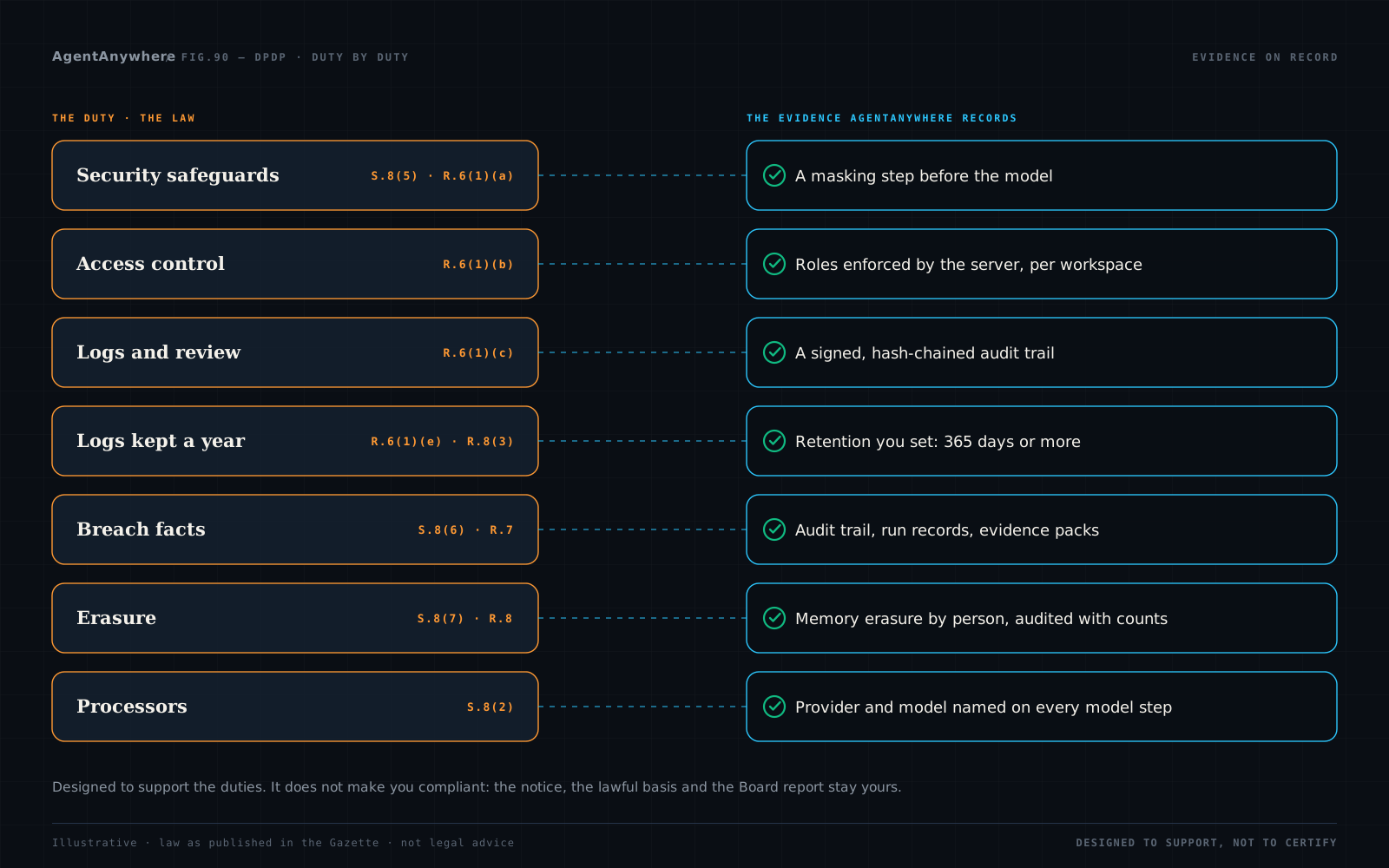
The duty map: the duty, where the law sets it, the evidence AgentAnywhere records, and what stays your job.
| Duty | Law | Evidence AgentAnywhere records | What stays your job |
|---|---|---|---|
| Duty: Notice | S.5; R.3 | Versioned notices per purpose, English and Hindi to start. Each consent names the version shown. | The notice's content; your legal review |
| Duty: Consent and withdrawal | S.6 | A consent ledger (person as keyed hash, purpose, notice version, channel); one-call withdrawal; a consent check as a workflow step. | Collecting consent in your channels; Consent Manager integration |
| Duty: Purpose limitation | S.6(1), S.8(7) | A declared purpose per agent and use case, recorded on each run. | Defining purposes |
| Duty: Security safeguards | S.8(5); R.6 | Masking before a model (Aavaran); keys encrypted; workspaces apart; roles enforced by the server; a signed, hash-chained audit trail you can verify on screen. | Your systems' safeguards; backups; processor contracts |
| Duty: One-year logs | R.6(1)(e), R.8(3) | Audit and run records kept for the period you set; defaults shorter than a year. | Setting a year or more |
| Duty: Breach intimation | S.8(6); R.7 | Audit trail and run records to establish facts; evidence packs. A 72-hour clock and drafted notices. | Declaring the breach; sending the notices and report |
| Duty: Erasure | S.8(7), S.12; R.8 | Memory erasure by person, including the index entry, audited with counts; document and collection deletion; fingerprint erasure. A single request with a receipt. | Erasure in your own systems; legal holds |
| Duty: Processors | S.8(2), S.11(1)(b) | The provider and model named on each model step; the workspace's own account only. | The contracts |
| Duty: Accuracy of decision data | S.8(3) | Grounded answers cite every sentence and refuse when the documents don't support an answer; held steps for a person's decision. | Your data quality |
| Duty: Rights requests | S.11–14; R.14 | Access report, correction notes, grievance clock. | Answering the person |
| Duty: Children | S.9; R.10 | A child or guardian flag; verification method recorded; purposes barred for children. | Age assurance in your channels |
| Duty: SDF duties | S.10; R.13 | Evidence packs, approvals and model records for the DPIA and audit. A structured record of each DPIA and audit. | The DPO, the auditor, the DPIA itself |
| Duty: Cross-border | S.16; R.15 | Designed to run in your own environment; any outside provider is set per step and named on its answer. A record of where each processor processes data. | Checking notifications; contracts |
Designed to support the duties. Not legal advice.
How should a bank prepare for May 2027?
1. Map every agent to a purpose and a lawful basis. List what personal data it touches: the prompt, documents, memory, logs, and the systems it writes to.
2. Mask before the model wherever a prompt may carry personal data, and record which model provider processes what.
3. Set retention to a year or more for audit and run records, and for service logs.
4. Test erasure end to end. Delete a person and confirm their data is gone from memory, from the search index and from documents, and that the receipt says what was kept and why.
5. Rehearse the 72-hour report: find the facts from the audit trail, draft both notices, and time it.
6. Write the notice in English and the languages your customers read, and record which version each consent saw.
7. Contract every processor, model providers included.
8. If you may be notified as a Significant Data Fiduciary, start the DPIA now, with the evidence your AI layer already records.
What stays your job under the DPDP Act?
Being the data fiduciary
The Act makes you responsible, "irrespective of any agreement to the contrary" (Section 8(1)).
The notice, the purpose and the lawful basis
And their legal review.
The Board report and the intimations
And the decision that a breach has occurred.
Rights requests and grievances
Answered within the period you publish.
Your processors' contracts
Model providers included.
Your counsel
This guide maps evidence to duties. It is not legal advice.
What does AgentAnywhere not do?
It does not make you DPDP compliant, and nothing it records replaces a decision the Act leaves to you.
A call to an outside model provider sends the prompt to that provider under your agreement with it, so mask first when the prompt may carry personal data.
Logs and records are kept for the periods the deployment sets, and those are shorter than a year until changed.
Service logs age out on their own schedule, and so do backups. An erasure does not reach them until they do.
The masking step's own input, the original value, stays in its run record until that record's retention period ends.
It is not a registered Consent Manager.
Frequently asked questions
What is DPDP compliance?
DPDP compliance means meeting the duties of the Digital Personal Data Protection Act, 2023 and the DPDP Rules, 2025: give notice, take valid consent or rely on a listed legitimate use, protect personal data with reasonable security safeguards, report breaches to the Data Protection Board within 72 hours, erase data on time, and answer Data Principals' rights requests.
When do the DPDP Rules come into force?
The DPDP Rules, 2025 were published on 13 November 2025. Rules 1, 2 and 17 to 21 apply from then. Rule 4 (Consent Managers) applies one year later, in November 2026. Rules 3, 5 to 16, 22 and 23, which include notice, safeguards, breach intimation, retention and children's data, apply eighteen months after publication, in May 2027.
What is a data fiduciary under the DPDP Act?
A data fiduciary is any person who alone or with others decides the purpose and means of processing personal data. It is responsible under the DPDP Act for all processing it does or a Data Processor does on its behalf.
What is a Consent Manager under the DPDP Act?
A Consent Manager is a person registered with the Data Protection Board through whom a Data Principal can give, manage, review or withdraw consent (Section 6(7)–(9) of the DPDP Act, 2023). The rules on their registration and duties (Rule 4) apply from November 2026.
How long must logs be kept under the DPDP Rules?
At least one year. Rule 6(1)(e) and Rule 8(3) of the DPDP Rules, 2025 require logs of processing to be retained for a minimum of one year, and then erased unless another law requires them kept longer.
What must a DPDP breach notification contain?
To each affected person, without delay: the breach's nature, extent and timing, likely consequences, mitigation, safety steps they can take, and a contact. To the Board, without delay and then within 72 hours: detailed facts, causes, mitigation, findings, remedial measures, and a report on the intimations given (Rule 7).
What are the penalties under the DPDP Act?
Up to ₹250 crore for failing to take reasonable security safeguards, up to ₹200 crore each for failing to notify a breach or breaching children's obligations, up to ₹150 crore for Significant Data Fiduciary obligations, and up to ₹50 crore for any other breach, under the Schedule to the DPDP Act, 2023.
Does the DPDP Act apply to AI agents?
Yes, whenever an AI agent processes digital personal data. Prompts, retrieved documents, agent memory, logs and the systems an agent writes to are all processing. The organisation running the agent is the data fiduciary, and a model provider processing prompts on its behalf is a data processor.
Is AgentAnywhere DPDP compliant?
No platform can be DPDP compliant on a customer's behalf: compliance is the data fiduciary's. AgentAnywhere is designed to support the duties for the AI agents it runs, and records evidence for them. ShepHertz's own position: SOC 2 and ISO 27001 certified, independently assessed for HIPAA and GDPR, and designed to support India's DPDP Act and RBI FREE-AI.
How is the DPDP Act different from the GDPR?
The DPDP Act allows processing on consent or listed legitimate uses, with no general legitimate-interests ground. It has no special categories of sensitive data, treats everyone under 18 as a child, provides for registered Consent Managers, and sets fixed maximum penalties in rupees rather than a share of turnover.
Can personal data be transferred outside India under the DPDP Act?
Yes, unless the Central Government restricts transfer to a notified country (Section 16(1)), and subject to any requirements it specifies about making the data available to a foreign State (Rule 15). A Significant Data Fiduciary may face further restrictions on specified data (Rule 13(4)).
Does masking personal data before an AI model help with DPDP compliance?
Yes. Masking is one of the security safeguards Rule 6(1)(a) of the DPDP Rules names. On AgentAnywhere a data masking step can run before a model step, so a model step wired after it receives the masked value, not the original.
How do you erase a person's data from an AI agent?
Erase it everywhere the agent keeps it: memory, search indexes, documents and run records. On AgentAnywhere, erasing a person from agent memory removes their entries and the matching search-index entries together, and records the erasure with counts in the audit trail.
Sources
Primary texts only, checked on 20 October 2026.
- 1The Digital Personal Data Protection Act, 2023 (22 of 2023), Gazette of India, Extraordinary, Part II, Section 1, 11 August 2023. Sections 2, 3, 5, 6, 7, 8, 9, 10, 11, 12, 13, 14, 15, 16; the Schedule.
- 2The Digital Personal Data Protection Rules, 2025, Gazette of India, Extraordinary, Part II, Section 3(i), No. 760, 13 November 2025. Rules 1, 3, 4, 6, 7, 8, 9, 10, 13, 14, 15; the Third Schedule.
- 3Press Information Bureau — explanatory document on the DPDP Rules, 2025, November 2025.
Written by
AgentAnywhere Research
The team that builds the platform and the models
AgentAnywhere Research writes about the platform, the model families and the trust layer we build and run in India. Where a figure is ours, it says what it covers; where something is a demonstration, it says so.